
International Space Elevator Consortium
August 2026 Newsletter
In this Issue:
Chief Architect’s Corner
Register for ISEC Space Elevator Conference 2026
Musical Corner
Tether Materials
The Green Road to Space
History Corner
Climber Motion Update
ISEC Terminology
Upcoming Events
Contact Us
Chief Architect’s Corner
by Pete Swan
New Partnership – SRI
ISEC has a new partnership with Space Renaissance International (https://spacerenaissance.space/faq/). As this is to enhance both organizations with combinations of people and projects, there are great expectations for an active future relationship. Both of our missions are focused on the movement of humans and logistics off-planet in timely and efficient operations while opening up towards an expanding and exciting future. As we looked at each other’s objectives, goals, and missions the common needs surfaced:
+ Develop low-cost access to and from space.
+ Settle and harvest the resources of the Moon and other objects in space, including those same asteroids and comets which may threaten our existence.
+ Develop a healthy and growing Geo-Lunar industrial and economic infrastructure, including research, technology development, entertainment, and tourism.
+ Develop the means to generate and return clean power from space using the energy of the sun.
This intriguing parallel is ISEC’s goal of becoming the “Logistics Giant” enabling all the above missions. ISEC will lead the industry to develop Modern Day Space Elevators providing massive logistics support to GEO, the Moon, and beyond with daily, routine, inexpensive, and safe operations while being the Green Road to Space. Our hopes and efforts are definitely in line with the Space Renaissance International’s goals. They just completed their 4th World Congress in July. After five days, SRI came out with their Final Resolutions, with #12 being of great interest to us:
12. Support the development of 100% reusable space vehicles and other transformative access-to-space infrastructures, including long-term space elevator concepts, with the objective of low-cost, safe, reliable and increasingly accessible passenger and cargo transportation to Earth orbit and beyond.
SRI’s philosophy for their organization is: “As a new Space Renaissance, we trace our roots back to the Renaissance of the 1500s.” This concept moves naturally to the movement off planet with an “enlightened mind and new views on the importance of human life, and focuses upon the development of solutions to human needs and aims.”
Please consider volunteering from either side of this partnership and help us move off planet on the green road to space routinely, efficiently, safely, inexpensively, and ecologically.
Free Registration for the ISEC Space Elevator Virtual Conference for 2026
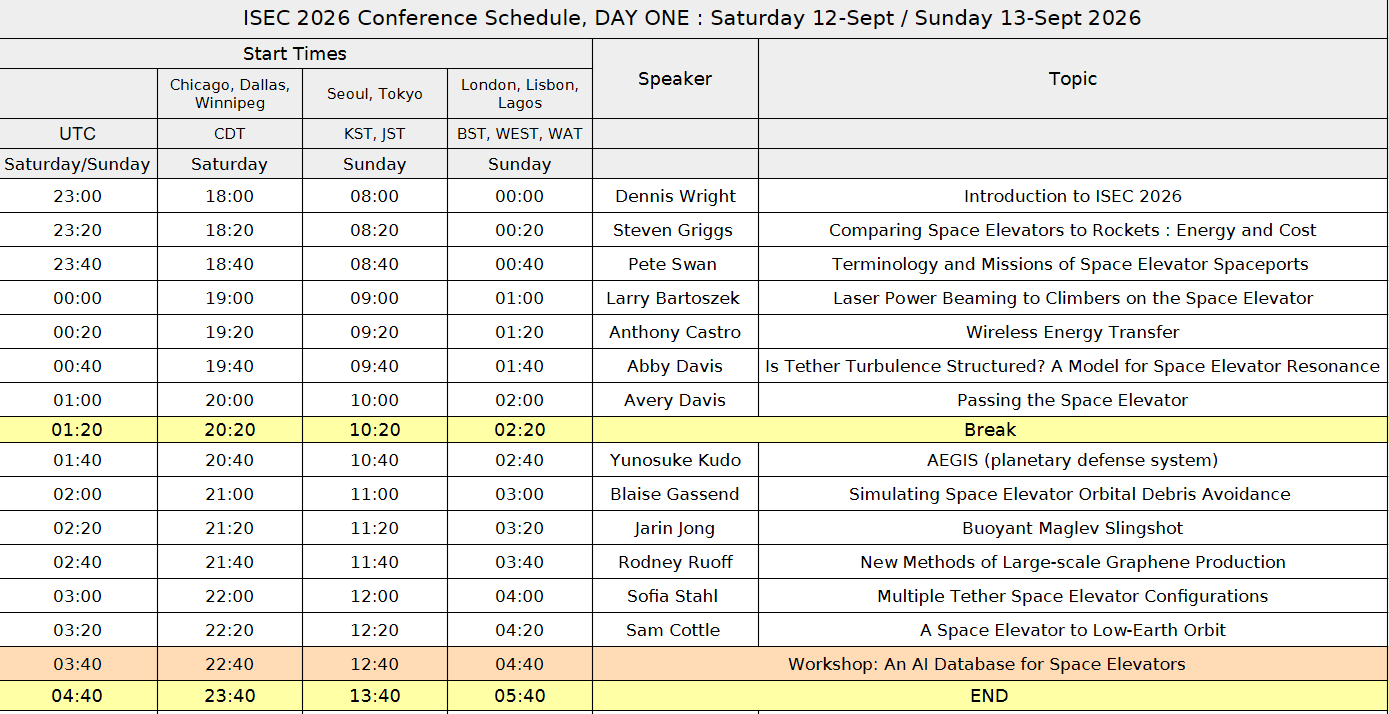
The International Space Elevator Consortium (ISEC) is holding its VIRTUAL annual conference and workshop over the weekend of Saturday September 12th through Sunday September 13th, 2026.
FREE REGISTRATION is now open for each day using the links below.
The “Day 1” timing may be suitable for participants from the Americas, Asia and Australasia. Provisional times are 1800-2220 CDT on Saturday 12th (= 2300-0320 UTC on Saturday 12th/Sunday 13th), to be confirmed.
To register for DAY ONE of the conference use this link:
https://us06web.zoom.us/meeting/register/hGLvDPVkTFakRE_BI2XH-g
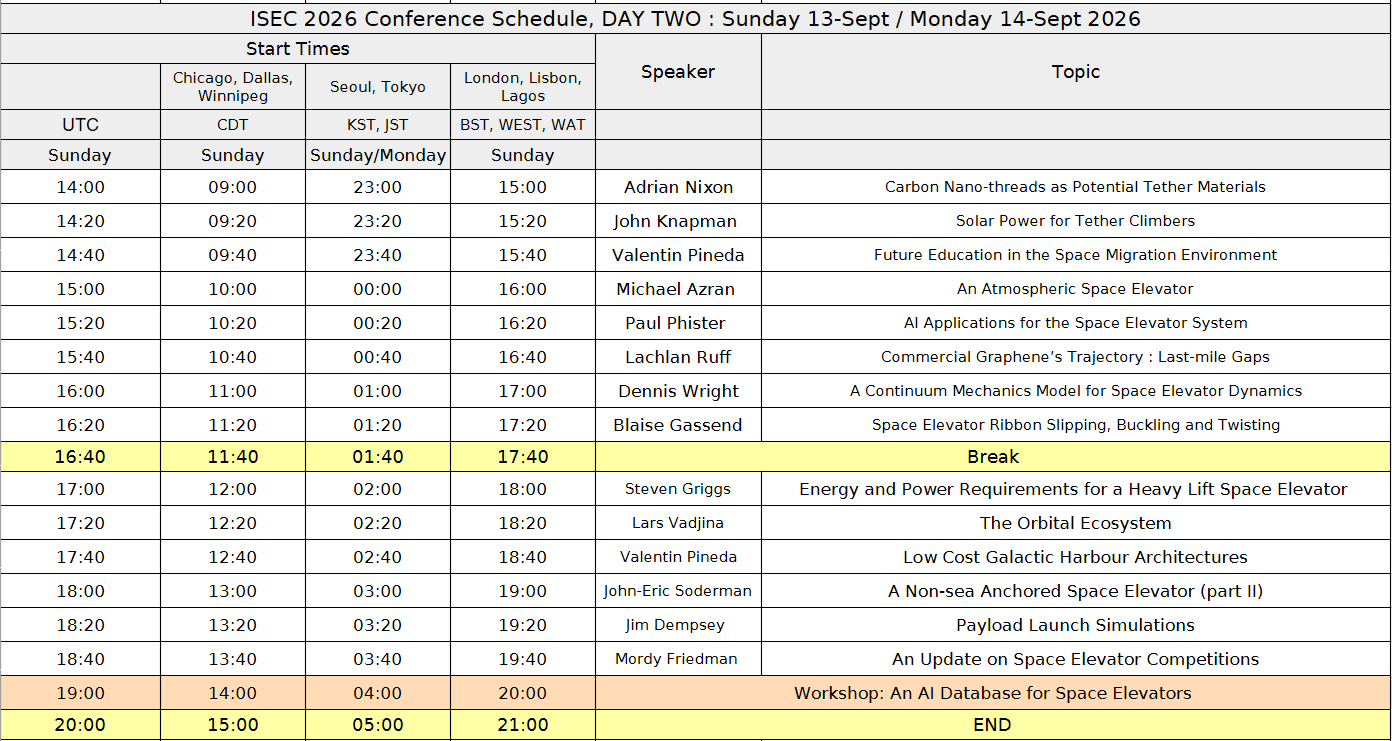
The “Day 2” timing may be suitable for participants from Europe, Africa and the Americas. Provisional times are 0900-1400 CDT (= 1400-1900 UTC) on Sunday 13th September, to be confirmed.
To register for DAY TWO of the conference use this link:
https://us06web.zoom.us/meeting/register/Oo3RP2lkTIOLMQA8n1_Amw
After registering you will receive a confirmation email containing information about joining the meeting.
The provisional schedules for the two days are:
Musical Corner
by Dr. Donny “Rocker” Deever
Three Space Elevator Songs
ISEC is elated that Dr. Deever has created three songs representing his/our feelings towards space elevators. Poetry to music supporting:
“Green Road to Space”
“Send It Up (Bring the Price Down)”
"Build the Road (To Mars, Asteroids, and Far-off Stars)”
by Donny Rocker Deever & America 250 Band
Tether Materials
by Adrian Nixon
Diamond Nanothread
Dear Reader, most of you will be familiar with the book by Arthur C Clarke: The Fountains of Paradise. It is probably the single most influential work of fiction ever written about the space elevator. In the book, Clarke envisions a microscopically thin but extremely strong "hyperfilament" that makes the elevator possible. This hyperfilament is constructed from "continuous pseudo-one-dimensional diamond crystal" [1].
The modern space elevator concept had been proposed by the Soviet engineer Yuri Artsutanov in 1960 [2]. As we know, at the time, one of the biggest objections was that no known material had a sufficiently high strength-to-weight ratio to support its own weight from Earth's surface to beyond geostationary orbit. In short, a material was needed that was as strong as possible and as lightweight as possible.
Arthur created diamond hyperfilament because, in the late 1970s, diamond was widely regarded as the strongest material imaginable. When he wrote The Fountains of Paradise (published in 1979), a hypothetical diamond-based material was a scientifically plausible extrapolation. He was following the science of his time, and remember, materials such as carbon nanotubes and graphene had not yet been made.
Clarke therefore invented hyperfilament, describing it as an almost perfect, continuous crystal of diamond. His reasoning was that diamond has extremely strong sp³ covalent carbon-carbon bonds. A defect-free crystal should have an enormous theoretical tensile strength and if such a crystal could somehow be made as a continuous fibre, it might support a space elevator. This was speculative, but it was grounded in known chemistry rather than being a magical material. Today we would call this kind of thinking and writing “hard science fiction”.
So much for the fiction, what about the facts?
Over the past decade, researchers have been exploring whether diamond nanothreads can be made. The first reported synthesis of diamond nanothreads was in 2014 by a team at Pennsylvania State University, USA [3]. They used benzene as the carbon source and compressed to 20 GPa at room temperature for one hour in a press fitted with a diamond anvil. The system was driven by an automatic hydraulic oil syringe pump, allowing for controlled pressure ramps.
The team discovered that if the pressure was released too quickly then randomly structured amorphous carbon formed. They overcame this by slowly releasing the pressure over ten hours and this allowed the diamond nanothreads to form. These nanothreads were extremely short, in the range of tens of nanometres long.
Further work with computer modelling has found that these diamond nanothreads are extremely strong and defects do not affect their mechanical properties as much as might have been expected. Figure 1 shows an example of a computer-generated model of a diamond nanothread.
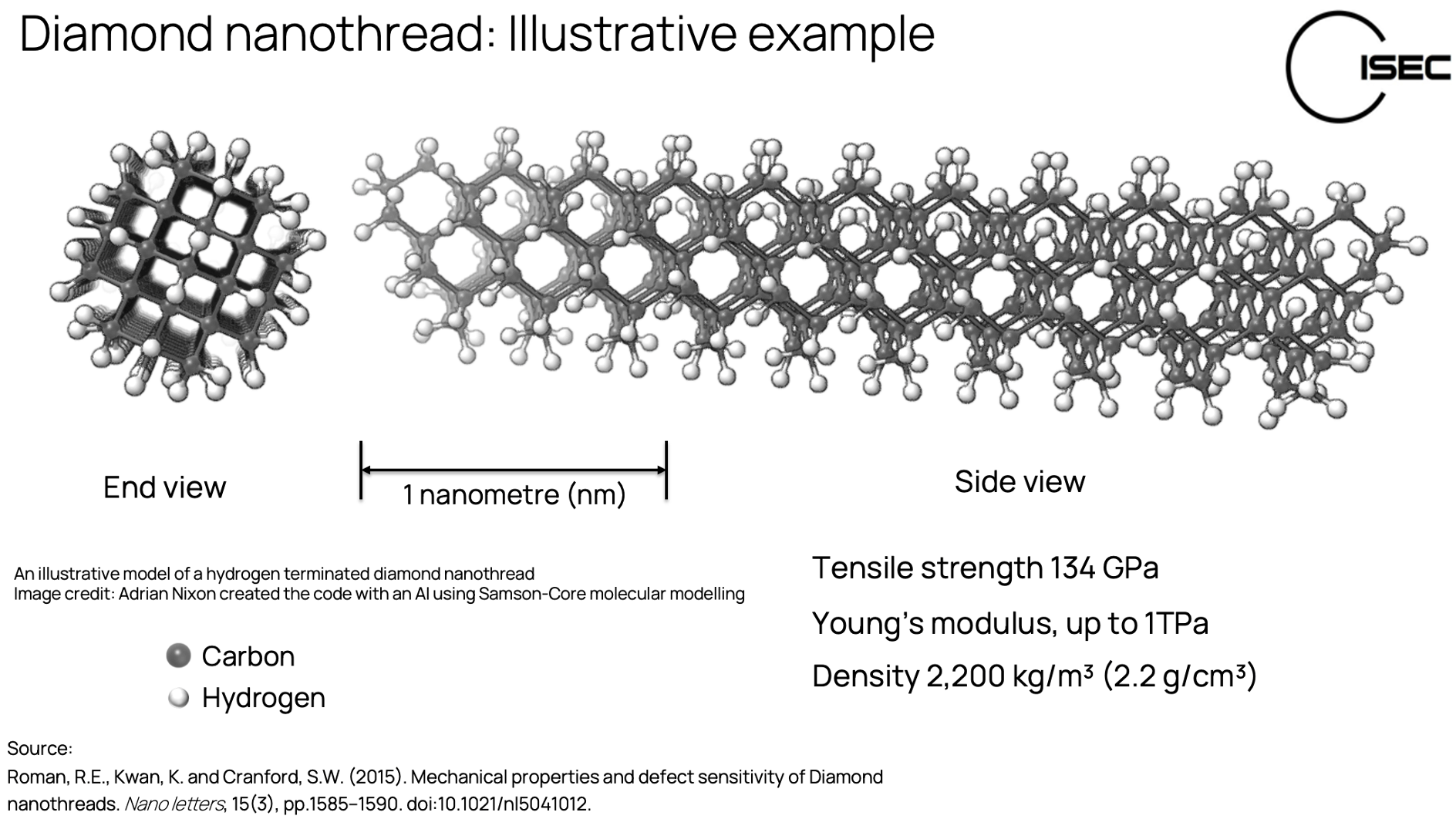
Fig 1. Diamond nanothread.
The simulations predicted the following mechanical properties:
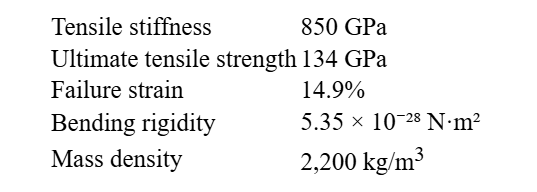
This strength is comparable with that of carbon nanotubes and graphene.
Diamond nanothreads represent one of the most promising materials for making space elevators physically possible, with the right combination of strength, lightness, and stability. However, the manufacturing challenge—producing continuous, defect-free fibres at kilometre scales—remains the critical bottleneck separating theory from reality.
The current state of the art process makes diamond nanothreads at a scale of tens of nanometres and very slow growth over tens of hours by a batch process that involves compressing benzene at extremely high pressures. Industrial-scale production suitable for megastructures like space elevators is still an open research frontier and we will monitor the research to watch how the manufacturing process speeds up in scale.
References
1. Clarke, A.C. (1979). The Fountains of Paradise. Victor Gollancz, p.39, 45.
2. Artsutanov, Y. (1960) ‘V kosmos na elektrovoze’ [Into the cosmos by electric train], Komsomolskaya Pravda, 31 July. English translation in Advances in Space Research, 1979, 11(7), pp. 51–53.
3. Fitzgibbons, T.C., Guthrie, M., Xu, E., Crespi, V.H., Davidowski, S.K., Cody, G. D, Alem, N. and Badding, J.V. (2014). Benzene-derived carbon nanothreads. Nature materials, 14(1), pp.43–47. doi:10.1038/nmat4088.
4. Roman, R.E., Kwan, K. and Cranford, S.W. (2015). Mechanical properties and defect sensitivity of Diamond nanothreads. Nano letters, 15(3), pp.1585–1590. doi:10.1021/nl5041012.
The Green Road to Space
by Michael Schaeffer, ISEC Director of IT
My journey with the Space Elevator began in a grocery store.
In July of 2002, I spotted a Popular Mechanics magazine featuring the Space Elevator. I bought it immediately and was fascinated by the concept. Wanting to know more eventually led me to Arthur C. Clarke’s The Fountains of Paradise, where a Space Elevator plays a central role.
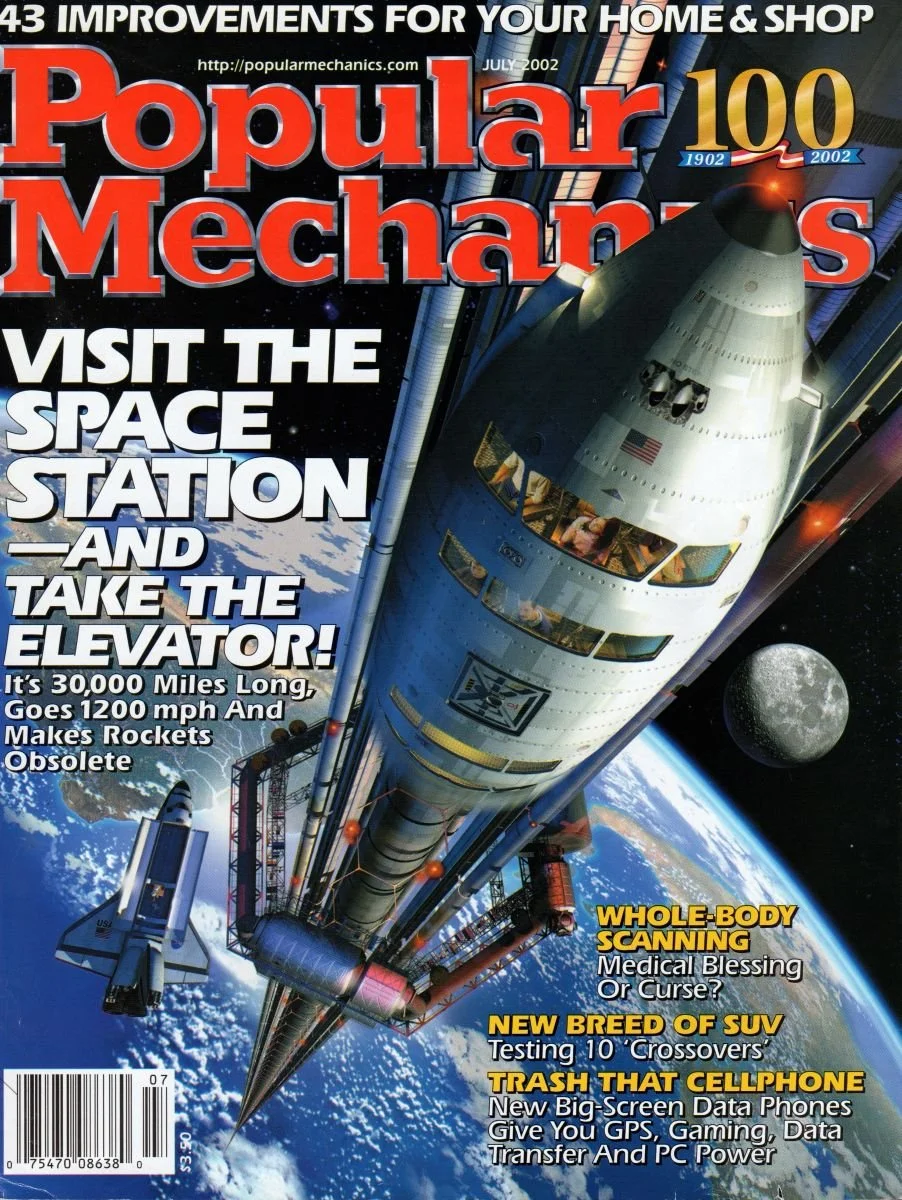
Years later, I came across an advertisement for a Space Elevator conference at Seattle’s Museum of Flight. I attended, discovered the International Space Elevator Consortium (ISEC), and immediately became a member.
The conferences, publications, and studies that followed have been inspiring. The Space Elevator represents humanity attempting to solve one of the most difficult engineering challenges we have ever undertaken.
At one of those early conferences, Pete Swan shared a wonderful lesson from aviation history. On October 9, 1903, The New York Times suggested that a practical flying machine might take one to ten million years to develop. Just 69 days later, Orville and Wilbur Wright made their historic first flight. Pete’s message to us was simple:
“The Space Elevator is closer than you think.”
Through ISEC, I also learned about Yuri Artsutanov’s 1960 vision of an “electric train” to space, carrying people and cargo along a permanent structure extending from Earth. Decades later, Jeff Bezos would speak of the need to “build a road to space” upon which future generations could build.
At the August 2019 ISEC Space Elevator Conference, discussions turned to the enormous number of rocket launches that would be required, not only to construct a Space Elevator, but also to support humanity’s larger ambitions in the solar system. I began looking at the emissions associated with all those launches.
There had to be a better way. After all, I was sitting at a Space Elevator conference. Near the end of the conference, attendees were invited to participate in “Shotgun Science,” creating a short elevator pitch aimed at people such as Elon Musk and Jeff Bezos. Thinking about emissions and a cleaner way to reach Mars, the asteroids, and beyond, I coined the phrase:
“The Space Elevator is the Green Road to Space.”
That small presentation grew into something larger. The idea helped inspire an ISEC study, Space Elevators: The Green Road to Space, and most recently, a song by Dr. Donny Deever of the National Space Society, celebrating the vision.
One line from that song captures what I was trying to say back in 2019:
“A future built with care and grace, a greener path… (a) green road to space.”
Listen to the song at:
History Corner
by David Raitt
Graphic Novels and Space Elevators
On the secondhand book stall here recently, I spotted a copy of The Adventures of Tintin – Explorers on the Moon (Fig 1) from the back cover, it seems there are two other similar titles – Destination Moon and Mission to the Moon, and as luck would have it, I found Destination Moon (Fig 2) a few weeks later in the local comic book shop in town. They are essentially illustrated, comic strip stories primarily for younger children (Fig 3). The author and artist was a Belgian cartoonist named Hergé (real name George Remi – 1907-1983) who created a series of 24 stories under the main title The Adventures of Tintin – the first being published in 1929 in French. My Explorers on the Moon was first published in French in 1954 and in English in 1959 and Destination Moon was first published in 1953 in French and also in 1959 for the English version (should be read before Explorers as it sets the scene!), but they are now in many different languages and have been reprinted several times.
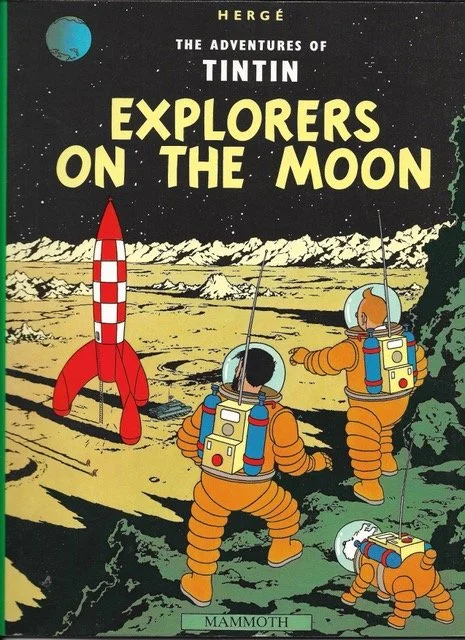
Fig. 1: Cover of The Adventures of Tintin – Explorers on the Moon by Hergé.
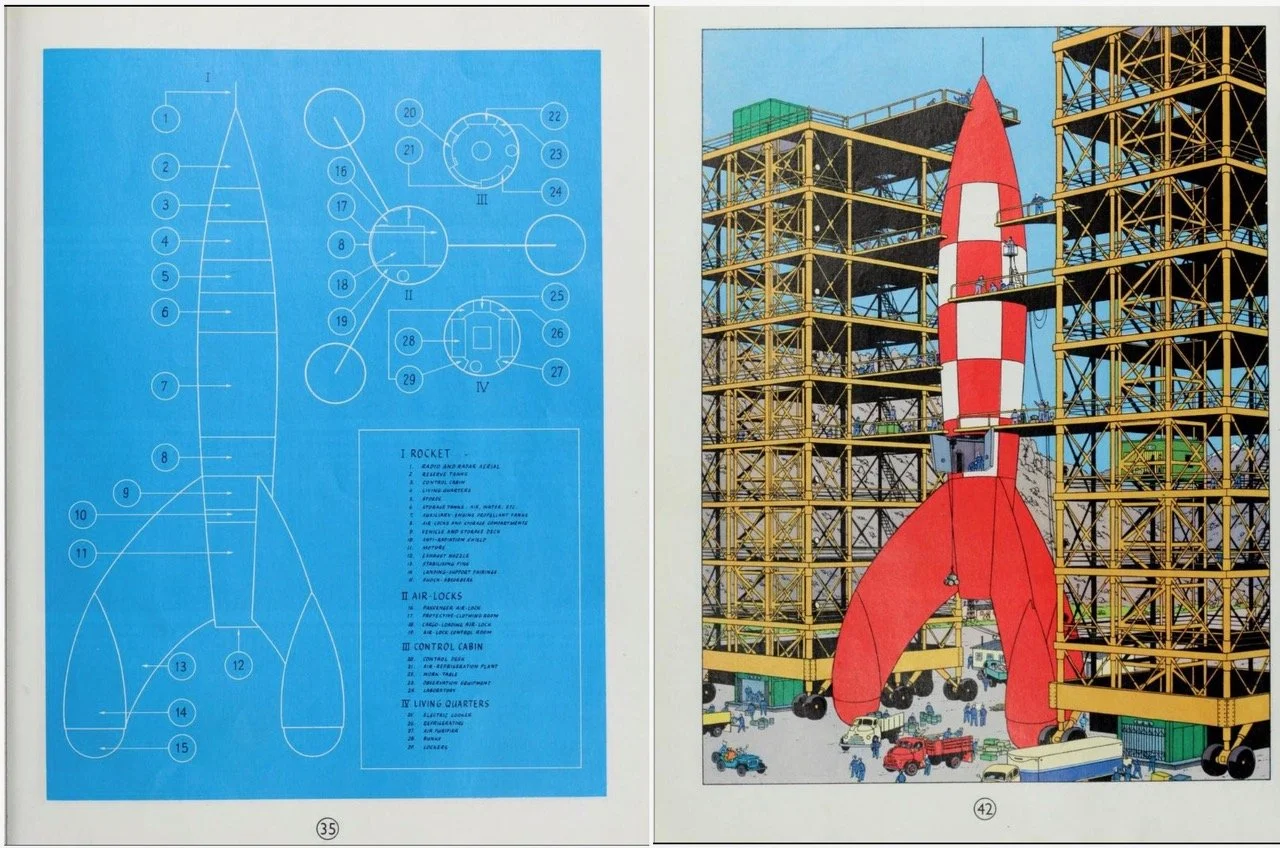
Fig. 2: Pages 35 and 42 of The Adventures of Tintin – Destination Moon.
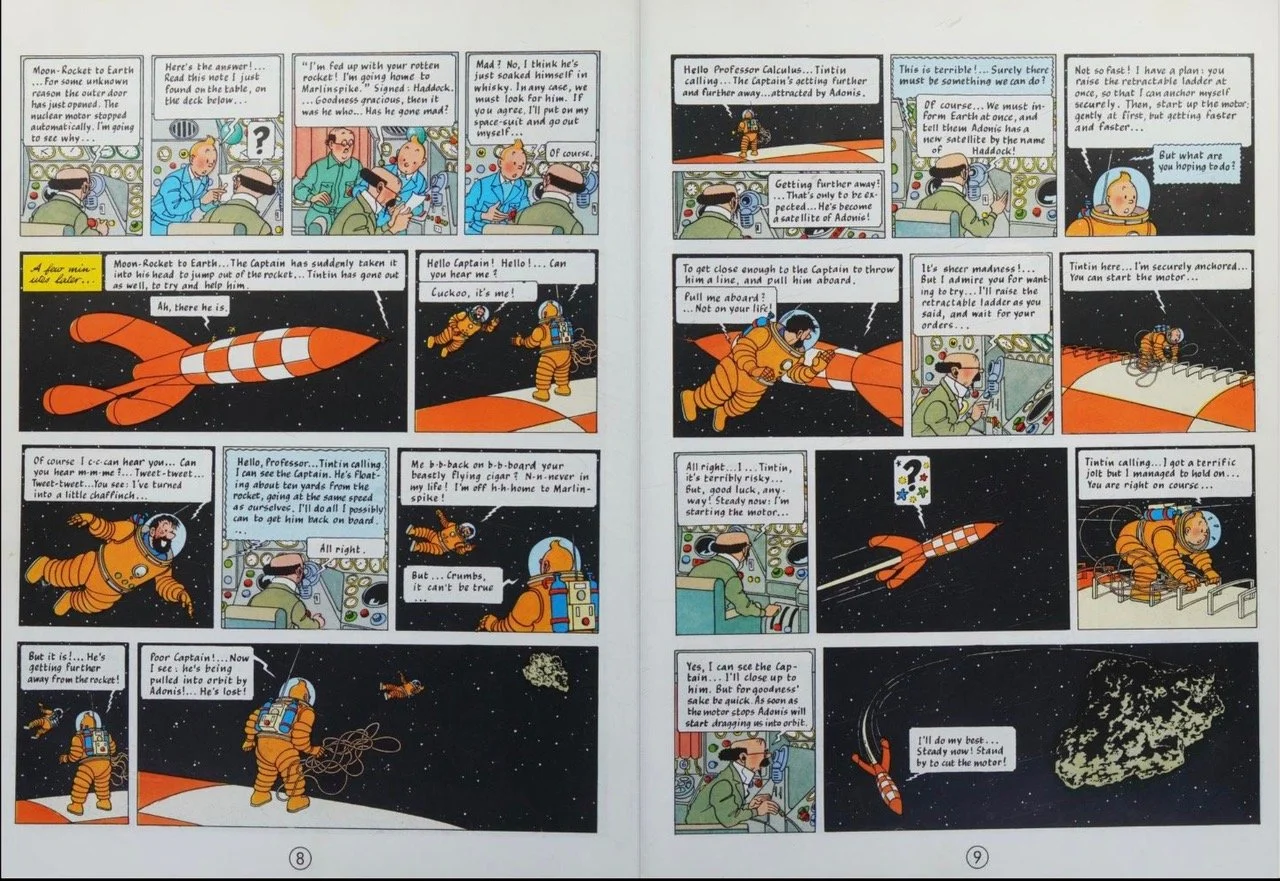
Fig. 3: Pages 8 and 9 of The Adventures of Tintin – Explorers on the Moon.
I wondered whether there was anything similar to the Tintin stories about space elevators that I had perhaps missed, so I did a little searching to see what was already out there! It appears that if you are looking to explore webcomics and comic strips about space elevators, several famous artists and webcomics have tackled the concept with varying degrees of scientific accuracy and humour. For instance, xkcd where creator Randall Munroe occasionally explores the mechanics and comedic potential of a space elevator with sarcasm, maths, and language. For example, see his “Space Elevators” strip which pokes fun at the timeline for it at https://xkcd.com/536, or his “Tensile vs. Shear Strength” comic image that imagines a disastrous end to a multi-trillion-dollar construction at https://xkcd.com/697/). There is an Archive on the site you can visit, but it does not seem to have too many additional cartoons on the space elevator as such. For diverse, single-panel gag or satirical strips, you can browse a curated Space Elevator Cartoons and Comics archive (https://www.cartoonstock.com/directory/s/space_elevator.asp). These include jokes about endless elevator music and zero-gravity. The cartoons have clickable keywords at the bottom so that you can explore topics further. Then, in my February 2026 column, I wrote about the book Soonish which has a space elevator on the cover. It appears that one of the authors, Zach Weinersmith, who created all the cartoons in the book, has developed a Soonish Space Elevator AR App to demonstrate how the mega-structure might theoretically work in real life (https://www.smbc-comics.com/soonish/app/index.html).
None of these, though, are in the same genre and style as Tintin, so I also checked out graphic novels and manga about space elevators as opposed to cartoon strips. Here are some of the more notable titles that were thrown up included Laddertop (Fig 4) – a young-adult black and white manga-style graphic novel series published first in 2011, and with three volumes in the series, by Orson Scott Card and Emily Janice Card. Here we follow two exceptionally gifted 11-year-old girls who are chosen to become operators on a massive, futuristic, space elevator. An alien race from outer space had built four giant towers, known as Ladders, on Earth which rose 36,000 miles into space. Long vanished, the alien race tasked the 11-year-olds with maintaining and preserving the Ladders.

Fig. 4: Cover of Laddertop by Orson Scott Card and Emily Janice Card.
The Life Eaters, by sci-fi author David Brin, is an SF graphic novel published in 2003 and based on an earlier novel by the author. The colour graphic novel features a plot revolving around Nazis and Norse Gods with Yggdrasil – the immense and sacred tree of Norse mythology being repurposed as a functional space elevator connecting Earth to a space habitat (https://en.wikipedia.org/wiki/The_Life_Eaters) (Fig 5).

Fig. 5: Cover of The Life Eaters by David Brin (author) and Scott Hampton (artist).
Mobile Suit Gundam 00 is a Japanese anime television series in colour that aired in Japan from October 2007 to the end of March 2009 and based on the long-running Gundam series created by animator Yoshikazu Yasuhiko. In the year 2307 when fossil fuels are completely exhausted and humanity finally focuses entirely on solar energy, there are three large-scale solar energy systems that should provide humanity with this energy source, each of them in the possession of one of the three superpowers on Earth. (https://en.wikipedia.org/wiki/Mobile_Suit_Gundam_00). While it is an anime and reputed to be scientifically accurate, Mobile Suit Gundam 00’s official manga adaptations heavily feature three massive 50,000 km tall “Orbital Elevators” that serve both as space transport and global solar-power collectors. (https://gundam.fandom.com/wiki/Orbital_Elevator_(Anno_Domini)) (Fig 6).
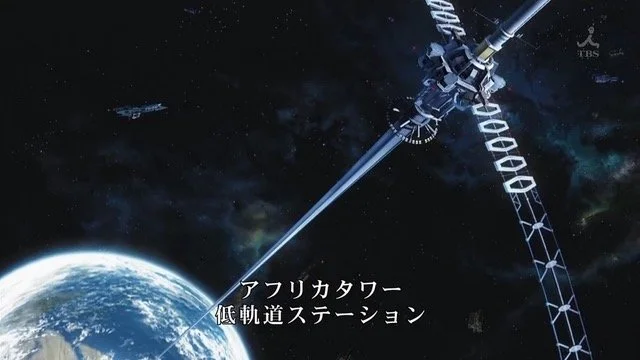
Fig.6: Panel depicting the orbital elevator "La Tour" from the anime Mobile Suit Gundam 00.
Battle Angel Alita: Last Order is a Japanese SF manga series created between 2000 and 2014 by Yukito Kishiro. The colour series tells the story of Alita continuing her quest to uncover her mysterious past. In Last Order, Alita goes into space and is caught up in a struggle between rival powers in the colonized solar system. A feature is a utopian futuristic city suspended several thousand feet above Earth and connected to a sister city in space through an inertially balanced orbital elevator. It is also connected to an orbital ring balanced by a similar orbital elevator and connected to a space city on the opposite side. (https://en.wikipedia.org/wiki/Battle_Angel_Alita:_Last_Order) (Fig 7).

Fig. 7: Cover of Battle Angel Alita: Last Order Vol.16 by Yukito Kishiro.
In the cyberpunk SF black and white manga series Biomega by Tsutomu Nihei, humanity's infrastructure is connected by a massive space elevator, referred to as the “Intercontinental Mooring Cable” reaching from Earth into orbit. It serves as a major narrative climax where the protagonist (Zoichi) rides a motorcycle up its vertical length to confront the leader of the Public Health and Welfare Bureau. Later in the series the space elevator structure is exaggerated and referred to as a “giant rope”. (https://tvtropes.org/pmwiki/pmwiki.php/Manga/Biomega)(Fig 8).
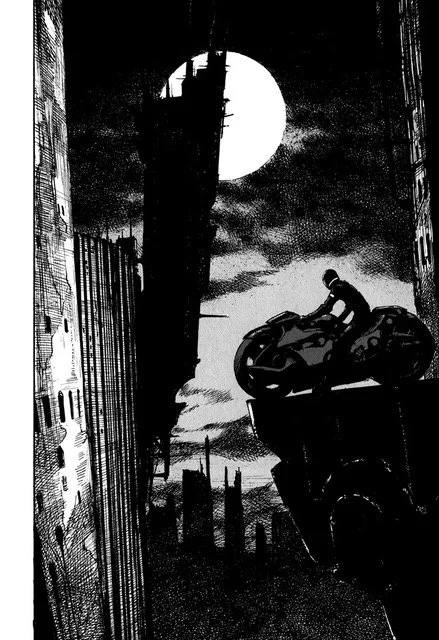
Fig 8: Panel from Biomega.
All these cartoon and graphic novels and manga are now rather elderly and with new generations coming along showing an interest in space and climate change, the need for sustainable energy and lower pollution, AI, and their own future, then perhaps the time is ripe to consider a new graphic novel/series in the style of Tintin to attract younger minds! I was thinking that we (ISEC) could possibly commission a similar illustrated comic novel about the space elevator! Not featuring Tintin, of course. We’d need to work up a decent story line with humour and get someone to draw the pictures – and publish by Lulu. For the story, we could possibly base it on Clarke's Fountains of Paradise – if we could obtain permission from the ACC Foundation. Or perhaps one of the other popular novels about space elevators - either an older novel or a more recent one. Or we could flesh out our own concept! Anyone interested?
Climber Motion Update: Power and Cost
by Peter Robinson
1. Introduction
The 2026 ISEC Study Report “Powering the Space Elevator” [1] explored the many options for delivering power to the Space Elevator Climber, concentrating on options for 4 MW of tractive power on a 20-tonne climber. That power is the current baseline system concept, first described in the ISEC 2013 Study Paper “Design Considerations for Space Elevator Tether Climbers” [2].
My 2022 IAC paper [3] explored how multiple climbers distributed along the tether contributed to the maximum tether stress, assessing climber parameters such as power, mass, departure intervals, maximum speed, and more. It was clear that climber power selection for any given tether strength was complex, and that it was likely that (as with any wheeled vehicle) there will not be a single design solution.
Prompted by the recent completion of the excellent 2026 Study Report, this article will revisit some of my 2022 analysis with new graphics. I have also attempted some new and highly speculative cost analysis, although I expect my simplistic engineering approach may not gain the full approval of the financial community!
2. Payload Mass
My numeric analysis method (see [3]) calculates the peak tether stress, based on the tether weight and the weight of climbers distributed between the Earth and GEO. The climber distribution along the tether depends on the ascent speed, influenced by altitude, power, mass, and maximum speed.
For this article, I will consider just one climber departure each day with a maximum climber speed of 235 km/hr, chosen as it yields a climb time to GEO of exactly 7 days for the baseline 4 MW/20-tonne climber.
Increasing climber power would increase the ascent speed at low altitudes, reaching the speed limit earlier. The climbers would then be distributed along the tether with a wider spacing at lower altitudes, resulting in a lower peak tether stress as their weight falls rapidly with altitude. This in turn means that the tether is no longer being used to its full capacity, meaning the climber can be laden with more payload, lowering the ascent speed and requiring another iteration of the analysis.
A further complication is that a more powerful unladen climber will be heavier as the motors, wheels, power systems, and other components become more numerous or massive. The baseline concept assumes a 4 MW climber with a net (unladen) mass of 6 tonnes plus 14 tonnes of payload, meaning a specific net mass/power ratio of 1.5 tonnes/MW. My analysis makes the simplistic assumption that this specific mass/power ratio is constant, meaning (for example) a 5 MW climber would be 1.5 t more massive than the baseline 4 MW.
Taking all these factors and assumptions into account yields the plot in Figure 1 below, showing the climber gross mass and effective payload for a range of climber powers above and below the baseline 4 MW figure, for a constant tether stress.
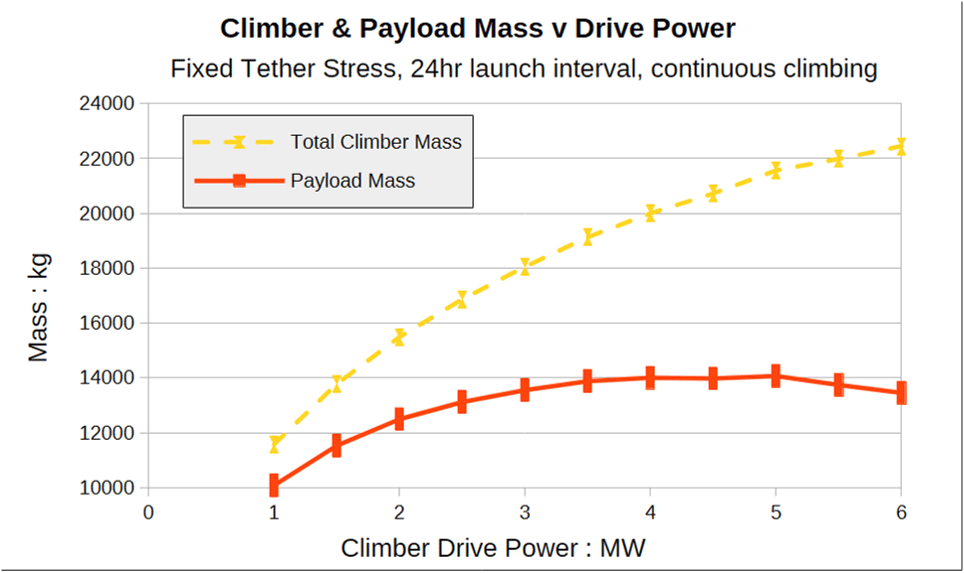
Figure 1: Climber Mass and Payload v Drive Power, with continuous climbing, 24-hour departure interval, 235 km/hr maximum speed. Error bars are indicative only of the uncertainty resulting from inadequate discretisation. Analysis: P. Robinson.
As expected, the feasible gross climber mass increases with climber power, but the rate of increase falls as the climber reaches the maximum speed sooner and so benefits less from the higher power.
The difference between the total mass and the payload is simply the mass of the unladen climber, assumed to be 1500 kg for each MW of drive power.
There is clearly little payload benefit from increasing the power above 4 MW, at least for the assumed specific power and maximum speed.
3. Payload Cost
This section includes cost analysis that may be questioned by those with more financial expertise; I would not include it in a technical paper, but in this article, I hope it will inspire some debate.
I shall first estimate the cost of a climber as a function of its power. One approach might be to itemise and cost every component, but I will use a simple estimate: given that a 1 MW climber (or module sub-assembly) is broadly similar in size, mass, and power to a large electric automotive vehicle, I will suggest that it will have a cost of the same order of magnitude as such a vehicle in low-volume production. Yes, there are very many design differences, but it will not be a tenth of the price and is unlikely to be ten times the price.
Therefore, I will initially suggest a cost of USD 50,000 for a 1 MW assembly, perhaps optimistic but hopefully achievable with a production rate of several hundred units per year and synergies with other commercial electric vehicles. This means my assumption for the baseline 4 MW climber is USD 200,000.
The next part of my analysis is even more speculative, but results in a conclusion that may be of interest. A payload cost target for the space elevator system has often been quoted at USD 100/kg, or USD 1,400,000 for a 14-tonne payload. If the baseline 4 MW climber itself is estimated at USD 200,000 the difference of USD 1,200,000 could be attributed to fixed costs covering the tether itself (manufacturing & deployment), plus operating costs.
If this “fixed” cost does not vary with climbers of different power then payload USD/kg figures can be calculated for the range of powers analysed; for example, the 10,075 kg payload of a 1 MW climber would have a total cost of $ 1,200,000 + $ 50,000 = $1,250,000, yielding a specific cost of USD 124.1/kg. Repeating this calculation for the full range of climber power yields Figure 2 below.
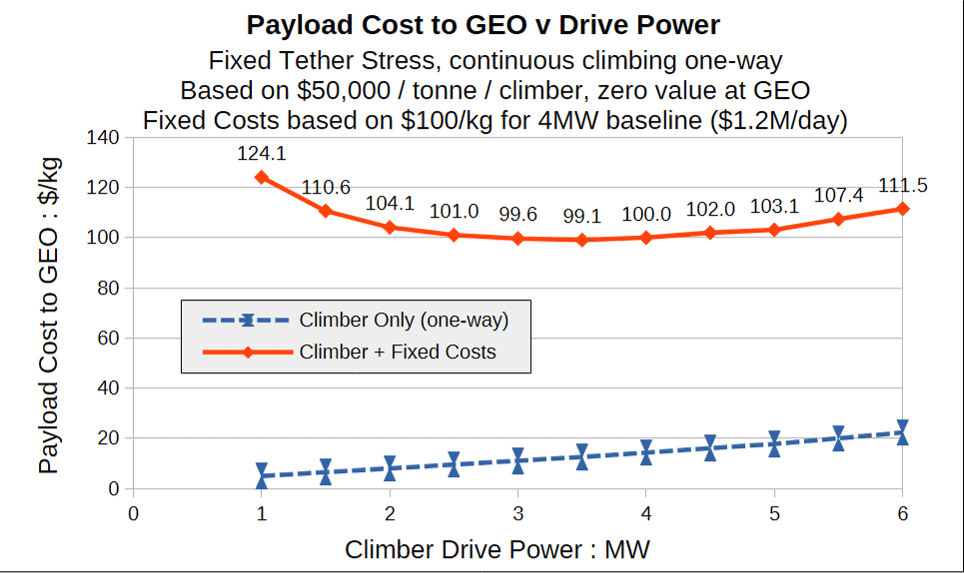
Figure 2: Payload Cost to GEO v Drive Power, with continuous climbing, 24-hour departure interval, 235 km/hr maximum speed, mass as Figure 1, $50k/MW climber cost, $1.2M fixed costs. Analysis: P. Robinson.
This analysis indicates that the 4 MW power is close to the optimum, but this conclusion completely depends on my cost speculations.
It may be argued that the $50k/MW estimate for the climber is far too low, considering the novel concept, the high reliability requirement, the arduous space environment and the relatively low production volumes. If the incremental climber cost figure is doubled to $100k/MW the conclusion is somewhat different, shown in Figure 3 below for two different “fixed” costs.
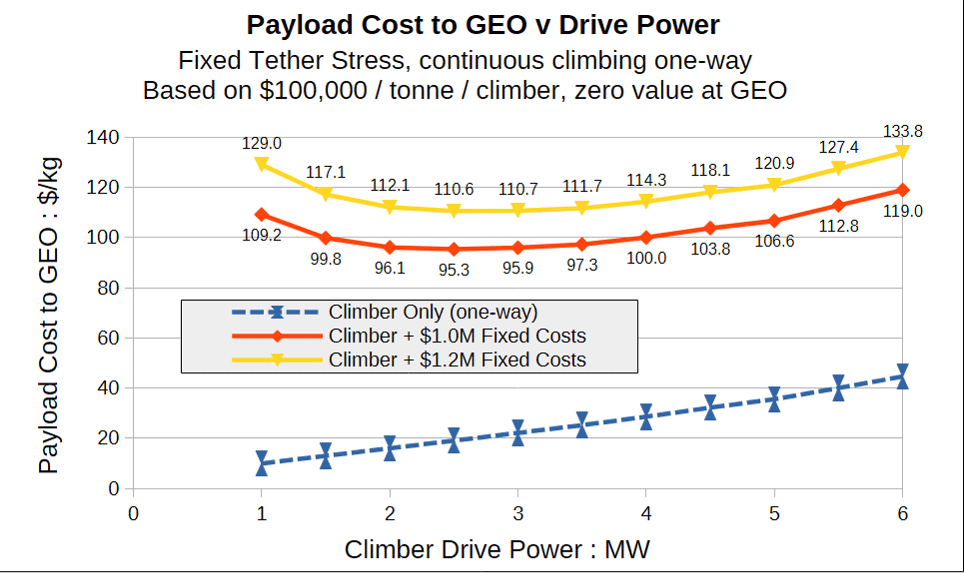
Figure 3: Payload Cost to GEO v Drive Power, with continuous climbing, 24-hour departure interval, 235 km/hr maximum speed, masses as Figure 1, $100k/MW climber cost, $1.0M & $1.2M fixed costs. Analysis: P. Robinson.
This analysis shows that increased climber specific costs will result in a lower climber power for best payload cost/kg, regardless of whatever “fixed” cost is applied.
These costs would be the cost to the Space Elevator operator, not necessarily the price to a third-party payload customer. Customer pricing may be flexible and based on demand, so perhaps the climber power might be increased above the lowest-cost power if the additional payload capacity could be sold at a higher margin. This scenario would certainly be feasible if the climber design was modular with an on-board power supply (such as solar arrays), but the high cost and complexity of surface power beaming systems (laser or microwave) described in [1] would complicate matters.
Note also that I have assumed the climbers are not returned to Earth for re-use. If the $100/kg payload cost equally applies to descending payloads it would not make economic sense to return a 6-tonne climber to Earth as payload. Any climber making the descent itself would need extensive modification to dissipate the braking energy and more than double the reliability, making it more massive and costly; it may well require expensive refurbishment before it could be used again. Thus, any climber descent could only be viable if the payload had a value substantially in excess of $100/kg.
4. Summary
The numbers in this article depend on many factors that are at present unknown, for example the strength of the tether and the maximum feasible climber speed. The tether strength will be a function of the material specific strength, the material safe working stress and the total tether mass that is launched and deployed: the maximum speed will be determined by engineering analysis and test.
That said, simple conclusions that can be drawn from this work include:
+ There will be some climber power above which there will be no further benefit in payload or cost.
+ The climber power will be determined by economics as well as by engineering capability.
+ As the climber cost, mass, and/or power improve with time (due to design enhancements) it will become more cost-effective to launch more powerful versions carrying substantially more payload, even with the same tether working strength.
If any readers have suggestions regarding my assumptions, or any other comments, I’d be pleased to read your views. You could email me directly, but it might be better to discuss it publicly; I’ll be posting this article on my personal LinkedIn page ( https://www.linkedin.com/in/pterr-robinson/ ), so please add a comment there.
In my next article I’ll consider the maximum climber speed in more detail, outlining the technical challenges and reviewing the impact of speed on payload mass, time-to-GEO and payload cost.
5. References
[1] “Powering the Space Elevator”, L. Bartoszek et al, ISEC 2026 Study Report.
[2] “Design Considerations for Space Elevator Tether Climbers”, P. Swan, C. Swan, R. Penny, J. Knapman & P. Glaskowsky, ISEC 2013 Study Report.
[3] “Space Elevator Climber Dynamics Analysis and Climb Frequency Optimisation”, P. Robinson, IAC2022 paper IAC-22,D4,3,8,x68299.
ISEC Terminology
by Pete Swan
“Renaissance”
ISEC just recently signed a partnership with Space Renaissance International as the goals and missions are so similar and will be more powerful when we combine our efforts. Their mission is centered around the concept of “A new Space Renaissance.” The concept traces our roots back to the renaissance of the 1500’s and the emergence from the dark ages with enlightened minds and new views on the importance of human life. The focus (now of both organizations) has matured to include solutions for human needs and aims. So, the parallel is to help open up the future in space with our resources to “expand beyond Earth’s Boundaries.” ISEC believes the Green Road to Space will greatly assist this new renaissance into a robust future in space.
Upcoming Events:
Virtual ISEC Space Elevator Conference 2026
Sponsored by the International Space Elevator Consortium
https://www.isec.org/events/isec2026
Saturday, September 12th, through Sunday September 13th, 2026
WSPEC Central Asia '26
Sponsored by USTEM Foundation
https://www.wspec.org/events
Thursday, August 27th, through Saturday, August 29th, 2026
Almaty, Kazakhstan
77th International Astronautical Congress
Sponsored by the International Astronautical Federation (IAF)
https://www.iac2026.org/iac-2026
https://www.isec.org/events/77th-international-astronautical-congress
Theme: “The World Needs More Space”
October 5th through October 9th, 2026
Antalya, Turkey
ISDC 2027
Sponsored by the National Space Society
https://www.isdc.nss.org/latest-news
May 27th through May 30th, 2027
Los Angeles, USA
78th International Astronautical Congress
Sponsored by the International Astronautical Federation (IAF)
https://www.isec.org/events/iac2027
Monday, September 27th through Friday, October 1, 2027
Poznań, Poland
79th International Astronautical Congress
September 1, 2028 through September 5, 2028
Samarkand, Uzbekistan
Contact Us:
Our website is www.isec.org.
You can find us on Facebook, X, Flickr, LinkedIn, Instagram, YouTube, Bluesky and Reddit.
Support us:
Sign up to be a member at: https://www.isec.org/membership
You can also give directly using the “Donate” link at the bottom of our website page.
Does your place of employment do matching funds for donations or volunteer time through Benevity? If so, you can make ISEC your recipient. Our 501(c)(3) number is 80-0302896.