
International Space Elevator Consortium
February 2026 Newsletter
Note: The January 2026 Newsletter was combined with December 2025
In this Issue:
President’s Note
Chief Architect’s Corner
SPEC2025: Event Report
ISEC Terminology
Everybody Knows What GEO is, Right?
History Corner
Tether Materials
Space Elevator Design Verification
Upcoming Events
Contact Us
President’s Note
by Dennis Wright
Space Elevator Competitions are Back!
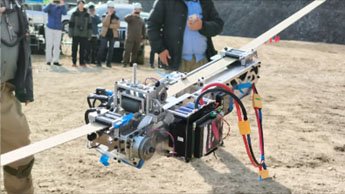
On November 21st, at an undisclosed location near Mt. Fuji, eleven teams gathered for the first international space elevator competition. This competition was a collaboration between the Space Elevator Association of Japan (JSEA) and World Space Elevator Competitions (WSPEC). It has been several years since the last competition, so a re-initiation of this effort is welcome.
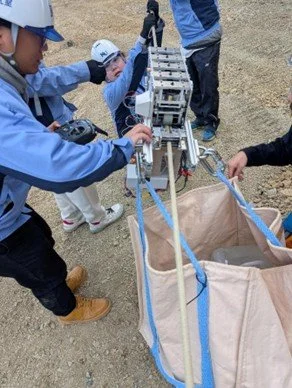
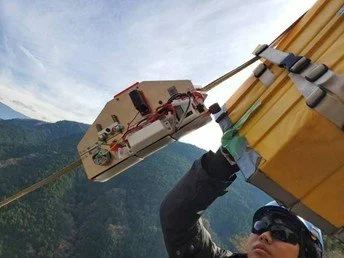
The competition took place over three days and was designed as a testing event for future space elevator climber technology, including performance, reliability and safety. Each team came with self-developed climbers and tested them on locally provided equipment. There was also technical exchange among teams.
While this competition focused more on testing than competitive rankings, next year’s event will likely have specific goals and prizes for the winners. WSPEC is organizing this event, which will probably occur in the US.
Interest in this type of activity is growing. There are well-established teams in Japan and Germany, with teams from Mongolia and Kazakhstan getting started. Who knows, maybe in a few years there will be a competition in Ulaanbaatar.
ISEC is a partner of both JSEA and WSPEC. If you haven’t done so, check out the new WSPEC web page www.wspec.org, where you’ll find everything you ever wanted to know about space elevator climber competitions. Planning to field a team or know someone who does? Contact Mordy Friedman at mordy@wspec.org.
Chief Architect’s Corner
by Pete Swan
Modern-Day Space Elevators are Revolutionary and Transformational
Perceptions of future capabilities of mega-projects are wide-ranging and must be stimulating enough to gain approval to move forward. The significant realization about Modern-Day Space Elevators is that they will leapfrog the rocket equation and enable humanity to move off planet with a permanent, efficient, transformational infrastructure. It is difficult to internalize that the future infrastructure created to realize the Space Elevator would provide both a revolutionary approach to fast and massive rocket (and spacecraft) release towards their mission orbits and a transformational aspect enabling missions not achievable by rockets to be performed. This discussion will focus on those two characteristics by relating them to locations on the tether – GEO Spaceport and Apex Anchor Spaceport.
From Google dictionary 10 Jan 2025:
Revolutionary: “…involving or causing a complete or dramatic change.”
Transformational: “…describes something with the capacity to transform, creating a deeper, more profound shift than mere incremental change.”
Revolutionary: GEO Spaceports will provide a remarkable location for revolutionary capabilities. There are several current programs that need to increase the size of their future space systems by assembling them in-orbit. In addition, the spaceport can provide a location for refueling, repair, assembly, and storage with a huge “truck stop” set of capabilities. Not only can the space system segments lift off from the Earth Spaceport with a travel time of approximately one week, but its revolutionary approach supports operations that are routine, daily, safe, inexpensive, and environmentally friendly. One element that is often overlooked is the delivery efficiency of Modern-Day Space Elevators – estimated at 70% of the pad mass reaching GEO (and Apex Anchor) by using electricity instead of rocket fuel. This compares with the rocket equation efficiency to GEO of only 2% of pad mass, definitely a revolution in capability. Of course, we will be working with advanced rockets under a Dual Space Access Architecture, ensuring people can move beyond Low Earth Orbit and through the radiation belts rapidly.
Transformational: Movement on Modern-Day Space Elevators to Apex Anchors will have all the revolutionary characteristics just discussed for the GEO Spaceport location; however, it also has additional strengths that transform the approach to space. When you look at the definition of “transformational” inside Google dictionary, it also relates to the following words and phrases: Radical Change: It signifies a fundamental alteration, not just a minor adjustment; Lasting Impact: The change is enduring and has long-term effects; Power to Change: It emphasizes the ability or potential to cause this change; and Positive Connotation (Often): While it technically just means change, it's frequently used for positive, enriching, or enlightening shifts, such as in personal growth or societal progress.
Enhancement of this term is very indicative of the characteristics of Apex Anchor Spaceports with their multiple missions. A satellite segment which has risen on a space elevator will gain altitude (100,000 km), energy, and velocity (7.76 km/sec). This huge transformational energy allows it to reach the Moon in 14 hours and depart for Mars every day of the year (no 26-month waiting period for alignment of the planets). In addition, each of the space system segments can then be assembled into a much larger spacecraft. These transformational changes are:
+ Huge velocity that will not be slowed down by Earth’s gravity.
+ Massive space systems after assembly of segments.
+ An ability to be released towards mission destinations once a day.
When one is discussing Modern-Day Space Elevators, one must ensure the aspects “revolutionary” and “transformational” must be brought up early and often. This enables the listener’s mindset to develop into “Wow – this is amazing.” The key element is that Modern-Day Space Elevators will enable significant, radical, and long-lasting improvements to humanity’s lifting of mass for so many future missions.
SPEC2025 (Space Elevator Challenge 2025) Event Report
by Alexander Joham
Eleven Teams Participated in the Climber Experiment Session,
Including a German Team
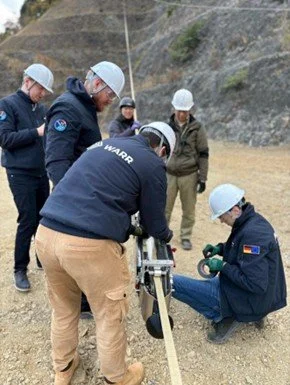
The Japan Space Elevator Association hosted the climber experiment event. The event, "SPEC (Space Elevator Challenge)" was held over three days from Friday, November 21 to Sunday, November 23, 2025.
The space elevator is a concept that connects the Earth's surface to space via a cable, using a climber (elevator) to transport people and cargo.
SPEC is an experimental event held to test the mechanisms and operations of climbers toward realizing this concept.
1. Event Overview
+ Name: SPEC (Space Elevator Challenge)
+ Organizer: JSEA (Japan Space Elevator Association)
+ Dates: November 21 (Fri) - 23 (Sun), 2025
+ Number of Participating Teams: 11 teams
+ Participating Countries: Japan, Germany (Team WARR)
This event is not a "competition" where teams vie for rankings or scores, but rather an experimental gathering where each team thoroughly verifies the performance, reliability, and safety of their self-developed climbers.
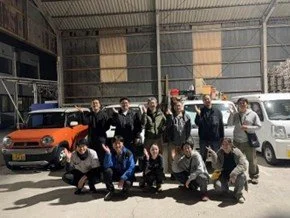
Alongside teams from across Japan, Team WARR from Germany participated again this year, making this year's event an international one.
Furthermore, staff members from the upcoming World Championship (WSPEC) scheduled for next year, visited to observe, exchanging opinions on operational systems, safety management, and how experiments are conducted at the venue, as well as learning and optimizing plans for future competitions.
2. Features of the Climbers and Experiments
At SPEC, each team brought their own ingeniously designed climbers, enabling diverse experiments.
+ Experiments on lifting, lowering, and stopping using climbers with new mechanisms.
+ Verification of load capacity and stability using large climbers capable of transporting approximately 120 kg.
+ Research into control methods for stabilizing posture during ascent/descent.
+ Design and testing of compact climbers prioritizing stability and reliability, etc.
Beyond these experiments, various approaches were evident, ranging from simple mechanisms to those pursuing maximum speed.
It was impressive to see each team bring their own unique answers driving development to the grand theme of the space elevator.
3. Team Initiatives and Venue Impressions
What stood out most over the three days was the consistent perseverance shown by every team, as they continued challenging themselves through the final moments.
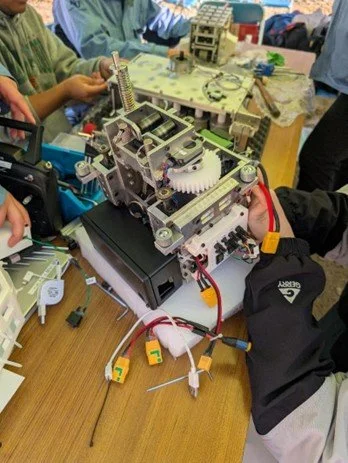
+ Even when problems arose, they repeatedly disassembled, adjusted, and reassembled their devices on the spot, attempting multiple retries.
+ They reviewed control parameters based on each attempt's results and attempted improvements that same day.
+ They consulted with other teams and staff, incorporating new ideas on the spot, and even 3D-printing missing parts overnight!
Their dedication was palpable.
It wasn't just about "whether it worked well," but also the insights and innovations gained during the process that were shared throughout the venue, perfectly embodying the collaborative essence of space elevator challenges.
WARR, participating from Germany, also introduced their unique designs and operational methods, leading to lively exchanges with domestic teams on structural design, safety measures, and operational procedures.
4. Connection with WSPEC and International Expansion
During the event, staff from WPSEC (World Space Elevator Competitions) visited the venue and participated.
Discussions primarily focused on the following points:
+ Operational methods for the experimental session format and confirmation of safety rules.
+ Sharing on-site innovations and challenges regarding climber and tether specifications.
+ Future operational structure direction, including knowledge for hosting international teams.
The experience and know-how accumulated at SPEC will be applied to future WSPEC operations and events.
While SPEC is a domestic event, it also serves as a stepping-stone to international competitions and as a proven testing ground.
5. Acknowledgements
For the successful hosting of this SPEC event:
+ To all those who provided the venue and facilities and offered their cooperation.
+ To the staff and volunteers who worked diligently on safety management and operations.
+ And all the teams who participated from Japan and Germany.
We extend our heartfelt gratitude.
We sincerely thank everyone who provided the venue and facilities for the event, through experimentation and hands-on creation. We will continue our efforts to ensure SPEC fulfills this role going forward.
We sincerely appreciate your continued understanding and support for the Japan Space Elevator Association and SPEC events.

ISEC Terminology
by Pete Swan
“Dual Space Access Architecture”
A combination of strengths of advanced rockets and Space Elevators for lifting massive loads within a collaborative and cooperative approach leads to a bright future enabling the dreams of many. When looking at advanced rockets and the future of humanity’s needs from/in orbit, there should be cooperation and coordination between advanced rocket projects and Space Elevators once they start operations. This Dual Space Access strategy will leverage the best of future rockets and Space Elevators allowing humanity to reach farther, resulting in:
“Rockets to open up the Moon and Mars with Space Elevators to supply and grow the settlements. In addition, Space Elevators will enable Green Missions such as Space Solar Power and L-1 Sun Shades. This approach is compatible and complementary with future rockets while leveraging the strengths of both inside a Dual Space Access Architecture.”
From: Eddy, Jerry, editor, “Leverage Dual Space Access Architecture, Advanced Rockets and Space Elevators.” ISEC Research Report 2021, https://www.isec.org/studies/#LeverageDualSpace
Everybody Knows What GEO is, Right?
by Blaise Gassend
LEO is Low Earth Orbit, MEO is Medium Earth Orbit, and GEO is Geostationary Earth Orbit. Such a natural progression that everybody is familiar with, right? Well, I certainly thought so, and so did Larry Bartoszek when he wrote the table of acronyms for the upcoming ISEC report on powering the space elevator. That’s when Peter Robinson chimed in with a correction: GEO stands for Geostationary Equatorial Orbit. He had recently learned that fact from Martin Lades when writing about Mars’ Areostationary Mars Orbit or AMO. Martin corrected Peter, telling him that he should be referring to AEO for Areostationary Equatorial Orbit.
Never one to shy away from a pedantic discussion, I decided to look more closely at this question. Geostationary Earth Orbit, which I had blissfully accepted without question until then, did appear flawed upon inspection because of its redundancy. Why bother saying Earth when the geo in geostationary already means Earth? But in that light, Geostationary Equatorial Orbit seems equally shaky. If an orbit keeps a satellite stationary relative to the Earth, that orbit will be on the equator, so why bother with the word equatorial? My next stop was the Wikipedia article on Geostationary Orbits [1]. And that page did indeed mention that this orbit is also called a Geosynchronous Equatorial Orbit. (If you search for that article directly, you’ll have to search through its history page because I corrected the Wikipedia entry based on this bit of research.)
While I missed this subtlety at the time, Geostationary Equatorial Orbit and Geosynchronous Equatorial Orbit are not the same thing. As I have said, a geostationary orbit is by necessity equatorial. Indeed, it is an orbit in which a satellite stays above a fixed location on the Earth. If that satellite isn’t above a point on the equator, then in a non-rotating reference frame, that satellite will be undergoing an orbit entirely contained in a plane that does not go through the center of the Earth, a physical impossibility.
A geosynchronous orbit is a different beast. It is an orbit with a period equal to one sidereal day [2] of 23 hours, 56 minutes and 4.09 seconds. That’s the time the Earth takes to do a full rotation in the non-rotating reference frame where distant stars are fixed. Geosynchronous orbits can be non-equatorial, and they can be elliptical. As long as they have the right period, they will follow the same trajectory relative to the Earth every day. With a small inclination orbit, an observer on Earth will see the satellite follow a figure eight trajectory centered on the equator. And even on the equator, a geosynchronous orbit isn’t necessarily geostationary as the orbit may be elliptical, in which case the point directly below the satellite will oscillate East-West with a period of one sidereal day. So pedantically speaking, the geosynchronous equatorial orbit that Wikipedia mentioned isn’t necessarily geostationary. It is only when a geosynchronous orbit is both equatorial and circular, then it is geostationary.
My next stop was to search for what the national space agencies use. Googling for GEO in combination with NASA, UKSA, or ESA painted a pretty clear picture that came as quite a surprise to me; in the space agencies GEO is usually considered to mean GEosynchronous Orbit [3, 4, 5]. Just two words, though nobody actually capitalizes the E when they write it. This shouldn’t really have surprised me if I had paid attention to the title of the GEO Wikipedia page [1], which is also Geosynchronous Orbit. But, while they were in a clear numerical minority, there were several pages that violated this rule. One NASA page used GEO for Geosynchronous Earth Orbit [6]. Or at least it did back in November. I contacted NASA about it and now this page and several others seem to say that GEO is a Geosynchronous Orbit. I also came across several pages that used Geostationary Earth Orbit [7, 8]. Geostationary Equatorial Orbit was definitely the rarest option.
At this point, I was ready to conclude that in the mainstream, GEO is Geosynchronous Orbit, and I shared this finding with the team. That’s when Peter Swan joined the discussion with the opinion that GEO is an overloaded term, sometimes used to refer to Geostationary Equatorial Orbits, and sometimes for Geosynchronous Earth Orbits. I wasn’t a fan of this interpretation because equatorial and Earth are, as we have seen, redundant in those two names. And the Wikipedia page on Geosynchronous Orbits had the perfectly good GSO acronym for geosynchronous orbits [9].
Peter Robinson, always on the lookout for material for the ISEC newsletter, suggested that I write all this up, and since I had just missed the newsletter deadline, I set this project aside for a future issue, which I am finally getting around to writing in late January. Why am I boring the reader with all these details? Because, since I first researched the topic, somebody has been editing Wikipedia. If you look at the Geosynchronous Orbit page today [10], you will see that there are Geosynchronous Orbits abbreviated as GEO, and Geostationary Orbits abbreviated as GSO. Exactly the opposite of what I had concluded in November! And while the Geostationary Orbit page currently says GEO, it did briefly say GSO before the edit got reverted [11]. What’s going on? It would appear that space agencies aren’t the only ones who care about these orbits. Telecommunication people such as the FCC or ITU are also interested, and they have different vocabulary. For them it is GeoStationary Orbit abbreviated as GSO [12, 13], and the person who changed Wikipedia refers to this as the “legal” definition of the term. While this is a strong case for GSO for geostationary orbit, I haven’t figured out the justification for GEO for Geosynchronous Orbit. It will be interesting to look at those Wikipedia pages again in a few months to see how things have evolved. And I can’t help wondering… did my November email to NASA about Basics of Space Flight, “Chapter 5: Planetary Orbits.” [6] prompt some rethinking of vocabulary on a few NASA pages and the edits to Wikipedia?
What should one conclude from all this? First of all, the E in GEO is not a word of its own unless you have the singularly misguided optimism that you can write GEO for Geosynchronous Equatorial Orbit and hope that people will understand it as a possibly elliptical orbit. In Geostationary Equatorial Orbit, Geostationary Earth Orbit and Geosynchronous Earth Orbit, the E-word is redundant. I’d recommend leaving it out, but if you don’t, you won’t be alone, particularly with the word “Earth”. As far as I can tell, and despite what Wikipedia says today [10], GEO most commonly refers to a Geostationary Orbit, but not always [6]. GSO is more problematic; it is clearly a Geostationary Orbit in the telecommunications context but is a Geosynchronous Orbit in other contexts [6, 14]. I now see the wisdom in Peter Swan’s position: Clearly these terms are used inconsistently, and if you want your spacecraft to end up in the right place, you should take the time to spell out exactly what it is you want. And I’ll leave it up to the reader how they want to abbreviate that Areostationary orbit that started this whole discussion.
You may wonder, as I do, what all this has to do with space elevators? For the most part nothing. But if one is desperate, small connections can be made. In the absence of librations, the space elevator is a geostationary object. But it behaves differently from geostationary satellites. First, because it is a large object orbiting in a nonlinear gravity well, it can be geostationary without having its center of gravity at GEO [15]. This is an academic point, however, because that large object, when not attached to the ground, is unstable [16]. The space elevator avoids these instabilities by being attached to the ground on one end. And because it is attached to the ground, the space elevator can be a non-equatorial geostationary object [17]. If this connection isn’t strong enough for you, I will refer you to Peter Robinson to see what he had in mind when he asked for this newsletter article.
[1] “Geostationary Orbit.” Wikipedia. Wikimedia Foundation. Accessed November 28, 2025. https://en.wikipedia.org/w/index.php?title=Geostationary_orbit&oldid=1312082921.
[2] National Aeronautics and Space Administration. 1973. Geosynchronous Platform Definition Study. Volume 3: Geosynchronous Mission Characteristics. NASA-CR-133970; SD-73-SA-0036-3. https://ntrs.nasa.gov/citations/19730020130.
[3] Schoeberl, Mark, Carol Raymond, and Peter Hildebrand. Active and Passive Sensing from Geosynchronous and Libration Orbits. IGARSS 2003, July 21–25, 2003, Toulouse, France. NASA Goddard Space Flight Center; Jet Propulsion Laboratory; NASA Technical Reports Server, January 1, 2003. Accessed January 26, 2026. https://ntrs.nasa.gov/api/citations/20030093736/downloads/20030093736.pdf.
[4] UK Space Agency. Nomadic Multi-orbit User Terminal Demonstrator: project brief and assessment criteria. ARTES Call for Innovative Hybrid Network Solutions. GOV.UK. Published December 9, 2024. Accessed January 26, 2026. https://www.gov.uk/government/publications/artes-call-for-innovative-hybrid-network-solutions/nomadic-multi-orbit-user-terminal-demonstrator-project-brief-and-assessment-criteria.
[5] European Space Agency. Geostationary orbit. ESA Multimedia Images, March 2, 2020. Accessed January 26, 2026. https://www.esa.int/ESA_Multimedia/Images/2020/03/Geostationary_orbit.
[6] NASA. “Chapter 5: Planetary Orbits.” Basics of Space Flight. NASA Science. Accessed November 28, 2025. https://science.nasa.gov/learn/basics-of-space-flight/chapter5-1/.
[7] UK Space Agency. UK Space Agency Corporate Plan 2025-26. GOV.UK. Published September 30, 2025. Accessed January 26, 2026. https://www.gov.uk/government/publications/uk-space-agency-corporate-plan-2025-26/uk-space-agency-corporate-plan-2025-26.
[8] European Space Agency. Orbits. ESA. Accessed January 26, 2026. https://www.esa.int/Applications/Connectivity_and_Secure_Communications/Orbits.
[9] “Geosynchronous Orbit.” Wikipedia. Wikimedia Foundation. Accessed November 28, 2025. https://en.wikipedia.org/w/index.php?title=Geosynchronous_orbit&oldid=1324581586.
[10] “Geosynchronous Orbit.” Wikipedia. Wikimedia Foundation. Accessed January 26, 2026. https://en.wikipedia.org/w/index.php?title=Geosynchronous_orbit&oldid=1333989498.
[11] “Geostationary Orbit.” Wikipedia. Wikimedia Foundation. Accessed January 18, 2026, within the right 23-minute window. https://en.wikipedia.org/w/index.php?title=Geostationary_orbit&oldid=1333483113.
[12] Federal Communications Commission. Space Stations. FCC. Accessed January 26, 2026. https://www.fcc.gov/space/space-stations.
[13] International Telecommunication Union. n.d. Geostationary (GSO) satellites. Accessed January 26, 2026. https://www.itu.int/hub/tag/geostationary-gso-satellites/.
[14] UNIDIR and Secure World Foundation, Geosynchronous Orbit (GSO), Outer Space Security Lexicon, accessed January 26, 2026, https://spacesecuritylexicon.org/common-definition/geosynchronous-orbit-gso.
[15] Gassend, Blaise. “Why the Space Elevator’s Center of Mass is Not at GEO.” Gassend.net. Accessed January 26, 2026. https://gassend.net/spaceelevator/center-of-mass/index.html.
[16] Cosmo, M. L., and E. C. Lorenzini. 1997. Tethers in Space Handbook. NASA/CR-97-206807. Washington, DC: NASA. Accessed January 26, 2026. https://ntrs.nasa.gov/api/citations/19980018321/downloads/19980018321.pdf.
[17] Gassend, Blaise, “Non-Equatorial Uniform-Stress Space Elevators,” in Proceedings of the Third Annual Space Elevator Conference, June 2004, Washington, DC. https://gassend.net/publications/NonEquatorialUniformStressSpaceElevators.pdf.
History Corner
by David Raitt, ISEC Chief Historian
Space Elevator - Soonish!
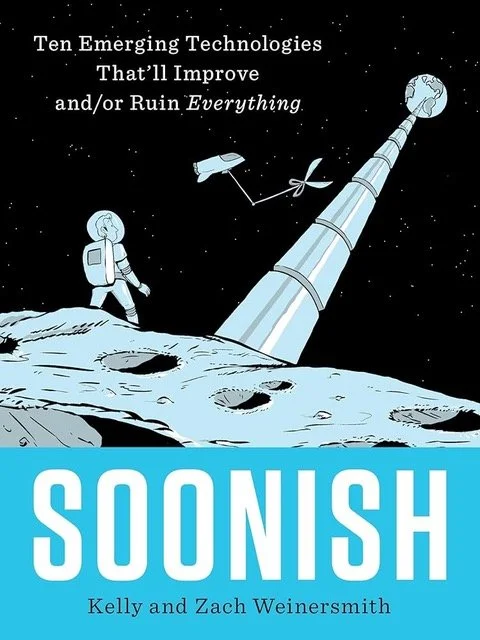
On the secondhand book stall in Leiden the other week I saw a book, on the cover of which was an astronaut on a rocky landscape gazing up at what appeared to be a space elevator affixed to Earth. The book was entitled Soonish: Ten Emerging Technologies That’ll Improve and/or Ruin Everything and written by Kelly and Zach Weinersmith, published in 2017 by Penguin Press in USA and Particular Books in UK.
Well, the book was a few years old (though in pristine condition), but what were these ten technologies and what did it say about them? The book has a lot of researched information and is written in a humorous style with plentiful cartoons by Zach. Section 1, following a brief Introduction, has the title “The Universe, Soonish” and contains two chapters: “Cheap Access to Space: The Final Frontier is Too Damn Expensive” and “Asteroid Mining: Rummaging Through the Solar System’s Junkyard”. Section 2 is entitled “Stuff, Soonish” and covers chapters on Fusion Power, Programmable Matter, and Robotic Construction. The final Section 3, “You, Soonish” has chapters on Precision Medicine, Bioprinting, and Brain-Computer Interfaces. The Conclusion is also in this section and discusses “Less Soonish, or The Graveyard of Lost Chapters”.
I immediately went straight to the index and there were the magic words “space elevators”! As you might have guessed, the bulk of the information was in the chapter “Cheap Access to Space” and that chapter itself is divided into several ways (or Methods) of getting into space. Following some preamble about the cost (in 2017) being about $10,000 to send a pound to space and that while the mass to LEO is given as 80% fuel, 16% rocket, and a highish 4% cargo, most of the actual cost is not the propellant or cargo, but the rocket itself. Thus, there are two ways to reduce the high cost: recover the launch vehicle or use less propellant. These options are both discussed. The question is asked, “So where are we now?” and the rest of the chapter discusses in some detail various ways of getting into space. Method 1 is all about Reusable Rockets; Method 2 covers Air-Breathing Rockets and Spaceplanes; Method 3 focuses on Mega-Superguns; Method 3.5 takes a light-hearted look at springs like a Mega Pogo Stick; Method 4 suggests Laser Ignition; Method 5 exhorts Starting at High Altitude; and finally, Method 6, discusses Space Elevators and Space Tethers.
The dozen or so pages in this Method start by asking you to imagine a big rock spinning around Earth with a ribbon-like cable some 62,000 miles long going all the way down to the surface of the Earth where specially designed elevators take cargo, travellers, and spacecraft up and down. The idea may seem outlandish and the authors opined, but they add it’s been quite well studied (particularly by former NIAC fellow Dr Bradley Edwards). The various elements of the system and its location are discussed in a readable style, and it is noted that researchers estimate that cargo could go up to space for under $250 per pound, very fast and very safe. One of the best features of the design, they say, is that you can reach different altitudes and release payloads and launch satellites just by climbing up and down the cable. Then we are asked, well if it is so good, why not just do it?
The next part attempts to explain some of the reasons why. The strength of the cable material (here Yuri Artsutanov gets a nod for giving his name to the unit of specific strength) is discussed along with the material for making it (carbon nanotubes – remember this is 2017!) and issues associated with lightning strikes, space debris, cable damage, and fall, etc. Some concerns are voiced such as possible terrorist attacks, conflict over claims as to who can own what or should it be for all humanity, ecological worries, and the overcrowded orbits (it’s a lot worse today!).
The last segment considers how it would change the world. The lowest cost of getting to space the authors came across was $5-10 per pound, with more conservative estimates in the $250-500 range. In terms of commerce, they suggest thinking about this: a typical space elevator proposal is for once-per-day climbers to be able to lift 40,000 pounds into orbit. The ISS weighs about 900,000 pounds, thus even with weekends off, the space elevator could launch a huge space station once a month for a cost of approximately $5bn instead of the currently (2017) estimated final price tag of $100bn. The segment ends with some observations about gravity inside the space elevator!
In the Conclusions chapter, which provides brief information on technologies which didn’t make the cut for reasons of space, rather than research, the First Gravestone reads “Here Lies Space-Based Solar Power - Too Good for this World”! The problem is that a fairly light rooftop solar panel weights about 20 pounds; at current (2017) launch costs that’s $200,000 per panel. Even if a space elevator at $250 per pound is used that would still be $5,000 per panel – although the cost of panel has fallen since then, by the time the 62,000-mile cable is built, then the price would have dropped much further! There are some details provided on solar arrays and John Mankin’s work is singled out where he argues that space-based solar panels might get forty times more power than ground-based ones. It is concluded that in the future even when space launch might be quite cheap, it will probably always be easier and cheaper to build forty panels in Arizona than to launch one into space!
Of course, all the information provided on space elevators in the book – which is now some eight years out of date – is well-known and understood by members of ISEC and others more familiar with the topic (and much more up-to-date). However, it is gratifying to see that a book discussing emerging technologies chose to cover the space elevator and mention names like Brad Edwards, Yuri Artsutanov, Michel van Pelt of ESA, John Mankins, and a couple of others from NIAC who have had thoughts about the system even if they didn’t write much about it. Sadly, ISEC doesn’t warrant a mention. Neither are there any words about the history of space elevators and their early advocates such as Tsiolkovsky, Artsutanov, Pearson, or Arthur C. Clarke! However, the book is factual and does provide an extensive bibliography for all the technologies discussed in the book and it is very pleasing to see that our IAA study Space Elevators: An Assessment of the Technological Feasibility and the Way Forward published in 2013 is listed under Swan and all the other authors (my name is spelled incorrectly!). Michel van Pelt has two books listed: Rocketing into the Future: The History and Technology of Rocket Planes (2013) and Space Tethers and Space Elevators (2009). Oddly, though, Brad Edwards’ NIAC studies and his book are not listed.
Although the book is available to buy in paperback and is also available to listen to on Audible, it does not seem to be available to reaad on the Internet Archive, where there are several clips of interviews with the authors. And, of course, it might be found in public libraries or secondhand bookshops.
Tether Materials
by Adrian Nixon
Does the Thermal Conductivity of a Graphene Laminate Tether Change with the Number of Layers?
Understanding the physical properties of tether materials is an important foundation for understanding how the material will function when the space elevator is built. One of these properties is the way the material deals with heat. The thermal conductivity is one important way of measuring how rapidly a tether would dissipate heat away from the source; Figure 1 shows a representation of local heating of tether material.
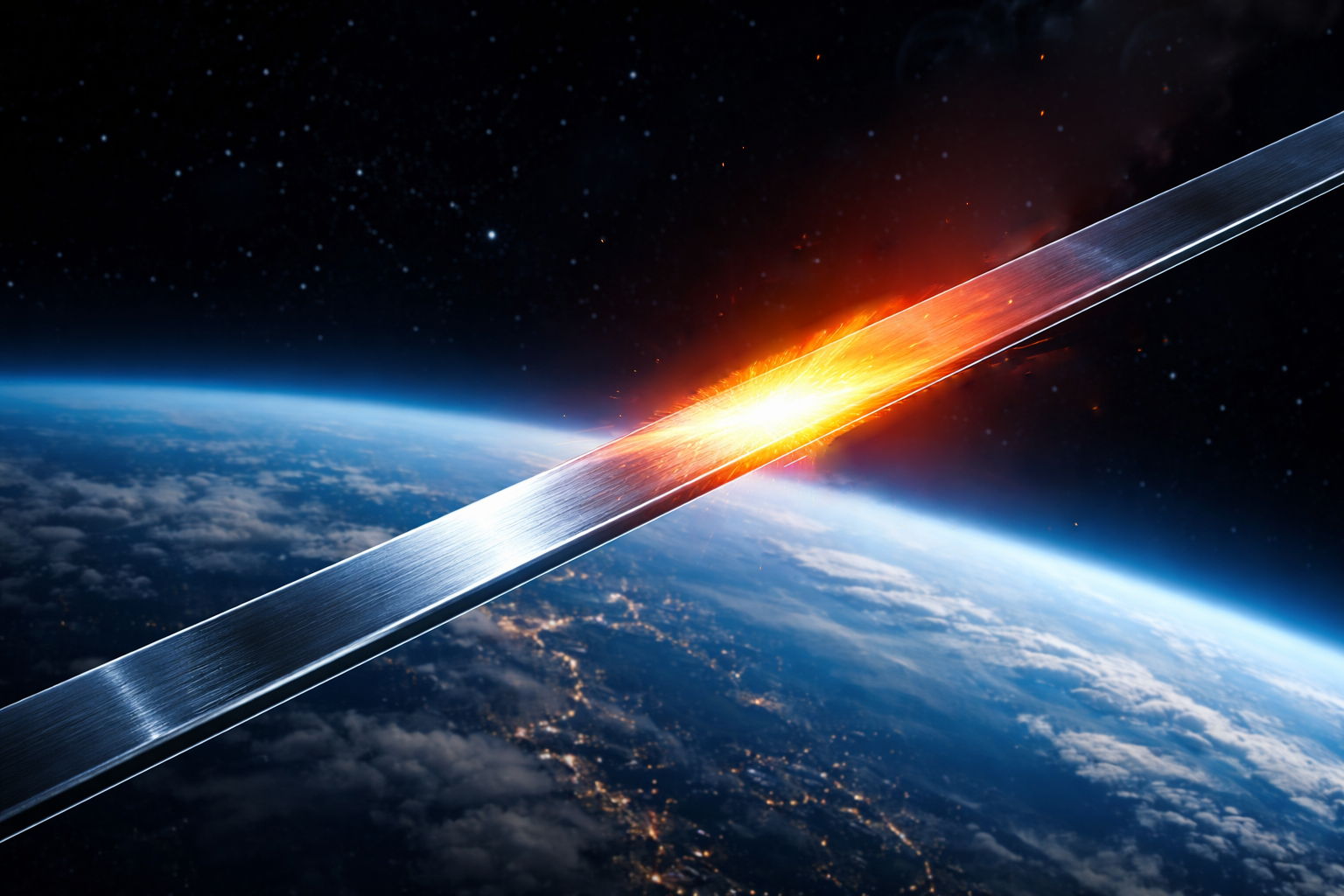
Figure 1: A space elevator tether material with a localised heated area above the Earth. Image created by an AI with additional content by A. Nixon.
Dear reader, as you will know, the leading candidate for the tether material is graphene. One of the delights of working with my colleagues at ISEC is the high level of intellectual challenge. A recent example came from the “powering the climber study group”. Larry Bartoszek is leading the group. He asked a penetrating question:
“We know graphene has an extremely high in-plane thermal conductivity. The measurements are for a single atomic layer. Does this change when we make a tether from many tens of thousands of layers?”
I didn’t know. So, I did the research to find out.
In the May 2025 newsletter [1], we explored how the thermal conductivity of graphene changes with the purity of the material. As Larry noted, the measurements in the literature are for a single atomic layer. I had been working on the assumption that this would translate to a graphene laminate structure. What we now need to explore is how the in-plane thermal conductivity of graphene changes as more layers of graphene are added.
We know that graphene has anisotropic thermal properties. It conducts heat differently along the graphene molecule (in-plane) than between graphene molecules layered in a stack (cross plane). The cross-plane thermal conductivity has been measured at 6.8 W/mK [2]. We also know from the work done supporting the Nobel Prize that in-plane graphene has the highest thermal conductivity of all materials at 5000 W/mK [3].
Heat energy causes the carbon atoms in graphene to vibrate. The vibrations set up wave-like oscillations in the two-dimensional lattice and these acoustic phonons transport heat energy from the hot part of the graphene molecule to another, cooler part. Figure 2 shows a representation of acoustic phonons in graphene.
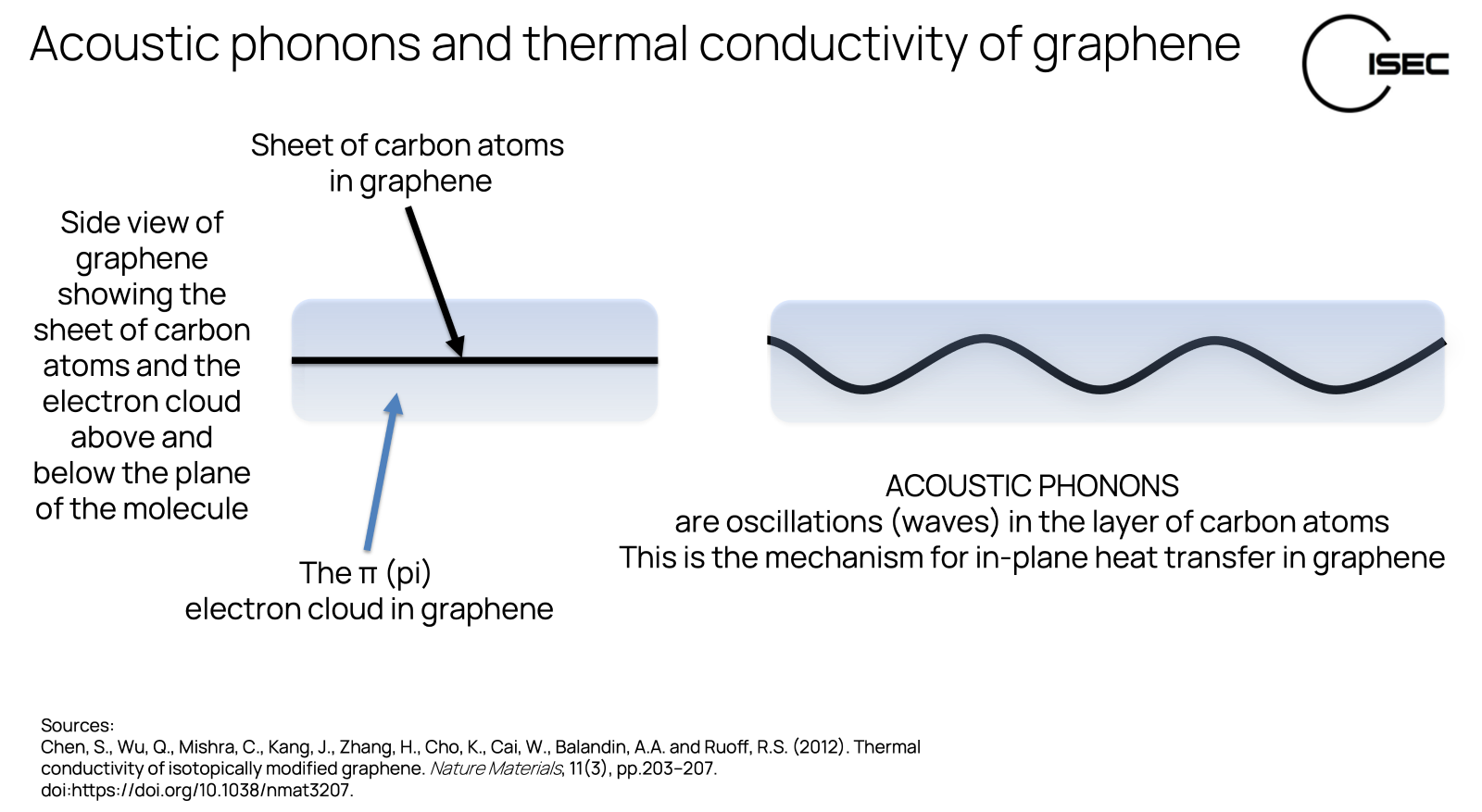
Figure 2: Representation of acoustic phonons in graphene.
This heat transport is a very efficient way of moving heat energy from one place to another in graphene. However, the 5000 W/mK measurement was made for a freestanding sheet of monolayer graphene.
Is this same efficiency preserved as more layers of graphene are stacked on top of one another? To find out we looked at experimental data in the published literature.
A review of peer reviewed literature shows that the thermal conductivity of graphene changes dramatically as layers are added. Figure 3 shows this trend clearly.
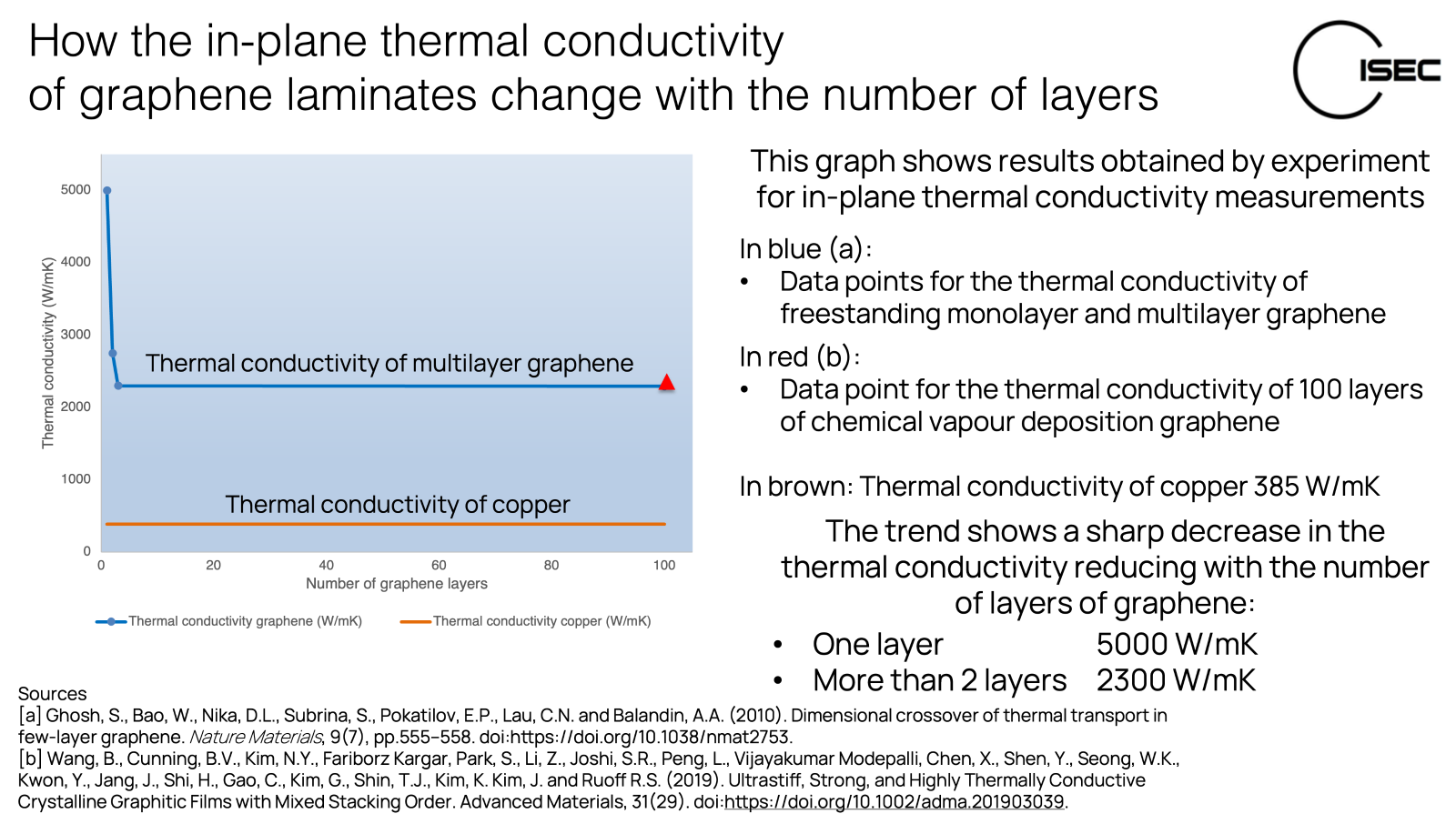
Figure 3. The change in thermal conductivity of graphene laminate with the number of layers.
Published data reveals that the thermal conductivity declines sharply with the number of layers of graphene. This is because the acoustic phonons in the graphene layers start to interact with one another as layers are added. Beyond three layers this effect is the same as at least 100 layers of freestanding multilayered graphene [4].
This dramatic decline in thermal conductivity needs placing into context. Copper and gold are among the most thermally conductive metals with thermal conductivities in the region of 300 to 400 W/mK [5].
We now have the answer to Larry’s question. Yes, the thermal conductivity of graphene laminate does change as more layers are added. The conductivity decreases rapidly from 5000 W/mK, with the first three layers, then levels out to 2300 W/mK. Experiments made on 100-layer graphene laminate samples have confirmed this value in the laboratory. Even with this decline graphene is still at least five times better than the best metals for thermal conductivity, after the material has been assembled into laminate structures such as that required for a space elevator tether.
References:
1. Nixon, A. (2025). How Isotopes of Carbon Would Affect a Tether Made from Graphene Super Laminate. [online] International Space Elevator Consortium. Available at: https://www.isec.org/space-elevator-newsletter-2025-may/#tether [Accessed 19 Jan. 2026]
2. Yan, Z., Nika, D.L. and Balandin, A.A. (2015). “Thermal properties of graphene and few-layer graphene: applications in electronics”. IET Circuits, Devices & Systems, 9(1), pp.4–12. doi: https://doi.org/10.1049/iet-cds.2014.0093
3. Anon (2010). The Nobel Foundation Scientific Background on the Nobel Prize in Physics 2010 GRAPHENE compiled by the Class for Physics of the Royal Swedish Academy of Sciences. [online] Sweden: Royal Swedish Academy of Sciences, p.8. Available at: https://www.nobelprize.org/uploads/2018/06/advanced-physicsprize2010.pdf [Accessed 10 Nov. 2025]
4. Wang, B., Cunning, B.V., Kim, N.Y., Fariborz Kargar, Park, S., Li, Z., Joshi, S.R., Peng, L., Vijayakumar Modepalli, Chen, X., Shen, Y., Seong, W.K., Kwon, Y., Jang, J., Shi, H., Gao, C., Kim, G., Shin, T.J., Kim, K. Kim, J. and Ruoff R.S. (2019). “Ultrastiff, Strong, and Highly Thermally Conductive Crystalline Graphitic Films with Mixed Stacking Order”. Advanced Materials, 31(29). doi: https://doi.org/10.1002/adma.201903039
5. Anon (2005). Thermal Conductivity of Metals, Metallic Elements and Alloys. [online] Engineeringtoolbox.com. Available at: https://www.engineeringtoolbox.com/thermal-conductivity-metals-d_858.html [Accessed 28 Dec. 2025]
Space Elevator Design Verification
by Peter Robinson
Article 4: “Pathfinder”, the Start of Verification Testing in Space, Part 1
1. Introduction
I previously discussed the variety of project management methodologies and the Technology Readiness Level (TRL) concept as used by NASA [1] and others. I also described how the Design Verification process would typically lag behind the TRL stages, covering Design Verification Phases 1 to 4 in the first three articles [2] [3] [4].
This fourth article will offer my suggestions for Phase 5 based on the key generic deliverables of NASA TRL-5 definitions as presented in Figure 1 below.
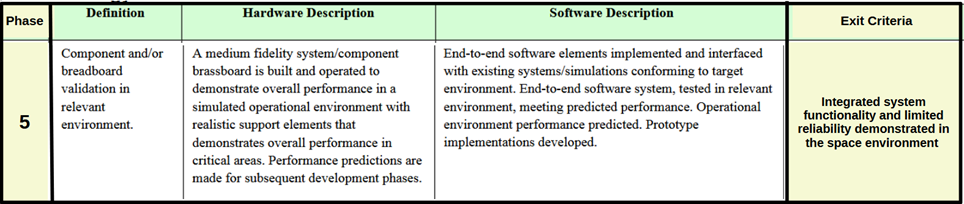
Figure 1: Proposed Design Phase 5 Definitions. Credit: NASA, P. Robinson.
In 2018 I outlined the work needed to meet specific Space Elevator TRL requirements in a paper presented in Bremen, Germany, at the IAC2018 conference [5]. Figure 2 below shows my thoughts presented then for TRL-5, equally applicable to “Design Verification Phase 5”.
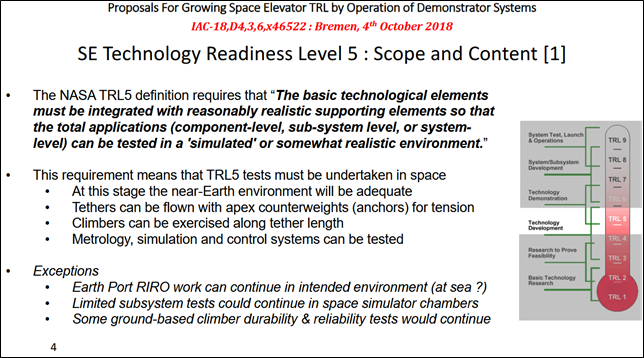
Figure 2: “Scope and Work Content for TRL-5”, from IAC-2018 Presentation by P. Robinson.
For this article I will describe two potential multi-purpose test cases to address TRL5 and “Verification Phase 4” requirements.
2. DESIGN VERIFICATION “PHASE 4” TEST CASES
2.1 “PATHFINDER”
The first test case, the “Pathfinder”, has been described in many earlier ISEC publications, notably ISEC Position Paper #2014-1 “Space Elevator Architecture and Roadmaps” [6] (section 5.4) and “Architecture Note #6” in 2017 [7]. My depiction of this concept is in Figure 3 below.
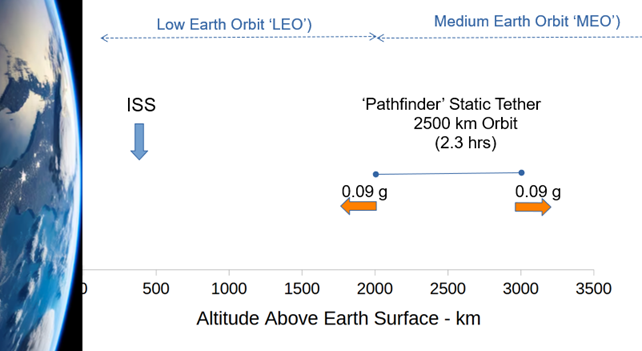
Figure 3: Schematic of ‘Pathfinder’ Tether. Credit: P. Robinson.
This concept comprises of a tether connected between two counterweight masses (anchors) in an Earth orbit with a mean altitude of 2500km, just above the LEO region. Gravitational forces will result in a non-rotating tether being under tension and aligning vertically relative to the Earth, albeit with perturbations from lunar, solar and other tidal forces. Table 1 below gives the parameters of this tether as proposed in [6]. My analysis additionally assumes Earth gravity/tidal forces only, Graphene Super Laminate (GSL) tether density, a fixed tether area (representative of low altitudes on an Earth SE), and arbitrary anchor masses.
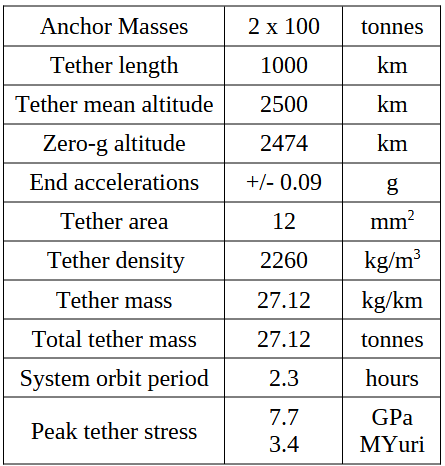
Table 1: Design Parameters for arbitrary ‘Pathfinder’ orbital tether. Analysis: P. Robinson.
A tether as described above with operating prototype climbers would yield much useful information on the impact of the real space environment (at the low-MEO level at least) on the tether itself, climber sub-systems, and tether dynamics control systems. A higher tether tension could be achieved with heavier anchor masses or by reducing the tether area. For example, 80GPa could be achieved with the same area and masses of just over 1000 tonnes each.
Unfortunately, the low effective weight on the tether (+/-0.09g at the ends, zero at the mid-point) would mean that any climber could only operate at no more than 49 kW/tonne (at 200km/hr) except whilst accelerating or braking, just under 25% of the design specific power for an Earth climber (4MW/20t). Figure 4 below shows the effective gravity along the tether; the line being slightly curved as gravity forces are not linear. At constant speed the required climber drive power will be proportional to the effective weight, so it can be seen that even the 25% power figure would only be approached at the ends of the tether.
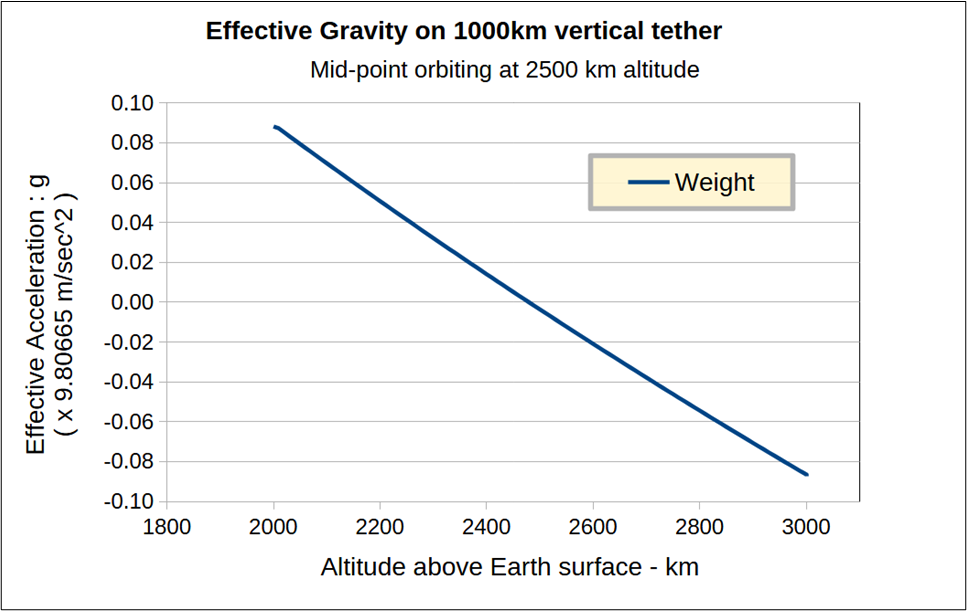
Figure 4: Effect gravity on vertical tether. Analysis: P. Robinson.
The tether tension should be sufficient to allow the climber to properly grip the tether, but there may be climber speed limitations due to Coriolis forces and other dynamic effects: more analysis is needed to investigate this.
The inability to test the climber over the full planned operating power range would be a major limitation of this test concept. I am therefore proposing a second test article as described below.
2.2 “PATHFINDER 2”: A Rotating Free Tether
The issue of the low sustained climber “weight” on a static tether could be resolved by rotating the tether to apply centripetal forces on the climber. Figure 5 below depicts one possible concept, again consisting of a 1000km tether. This would enable climber/tether interactions more representative of an Earth SE system.
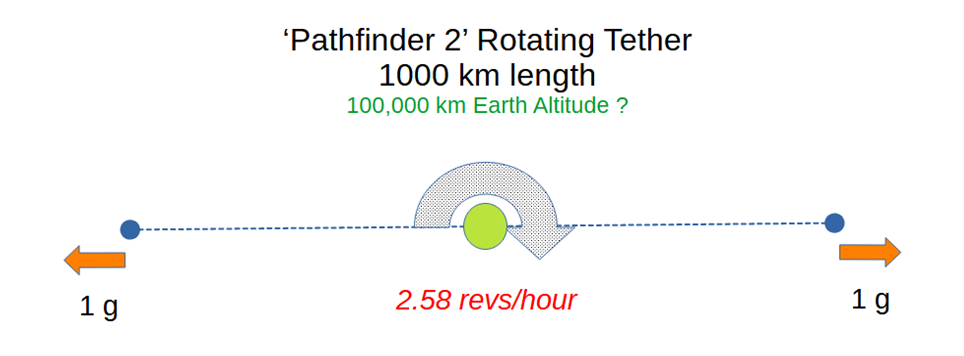
Figure 5: Schematic of “Pathfinder 2” Tether at maximum rotation. Credit: P. Robinson.
Table 2 contains more details of such a tether/mass system rotating as required to yield 1g at the end anchor masses. The tether and anchor parameters are arbitrary, chosen to yield the latest working strength estimate for GSL (80 GPa).
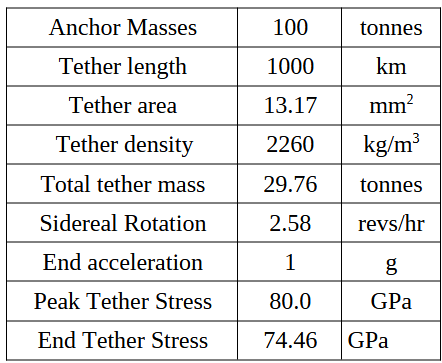
Table 2: Design Parameters for non-orbital rotating tether. Analysis: P. Robinson.
Tidal forces are not included in the above analysis, representing a system location far from the Earth. I suggest an altitude of around 100,000 km: far enough from Earth to minimise tidal forces whilst still representative of the upper end of the current Earth Elevator concept. This altitude would result in the tether periodically leaving the Earth’s magnetosphere and subjecting the tether and climbers to the full solar wind, a different space environment to that experienced by the lower “Pathfinder”.
The tether area shown in Table 2 is slightly higher than for the “Pathfinder” test, chosen to yield the target working stress of 80 GPa with the same 100 tonne anchor masses (with no additional climber masses). The tether rotation rate is as needed to yield +/- 1g acceleration at each end, though testing would probably start at a lower rotation rate and gradually increase until these maximum values are achieved. Different maximum stresses and end accelerations could also be achieved by adjusting the end masses, tether cross-sectional area, or peak rotation speed.
As before, the precise impact of moving climbers on this system will need to be established by dynamic analysis. The effect of Coriolis forces may be significant—the Coriolis acceleration of 0.05g at 200 km/hr at the peak rotation rate being over 60 times that experienced on an Earth equatorial tether rotating once every 24 hours.
The above two tether systems are arbitrary examples only, chosen here to allow better space evaluation of many aspects of the Tether, Climber, and Dynamics sub-systems. The second example does NOT align with the recommendations of earlier ISEC work [6] [7], but I suggest it is required to fully assess system components in the real space environment and so maximise the learning from this phase of work.
Project requirements may dictate the launch and test of more than two test tethers, perhaps with different test objectives, but this must be decided by a thorough review of validation requirements nearer that time.
Figure 6 below is the slide from my IAC2018 conference presentation [5] outlining some of the above.
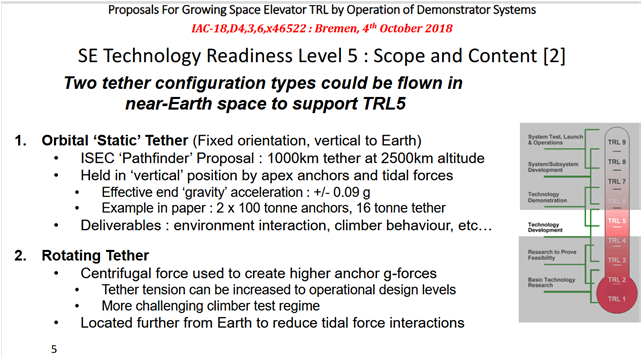
Figure 6: “Scope and Content for TRL-5 [2]”, from IAC-2018 Presentation by P. Robinson.
3. CONCLUSION
The above describes two potential space test scenarios, the second being additional to that proposed in earlier ISEC studies [6] [7]. I recognise that the need for the second test may be questioned, and I would welcome the opportunity to debate this at some suitable forum. The final decision on the test programme will be a decision for the mega-Project management team at a later date.
The next article (“Article 5: ...the Start of Verification Testing in Space, Part 2”) will explore in more detail how these “Pathfinder” test cases might contribute to the Verification of the Tether, Climber, and Dynamics System designs.
4. REFERENCES
[1] Technology Readiness Levels - NASA
[2] Peter Robinson: September-2025 ISEC Newsletter Article, “Introduction, Technology Readiness and Design Verification”
[3] Peter Robinson: November-2025 ISEC Newsletter Article, “Part 2: The Start of Design Verification Testing”
[4] Peter Robinson: December-2025 ISEC Newsletter Article, “Part 3: Verification Testing to Prepare for Space”
[5] Peter Robinson: Presentation at October-2018 IAC conference, Bremen (IAC-18-D4.3,6,x46522): “Proposals For Growing Space Elevator TRL by Operation of Demonstrator Systems”.
[6] Fitzgerald, Penny, Swan & Swan: ‘ISEC Position Paper #2014-1 "Space Elevator Architecture and Roadmaps"
[7] Michael “Fitzer” Fitzgerald: Architecture Notes #6 (February 2017)
Upcoming Events:
If you have a new idea or concept, or simply a new take on an existing idea, the three main Space Elevator events this year are now all open for abstract submission.
1st IAA Planetary Sunshade Workshop
Sponsored by the International Academy of Astronautics
https://sunshadeworkshop.com/
Wednesday, May 13th through Friday, May 15th, 2026
Nottingham, United Kingdom
International Space Development Conference 2026
Sponsored by the National Space Society
https://www.isec.org/events/isdc2026
Thursday, June 4th, through Sunday, June 7th, 2026
Space Elevator Session, Saturday, June 6th
Hilton McLean Tysons Corner, Virginia
+ Abstracts for ISDC2026 are due by April 15th
Virtual ISEC Space Elevator Conference 2026
Sponsored by the International Space Elevator Consortium
https://www.isec.org/events/isec2026
Saturday, September 12th, through Sunday September 13th, 2026
+ Abstracts for our Space Elevator conference are due by June 1st
77th International Astronautical Congress
Sponsored by the International Astronautical Federation (IAF)
https://iac2026antalya.com/
https://www.isec.org/events/77th-international-astronautical-congress
Theme: “The World Needs More Space”
October 5th through October 9th, 2026
Antalya, Turkey
+ Abstracts for IAC2026 are due by February 28th
78th International Astronautical Congress
Sponsored by the International Astronautical Federation (IAF)
https://www.isec.org/events/iac2027
Proposed Dates: Monday, September 27th through Friday, October 1, 2027
Poznań, Poland
Contact Us:
Our website is www.isec.org.
You can find us on Facebook, X, Flickr, LinkedIn, Instagram, YouTube, Mastodon, Threads, Bluesky and Reddit.
Support us:
Sign up to be a member at: https://www.isec.org/membership
You can also give directly using the “Donate” link at the bottom of our website page.
Does your place of employment do matching funds for donations or volunteer time through Benevity? If so, you can make ISEC your recipient. Our 501(c)(3) number is 80-0302896.