
International Space Elevator Consortium
May 2026 Newsletter
In this Issue:
Chief Architect’s Corner
Space Elevator Modeling Paper Wins Prestigious Award
ISEC Terminology
Tether Materials
Astronomia Interview of Larry Bartoszek
Around the Web
Upcoming Events
Contact Us
Chief Architect’s Corner
by Pete Swan
Excitement Surrounding International Space Development Conference
Come join us at our partner’s remarkable yearly conference! The National Space Society and ISEC form a great team with several interactive activities. We have been an active partner with the NSS since 2013 and support the conference through many roles. Their mission is: “To promote social, economic, technological, and political change in order to expand civilization beyond Earth, to settle space and to use the resulting resources to build a hopeful and prosperous future for humanity.” Their vision is strong, as it focuses on: “People living and working in thriving communities beyond the Earth, and the use of vast resources of space for dramatic betterment of humanity.” As they are in parallel with ISEC’s mission and vision, we have very similar priorities.
This conference is in McLean Virginia from June 4th to 7th. The full four days will have major players in our space world speaking at all the lunches and dinners as well as leading the discussions during active daily panels, presentations, and student activities. Yes, the NSS believes that their conference will support students in space activities with contests, working groups, and presentations (by the students). So far, I know of two students who have worked with ISEC who are presenting during the conference. This is not unusual and provides a “starting point” for young professionals intrigued by the rapidly expanding space area.
Our leadership role is, of course, Modern-Day Space Elevators with a workshop in the morning and several presentations and a panel in the afternoon of Saturday, June 6th. One key emphasis will be the culmination of several years of complex calculations and imaginative thinking which led to the 17th ISEC study report “Powering the Space Elevator.” This will be a focus for our morning workshop. Both Larry Bartoszek and Dennis Wright have accomplished the complex task of scheduling exciting presentations and topics. In addition, ISEC is sponsoring the evening reception for an opportunity to spread the word on space elevators.
Please join us at the four-day event and do not miss the Saturday Modern-Day Space Elevator focus! https://www.isec.org/events/isdc2026.
Space Elevator Modeling Paper Wins Prestigious Award
By Paul W. Phister, Jr., Ph.D., P.E. Chair, Education
2026 COMAP’s MCM/ICM Modeling Competition
I was honored to work with the COMAP’s MCM judging team to create the first-ever Space Elevator problem set under Problem B (Discrete). There were 32,213 total entries for the 2026 competition with 5,194 entries in Problem B which indicated a great interest in the Space Elevator concept. Total prize money was $60,000 over the six problem sets with $10,000 going to Problem B. A copy of the final Problem B, and the finalists, are below.
Each year the Consortium for Mathematics and its Applications (COMAP) conducts contests in two areas:
The Mathematical Contest in Modeling (MCM)®, an international contest for high school students and college undergraduates, challenges teams of students to analyze, model, solve, and present solution reports to an open-ended application problem. Contest teams of up to three students address one of three problems choices: continuous mathematics, discrete mathematics, and data insights.
The Interdisciplinary Contest in Modeling (ICM)® is an extension of the MCM designed to develop and advance modeling and problem-solving skills in an interdisciplinary scenario to broaden both the focus of the problems and the methods of solution. Contest teams of up to three students address one of three problems choices: operations research/network science, sustainability, and policy.
The 2026 International COMAP Scholarship Award will be awarded to the six (6) top MCM/ICM teams from any of the participating countries/regions; $9000 being split among the team members and $1000 to the school with a maximum of $3000 paid per team member. Additionally, there will be awards for Problems A, B and C, as follows:
+ The Ben Fusaro Award will be accorded to an especially creative paper and will be chosen from the contest finalists.
+ The Frank R. Giordano Award began in 2012. It honors Brig. Gen. (ret) Frank Giordano who directed the MCM for 20 years. This award goes to a paper that demonstrates true excellence in the execution of the modeling process.
+ The Veena Mendiratta Award honors a Problem C paper that takes an application-oriented approach with a focus on usefulness and clarity. It recognizes creative and effective use of the data, along with a model that is well-explained and easy to understand.
+ More information available at: https://www.comap.org/contests/mcm-icm
Problem B
Global Modern-Day Space Elevator versus Rockets to Build a 100,000 Person “Moon Colony”
Imagine a future where it’s possible for anyone to visit space by taking a leisurely and scenic ride from the Equator to Earth’s orbit and then catching a routine, safe, and inexpensive rocket flight to the Moon, Mars, or beyond. In this future, we could build lush, green, and beautiful space habitats with artificial gravity, where people would vacation, work, or even live. These habitats would alleviate pressure on Earth’s delicate, overworked, and fragile ecosystems. The technology to enable these events would provide humankind with limitless, safe, routine, environmentally friendly, efficient, and global access to space. To achieve these goals, some people envision a Space Elevator System, powered by electricity, offering a scalable infrastructure for interplanetary logistics, commerce, and exploration.
At its final operating configuration, the Space Elevator System would comprise three Galactic Harbours, ideally separated by 120 degrees around the equator. Each Galactic Harbour would include a single Earth port with two100,000 km-long tethers connected to two apex anchors, with multiple space elevators operating together, each capable of lifting massive payloads daily from Earth to geosynchronous orbit (GEO) and beyond to the apex anchor where they can be loaded on a rocket and delivered anywhere using much less fuel.
The Moon Colony Management (MCM) Agency is preparing to build a Moon Colony with an estimated 100,000 people beginning in the year 2050, after completion of the Space Elevator System. It is estimated that the Moon Colony will need about 100 million metric tons of materials. Additionally, water and supplies will routinely need to be sent to sustain the Moon’s population once the colony is complete. To get to the Moon, the Galactic Harbour must send material in two steps: first, from the Earth port to the apex anchor via a space elevator, and second, from the apex anchor to the Moon Colony via a rocket. The MCM Agency anticipates that the Galactic Harbor will provide an advanced lift system capable of moving 179,000 metric tons every year, while generating no atmospheric pollution.
The agency is also considering using traditional rockets to supply material for construction and supplies to the Moon Colony. The Earth current has ten rocket launch sites: Alaska, California, Texas, Florida, and Virginia (United States), Kazakhstan, French Guiana, Satish Dhawan Space Centre (India), Taiyuan Satellite Launch Center (China), and Mahia Peninsula (New Zealand).
A rocket would require a single step from the rocket launch site on Earth to the Moon Colony. By 2050 it is estimated that rockets will be able to carry 100-150 metric tons of payload to the Moon using advanced Falcon Heavy launches. You may assume perfect conditions for both the Galactic Harbour system (e.g., no swaying of the tether) and rocket launches (e.g., no failed launches). You should consider the cost and timeline to deliver the materials from the surface of the Earth to the Moon Colony site for the different scenarios.
Your Task:
Your task is to utilize a mathematical model to determine the cost and associated timeline in order to transport material to build a 100,000 person Moon Colony starting in 2050. You will need to compare the Modern-Day Space Elevator System’s three Galactic Harbours to traditional rockets launched from selected rocket bases.
Your model should include:
1. Consideration of three different scenarios for how the 100 million metric tons of materials will be delivered to build the 100,000-person Moon Colony.
a. using the Space Elevator System’s three Galactic Harbor’s alone,
b. traditional rocket launches from existing bases alone (you may choose which facilities to use), or,
c. some combination of the two methods.
2. To what extent does your solution(s) change if the transportation systems are not in perfect working order (e.g., swaying of the tether, rockets fail, elevators break, etc.)?
3. Investigate the water needs for a one-year period once the 100,000-person Moon Colony is fully operational. Use your delivery model to understand the additional cost and timeline needed to ensure the colony has sufficient water for one full year after the Moon Colony is inhabited.
4. Discuss the impact on the Earth’s environment for achieving the 100,000-person Moon Colony under the different scenarios. How would you adjust your model to minimize the environmental impact?
5. Write a one-page letter recommending a course of action to the fictional MCM Agency to build and sustain a 100,000-person Moon Colony.
Your PDF solution of no more than 25 total pages should include:
+ One-page Summary Sheet.
+ Table of Contents.
+ Your complete solution.
+ One-page letter to MCM Agency
+ References list.
+ AI Use Report (If used does not count toward the 25-page limit.)
Note: There is no specific minimum page length required for a complete MCM submission. You may use up to 25 total pages for all your solution work and any additional information you want to include (for example: drawings, diagrams, calculations, tables). Partial solutions are accepted. We permit the careful use of AI such as ChatGPT, although it is not necessary to create a solution to this problem. If you choose to utilize a generative AI, you must follow the COMAP AI use policy. This will result in an additional AI use report that you must add to the end of your PDF solution file and does not count toward the 25 total page limit for your solution.
Glossary
Space Elevator System is comprised of three Galactic Harbours plus additional support facilities.
Galactic Harbour is comprised of two apex anchors each connected by two tethers to a single Earth Port. Earth Port is the location on Earth that provides surface support for the Galactic Harbour.
Tethers are 100,000 km long graphene material that links the Earth port and apex anchors in the Space Elevator System.
Apex Anchor is the counterweight in space at the end of the 100,000 km tether.
Geosynchronous orbit (GEO) is approximately 35,786 km above the surface of the Earth where the orbital period to circle Earth is 24 hours, matching Earth’s rotation so it stays over the same longitude each day.
Moon Colony is a habitat on the moon with the capacity to support 100,000-persons.
Outstanding Teams
Team 2600475, Zhejiang University of Technology, China:
+ Haochen Tian, Computer Science
+ Lejian Yang, Computer Science
+ Yingying Zhou, Computer Science
+ Advisor: Yanmei Di
Team 2602524, Zhejiang University, China (SIAM Award, COMAP Scholarship Award):
+ Yuxuan Liu, Computer Science
+ Wenzhe Han, Computer Science
+ Ziheng Shen, Computer Science
+ Advisor: Yuxuan Liu
Team 2605749, Dalian University of Technology, China (AMS Award):
+ Xinyu Liao, Information & Data Sciences
+ Jingwen Liu, Computer Science
+ Zeen Sun, Computer Science
+ Advisor: Yonggang Fan
Team 2621057, Tongji University, China (INFORMS Award):
+ Xu Cheng, Computer Science
+ Jiayao Li, Computer Science
+ Borui Jia, Computer Science
+ Advisor: Chunyan Duan
Team 2624189, Shandong University, China (Frank Giordano Award):
+ Tan Shaoting, Computer Science
+ Cai Lirong, Computer Science
+ Qu Wenlu, Computer Science
+ Advisor: LUAN Junfeng
Team 2625185, Xi’an Jiaotong University, China:
+ Hanfei Dai, Engineering
+ Yufei Li, Engineering
+ Lexuan Zhu, Engineering
+ Advisor: Lei Chen
ISEC Terminology
by Pete Swan
“Powering the Space Elevator”
This 2026 ISEC report presents the results of research into several different methods to power climbers on space elevators. The first part of the report states the requirements common to any climber power system and establishes the power requirements for multiple climbers on a tether simultaneously. The terminology for power delivery methods being formalized are:
+ laser power beaming,
+ microwave power beaming,
+ solar-powered climbers, and
+ climbers powered by an electrically conducting tether.
(note: words used from final report, https://www.isec.org/studies/#powering)
Tether Materials
by Adrian Nixon
A New Hypothesis for Cross-linking Graphene and hBN Laminates
In a previous issue of the newsletter, we explored cross-linking between layers in graphene laminate and graphene-hexagonal boron nitride (hBN) heterostructures [1]. Making heterostructures from alternating layers of graphene and hBN preserves the electrical conductivity of the graphene. However, the layers can slide over one another and this can reduce the apparent strength of the bulk material.
Cross-linking the layers in small regions (spot welds) through the laminate material would be an ideal way of achieving this outcome. Figure 1 shows the bonding between two layers of graphene.
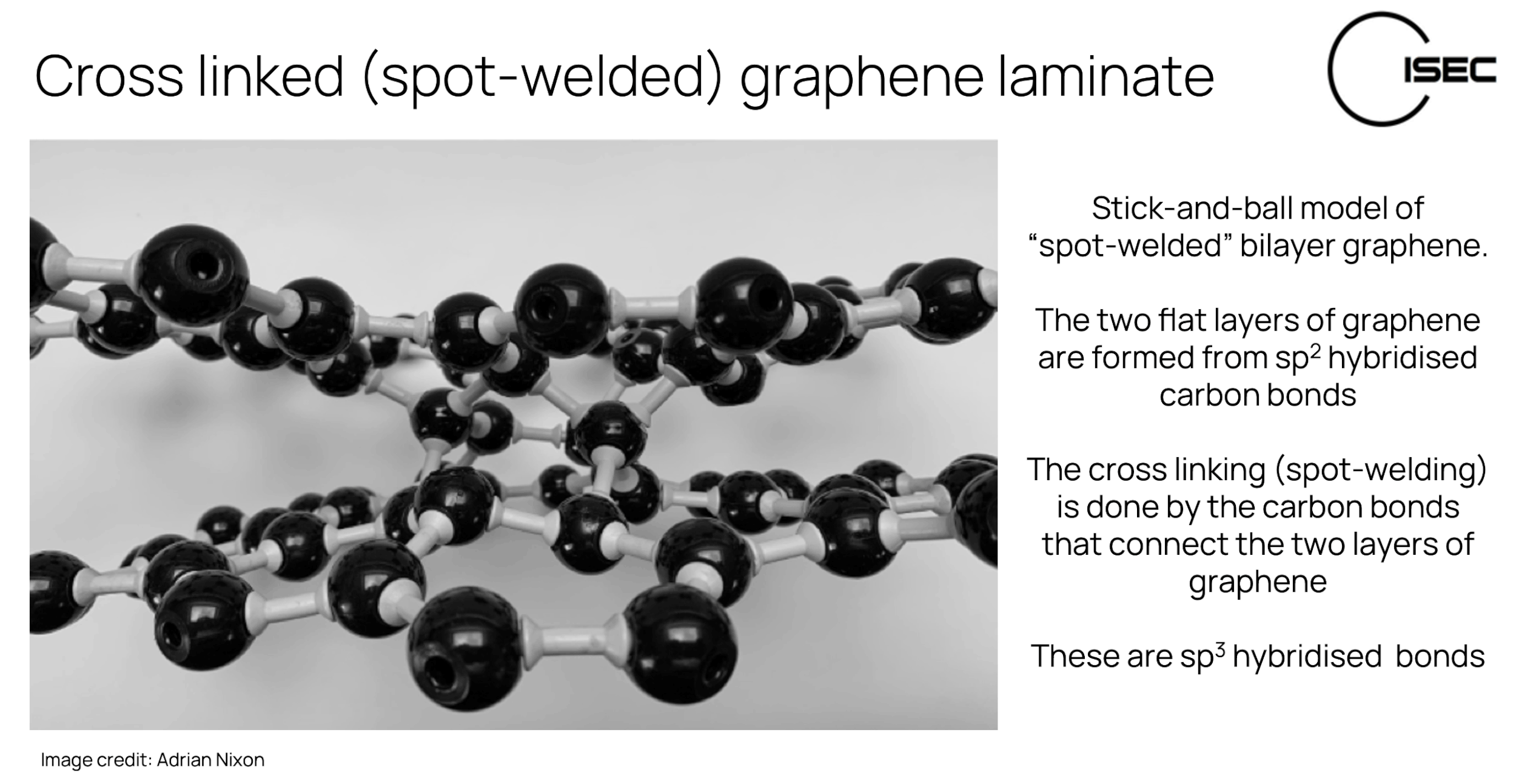
Fig.1: Stick-and-ball model of “spot-welded” multilayer graphene. The sp3 hybrid bonds are shown in the centre, between two layers of graphene.
This cross-linking has been achieved in several recent experiments, most recently by a team in China using high pressures 20 GPa and high temperatures of 1400°C [2]. Figure 2 shows a diagram summary of this work.
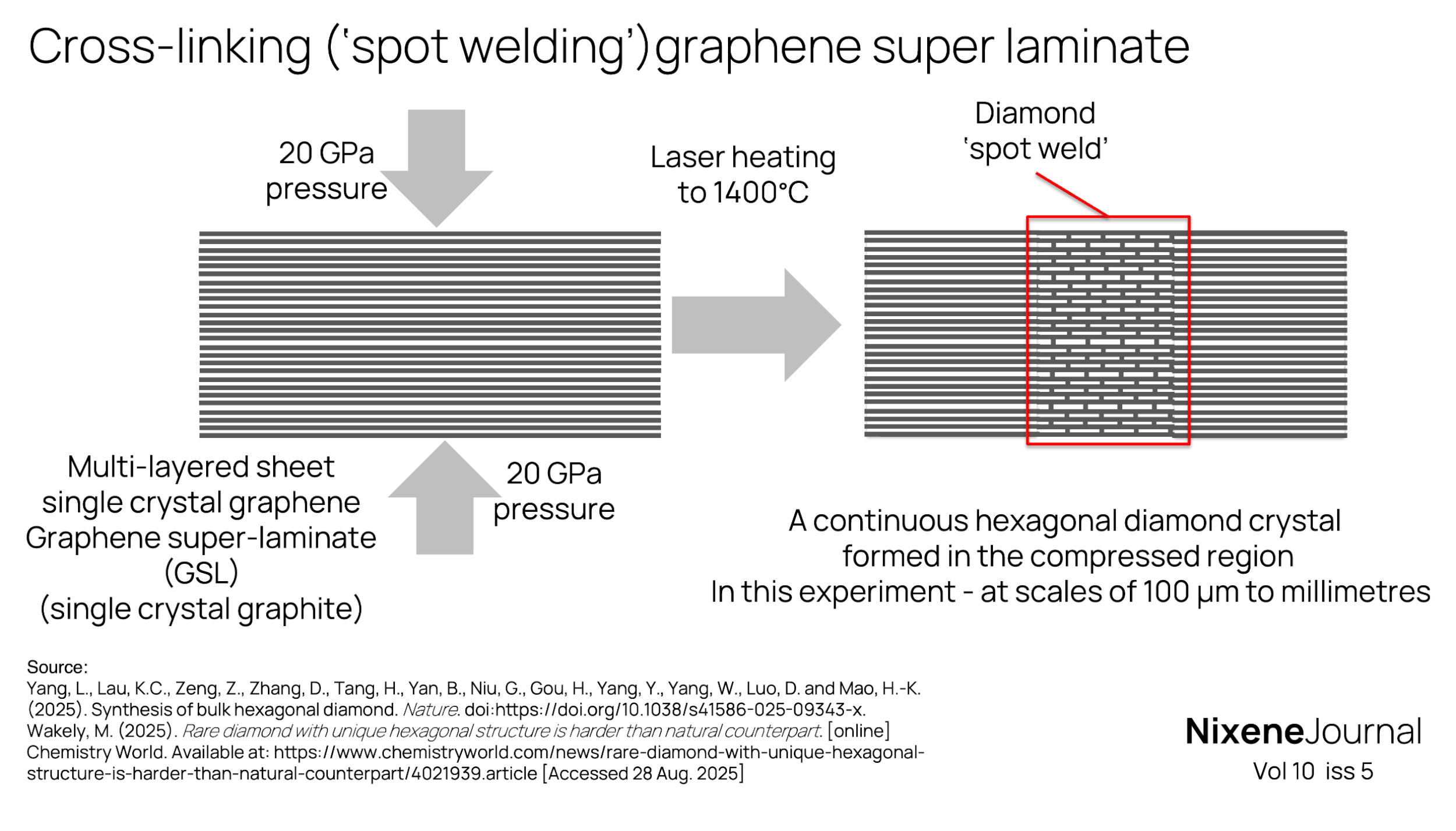
Fig.2: Cross linked “spot-welded” multilayer graphene.
Lateral heterostructures of graphene and hBN have been made and this opens the potential to create cross-links between the layers of different materials. At the time of writing these cross-linked heterostructures have not been made in the laboratory. However, we proposed a hypothesis that gamma radiation could be used to make the cross-links in graphene laminate and graphene-hBN laminates as this could be an industrially scalable process for spot welding the bulk material [3].
My colleagues, Larry Bartoszek and Dennis Wright, thought that using gamma radiation might be too extreme and create more damage than useful cross-links to a laminate structure. They prompted me to look at slightly longer wavelengths to achieve this cross-linking. Figure 3 shows the classification of parts of the electromagnetic spectrum.
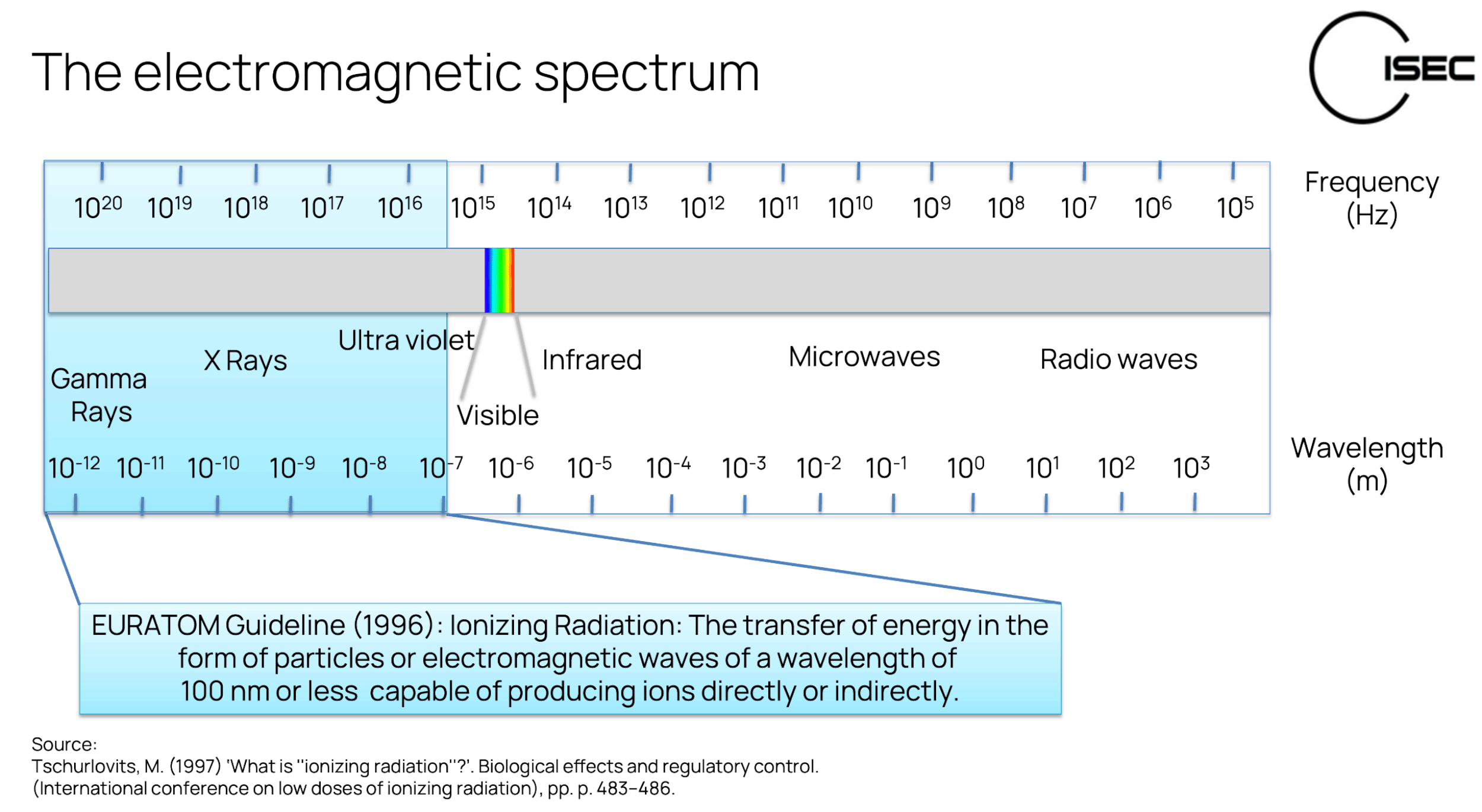
Fig.3 The electromagnetic spectrum.
The goal here is to cross-link a laminate structure of many thousands of layers of graphene and/or graphene and hBN. In the optical region of the electromagnetic spectrum graphene absorbs 2.3% of the incident light [4]. This means light in the optical region would penetrate 42 layers before being absorbed. Longer wavelengths are reflected highly and would penetrate even less than the optical region [5].
This leaves the ionising section of the electromagnetic spectrum, which is why we began thinking about gamma radiation. However, there are other parts of the spectrum that could be just as useful, in particular the X-ray region shown in figure 3 [6]. X-rays will penetrate many thousands/millions of layers of graphene depending on their wavelength and intensity [7]. We also know that the energy barrier for cross-linking single crystal graphene layers (sp² → sp³ transformation) is 3.5 - 4.5 eV (337.7 to 434.2 kJ/mol) [8,9].
We also know that grain boundaries in polycrystalline graphene and hBN contain Stone-Wales defects with strained bonding that make the 2D material more reactive and lower the energy required to convert the bonding from sp2 to sp3[10]. This means polycrystalline graphene and hBN will be easier to cross-link than the perfect single crystal material. However, at the time of writing no references exist that show this work has been done.
Putting all this together, we can propose a hypothesis that carefully controlled application of X-rays should have some promise to create the cross-linking required for making more mechanically robust 2D laminate materials. In particular, polycrystalline graphene and hBN laminates and combinations of the two materials should be capable of being improved by this treatment. The work has not been done at the time of writing, so we are right at the edge of what is currently known. We will continue to monitor the research to see if others follow our logic and perform these experiments in the laboratory.
References
1. Nixon. A., (2025b). Could a Tether Made from Multilayered Hexagonal Boron Nitride be Cross-linked to Spot-weld the Layers? [online] isec.org. Available at: https://www.isec.org/space-elevator-newsletter-2025-july/#tether.
2. Yang, L., Lau, K.C., Zeng, Z., Zhang, D., Tang, H., Yan, B., Niu, G., Gou, H., Yang, Y., Yang, W., Luo, D. and Mao, H.-K. (2025). Synthesis of bulk hexagonal diamond. Nature. doi: https://doi.org/10.1038/s41586-025-09343-x.
3. Nixon, A. (2023). How Ionising Radiation Affects Graphene Super Laminate. [online] International Space Elevator Consortium. Available at: https://www.isec.org/space-elevator-newsletter-2023-august/#tether.
4. Nair, R.R., Blake, P., Grigorenko, A.N., Novoselov, K.S., Booth, T.J., Stauber, T., Peres, N.M.R. and Geim, A.K. (2008). Fine Structure Constant Defines Visual Transparency of Graphene. Science, [online] 320(5881), pp.1308–1308. doi: https://doi.org/10.1126/science.1156965.
5. M. Said Ergoktas, Bakan, G., Evgeniya Kovalska, Le, L.W., Fields, R., Steiner, P., Yu, X., Ömer Salihoğlu, Sinan Balci, Vladimir Falko, Novoselov, K.S., Robert and Coşkun Kocabaş (2021). Multispectral graphene-based electro-optical surfaces with reversible tunability from visible to microwave wavelengths. Nature Photonics, 15(7), pp.493–498. doi: https://doi.org/10.1038/s41566-021-00791-1.
6. Tschurlovits, M. (1997) ‘What is ''ionizing radiation''?’. Biological effects and regulatory control. (International conference on low doses of ionizing radiation), pp. p. 483–486.
7. Karolina Filak-Mędoń, Fornalski, K.W., Bonczyk, M., Alicja Jakubowska, Kamila Kempny, Katarzyna Wołoszczuk, Filipczak, K., Klaudia Żerańska and Mariusz Zdrojek (2024). Graphene-based nanocomposites as gamma- and X-ray radiation shield. Scientific Reports, [online] 14(1). doi: https://doi.org/10.1038/s41598-024-69628-5.
8. Inami, E., Nishioka, K. and Kanasaki, J. (2023). Atomic-scale view of the photoinduced structural transition to form sp3-like bonded order phase in graphite. Scientific Reports, [online] 13(1), p.21439. doi: https://doi.org/10.1038/s41598-023-47389-x.
9. Conversion Factor: 1eV ≈ 96.485 kJ/mol
10. Seifert, M., Vargas, J.E.B., Bobinger, M., Sachsenhauser, M., Cummings, A.W., Roche, S. and Garrido, J.A. (2015). Role of grain boundaries in tailoring electronic properties of polycrystalline graphene by chemical functionalization. 2D Materials, 2(2), p.024008. doi: https://doi.org/10.1088/2053-1583/2/2/024008.
Astronomia Interview of Larry Bartoszek
Larry Bartoszek, VP of ISEC, was interviewed by Maciej Draws, a Polish writer for the astronomy magazine Astronomia. The April, 2026, edition of the magazine can be purchased in Polish from the publisher at https://astronomia.media.pl/, but the publisher has given us permission to share the machine translated English version of the article. Maciej asked many good questions about the space elevator. The article is a good primer on how space elevators work and what some of the challenges are. The English version can be found at https://www.isec.org/s/Astronomia-ISSUE-4-166-APRIL-2026.pdf.
Around the Web
Graphene continues to make headway and headlines. Check out this article titled, "Graphene-ITO Electrodes Show Promise for More Efficient Space Solar Power"on how graphene synthesized with Indium Tin Oxide can be used to make solar cells lighter and more efficient for aerospace applications:
Upcoming Events:
If you have a new idea or concept, or simply a new take on an existing idea, the three main Space Elevator events this year are now all open for abstract submission.
International Space Development Conference 2026
Sponsored by the National Space Society
https://www.isec.org/events/isdc2026
Thursday, June 4th, through Sunday, June 7th, 2026
Space Elevator Session, Saturday, June 6th
Hilton McLean Tysons Corner, Virginia
Virtual ISEC Space Elevator Conference 2026
Sponsored by the International Space Elevator Consortium
https://www.isec.org/events/isec2026
Saturday, September 12th, through Sunday September 13th, 2026
+ Abstracts for our Space Elevator conference are due by June 1st
77th International Astronautical Congress
Sponsored by the International Astronautical Federation (IAF)
https://www.iac2026.org/iac-2026
https://www.isec.org/events/77th-international-astronautical-congress
Theme: “The World Needs More Space”
October 5th through October 9th, 2026
Antalya, Turkey
78th International Astronautical Congress
Sponsored by the International Astronautical Federation (IAF)
https://www.isec.org/events/iac2027
Monday, September 27th through Friday, October 1, 2027
Poznań, Poland
Contact Us:
Our website is www.isec.org.
You can find us on Facebook, X, Flickr, LinkedIn, Instagram, YouTube, Mastodon, Threads, Bluesky and Reddit.
Support us:
Sign up to be a member at: https://www.isec.org/membership
You can also give directly using the “Donate” link at the bottom of our website page.
Does your place of employment do matching funds for donations or volunteer time through Benevity? If so, you can make ISEC your recipient. Our 501(c)(3) number is 80-0302896.