
International Space Elevator Consortium
December 2025/January 2026 Newsletter
In this Issue:
Editor's Note
Presentation at Manchester Lit & Phil
Academic Challenge 2026 Abstracts
ISEC Terminology
Chief Architect’s Corner
WSPEC 2025: Overview
Space Elevator Design Verification
Tether Materials
Space Elevators in the Movies
History Corner
ISEC Presents at Chinese Symposium
Around the Web
Upcoming Events
Contact Us
Dear Space Elevator Enthusiasts,
With the winter holidays in full swing and this year coming to a close, we hope this longer than usual Newsletter will tide you over for the end of 2025 and beginning of 2026. As in years past, we will not have a January issue grace your inboxes (unless something incredibly important pops up) to allow for our usual break for the newsletter contributors and editors.
In the meantime, enjoy the holidays and have a happy new year!
Emily Fisher
Junior Newsletter Editor
Presentation at Manchester Literary and Philosophical Society 2025
by Adrian Nixon
Author Gurbir Singh invited Rob Whieldon and Adrian Nixon to present to the prestigious Manchester Literary and Philosophical Society (Lit & Phil) about graphene and the space elevator. Founded in 1781, the Manchester Literary and Philosophical Society is almost 250 years old and the second oldest such society in the world after the Royal Society. Scientists such as John Dalton, James Joule, and Alan Turing were members, and Rutherford and Bragg were distinguished visitors, so both the atom and the nucleus were conceived in their shadow. Today, the society is a non-profit-making charity which arranges about 30 events each year for the general public on Science and Technology, the Arts, and Social Philosophy. The Society has about 350 members, and non-members also attend. They strive to attract people from all parts of society, especially younger visitors, to the meetings.
More information can be found about the Lit & Phil on their Wikipedia page (https://en.wikipedia.org/wiki/Manchester_Literary_and_Philosophical_Society), and on their website (https://www.manlitphil.ac.uk/events/).
We had big shoes to fill. No pressure, then!
There was so much interest in our topic that the Lit & Phil had to book the Reynold Theatre on the UoM campus (near the Graphene Engineering Innovation Centre, or GEIC building).
Rob presented about graphene and its applications and Adrian followed with a briefing for the audience about the science and technology for the ultimate application: the space elevator.
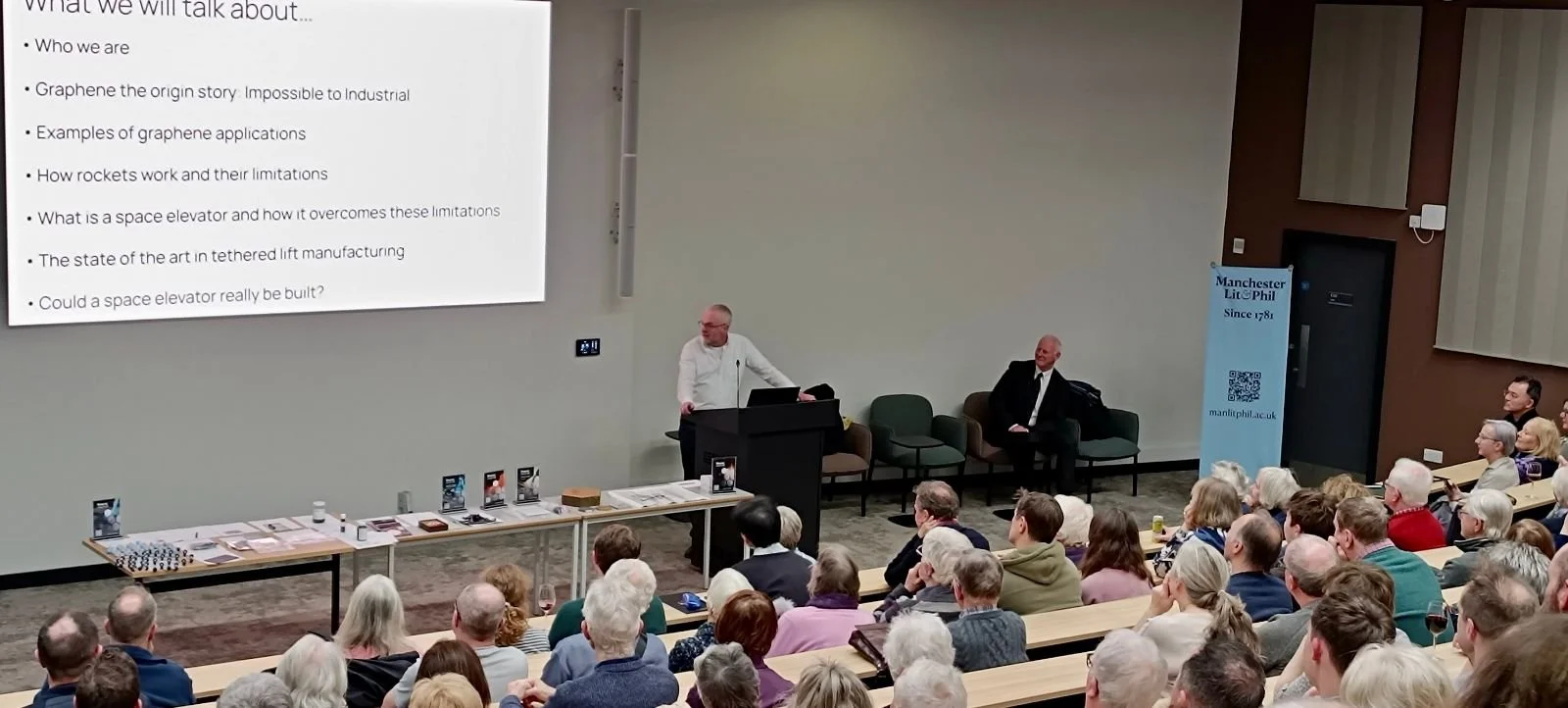
Rob Presenting to the Manchester Literary and Philosophical Society. Image Credit: Gurbir Singh.
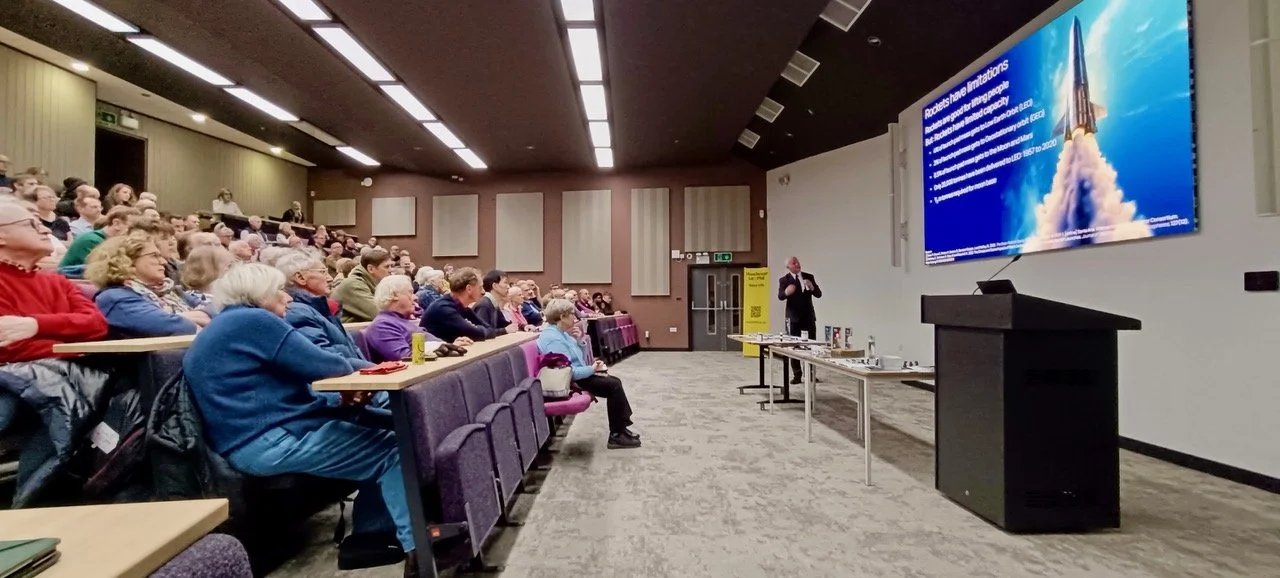
Adrian Presenting to the Manchester Literary and Philosophical Society. Image Credit: Gurbir Singh.
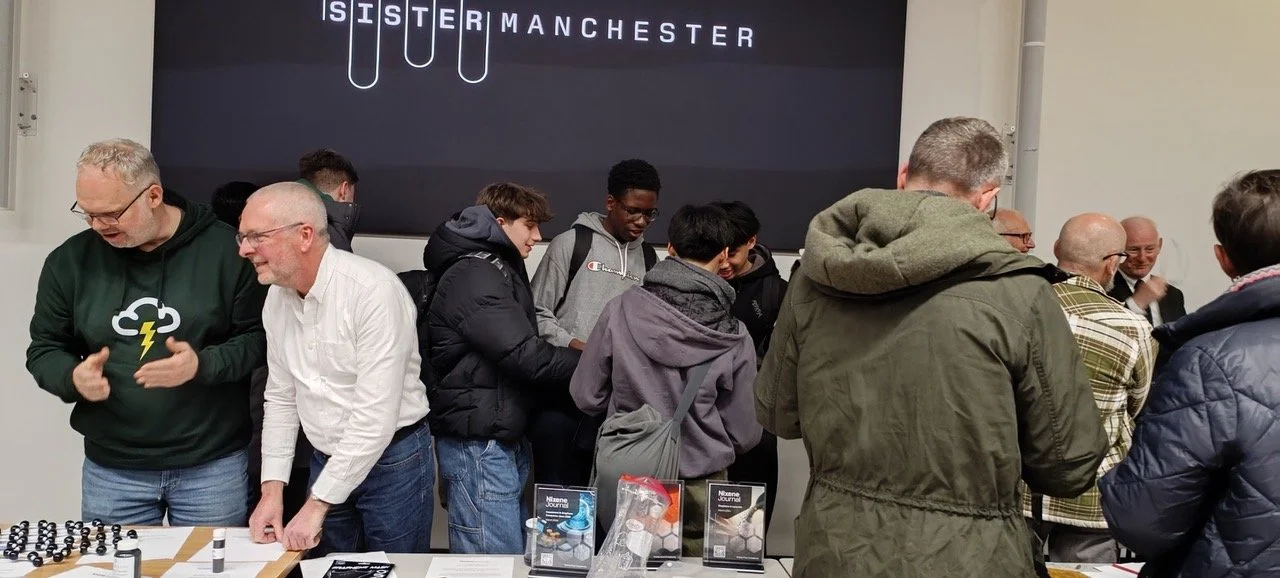
Rob and Adrian mobbed by the audience at the end of the event. Image credit: Gurbir Singh.
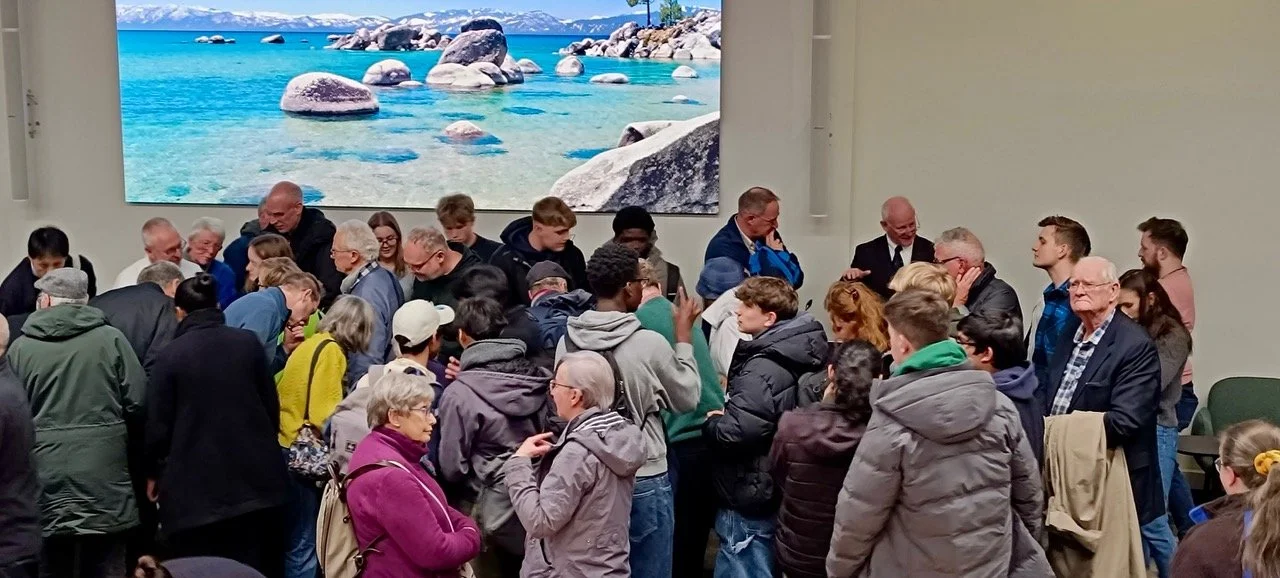
The mob thickens. Image credit: Gurbir Singh.
This is what Gurbir told us after the event:
“The presentation styles, beautifully illustrated slides, and your ability to describe inherently complex technology in an accessible way to a large and disparate audience were a terrific achievement. The combination of deep personal knowledge, hands-on experience, and technical insights is the sort of combination we seek for these public events. You hit all the marks - thank you.
“Whilst you were both "mobbed" after the presentation - see the photos - several people came up to me and expressed their enjoyment of your presentation. One mother told me that she had never seen how engaged her son was. There were several students (from Loreto Sixth Form College) who already contacted me requesting your PDF.
“On behalf of the Manchester Literary and Philosophical Society, thank you both for an excellent evening.”
Looks like a job well done.
Academic Challenge 2026
by Dr. Paul Phister, Chair, Academic Challenge 2026
In July 2025, we announced this topic:
Utilizing AI Technologies for a Space Elevator Mission – Planetary Defense
Our announcement went out on 18 Aug. 2025 as follows:
The International Space Elevator Consortium (ISEC) and the National Space Society (NSS) want to explore “Planetary Defense". How the Space Elevator system can enhance the safety of Earth is explored by high school and university students to design key elements using AI technologies towards Planetary Defense. As people begin to live and work in space this provides a unique capability to develop systems, on Earth, journey to orbit, in orbit on the Apex Anchor, or further out into space that can provide early warning and negation of threats to Earth. By researching and designing the infrastructure necessary to provide a planetary defense system, students contribute to solutions that benefit people living on Earth, the Moon, or Mars.
Winners will receive $2,000 USD for 1st, $1,000 USD for 2nd, and $500 USD for 3rd.
The timeline for the Academic Challenge 2026 is as follows:
1. Announcement of Space Elevator Academic Challenge 2025 — 01 September 2025
2. Submission of Abstract to enter this year’s competition — 15 September 2025
3. Paper submissions — 15 January 2026
+ Finalist selection, notification (top 10 each challenge) — 01 February 2026
4. Finalists’ audio/video submission — 15 February 2026
+ Final Selections (top 3 of each challenge) — 01 March 2026
5. Potential invitations to attend NSS Conference (High School) — June 2026
6. Potential Invitations to attend ISEC Conference — September 2026
Our first milestone was met on 15 September 2025 where we received ten abstracts. By 15 January 2026 we expect to receive ten papers to be evaluated for the three prizes.
The ten abstracts that we received are:
ABSTRACT-1: Asteroid Interception System (AIS): Planetary Defense and the Space Elevator: Building Earth’s Shield
Humanity’s survival depends on its ability to defend Earth from the silent but inevitable threat of asteroids and comets. Planetary defense has long relied on concepts such as deflection, kinetic impactors, or nuclear devices—but the true challenge has never been the weapon itself, it has been our ability to reach space with the scale, speed, and resources required. Rockets alone cannot provide this. Among the most transformative technologies proposed for this mission is the space elevator, which would provide continuous, affordable, and large-scale access to space. The space elevator, with its Apex anchor facility, however, changes everything. By enabling the transport of massive payloads, infrastructure, and resources far more efficiently than rockets, the space elevator could become a cornerstone of a robust planetary defense strategy. Traditional asteroid defense concepts—such as deflection by gravity assist, kinetic impactors, or nuclear devices—require the rapid deployment of heavy and complex systems into space. Today, such launches are costly, limited in scale, and time constrained. With the advent of a space elevator, however, we could establish a permanent capability to assemble and deploy defense platforms in orbit or beyond. We propose a planetary defense architecture built on three pillars: (1) early detection, using space- and ground-based telescopes guided by advanced AI to continuously map asteroid trajectories; (2) modular assembly of defense assets, defined as battle stations permanently in space at convenient locations, enabled by the space elevator and its Apex anchor facility, where massive components could be transported from Earth and assembled in orbit; and (3) forward-deployed battle stations, positioned at translunar and -or Earth–Moon libration points. Each station, estimated at 50,000 tons, would carry missile interceptors equipped with extremely powerful nuclear bombs, plus propulsion, navigation, and guidance systems, ready to intercept threats as far as possible from Earth. The space elevator makes the AIS system not only technically feasible but economically viable. By eliminating launch bottlenecks, it allows repeated deployment, resupply, and scaling of planetary defense infrastructure. At the same time, the Apex facility would allow convenient housing in space for all assembly activities that would also be performed by advanced AI. Human operators and advanced AI would jointly oversee assembly and maintenance, while AI systems would manage rapid response operations. Such system, after being conveniently tested on a NEO asteroid will be permanently in space, ready to intercept any threatening asteroid, even with few days’ notice. In this way, the space elevator transforms planetary defense from a series of emergency measures into a sustainable, proactive shield for Earth—providing humanity with a realistic, affordable, and resilient means of facing future asteroid threats.
ABSTRACT-2: Design of an AI-Driven Apex Hub Control System for Autonomous Interceptor Operations in Planetary Defense
Conventional planetary defense architectures will continue to face limitations arising from their dependence on ground-based detection systems and rocket-launched interceptors. These systems are constrained by launch readiness, limited deployment frequency, and lengthy decision-making cycles. This paper will present a conceptual framework for an AI-driven control system located at the Space Elevator’s Apex Hub, offering a transformative alternative to traditional, Earth-bound defense systems. The Apex Hub, positioned in geostationary orbit, will function as a permanent, powered, and logistically connected command node for planetary defense. Its stationary position relative to Earth will enable continuous line-of-sight coverage over vast regions of space, minimize communication latency, and allow the pre-positioning and maintenance of interceptor assets without the recurring cost or delay associated with launch vehicles. This architecture will shift planetary defense from a reactive, launch-based model to a proactive, pre-deployed defense posture capable of immediate response. Artificial Intelligence will serve as the core enabler of autonomy within this system. AI algorithms will fuse multi-source sensor data, predict the trajectories of potential threats, prioritize risks, and coordinate multiple interceptor units simultaneously. The integration of AI will enable the Apex Hub to make rapid, independent, and reliable decisions in real time, even under degraded communication conditions or during high-threat situations. By combining the Space Elevator’s persistent orbital infrastructure with AI-enabled decision systems, this approach will offer significantly faster response times, greater operational availability, and reduced long-term costs compared to conventional planetary defense architectures. The proposed system will represent a strategic evolution toward a continuous, intelligent, and sustainable defense paradigm, enhancing Earth’s preparedness against near-Earth objects and other extraterrestrial threats.
ABSTRACT-3: A.E.G.I.S. (AI-driven Earth Guard Interception Shield) Integrated System for NEA Mitigation, Space Debris Recycling, and Space Weather Protection
Near-Earth Asteroids (NEAs), hazardous space debris, and intense space weather phenomena such as solar flares represent critical internal and external threats to both planetary security and the long-term sustainability of space exploration. Given the catastrophic potential of an NEA impact, prevention and mitigation are of the highest priority. This paper proposes an integrated and sustainable planetary defense system designed not only to comprehensively mitigate these diverse threats but also to repurpose the recovered materials for future space infrastructure development. The system employs Artificial Intelligence (AI) for high-precision NEA orbit determination and trajectory prediction. Once analyzed, the asteroid is neutralized through a Slingshot mechanism. The resulting fragments—along with pre-existing space debris in Low Earth Orbit (LEO) and Geostationary Orbit (GEO)—are then efficiently collected by specialized space elevator climbers equipped with parabolic capture mechanisms. Importantly, the recovered NEA material and debris are treated as valuable resources. These materials are transported to a GEO-based processing station, where they are refined into construction-grade materials to be used alongside resources mined from other celestial bodies, thereby supporting the expansion of human presence in space. Furthermore, the system incorporates advanced defenses against space weather. AI continuously monitors and forecasts solar activity. When a potentially disruptive event is detected, a large-scale magnetic shield—anchored by an Apex Anchor—is deployed to minimize damage to both orbital and planetary assets. This dual-use architecture transforms planetary threats into opportunities, establishing a sustainable framework in which defense against external hazards simultaneously drives and funds the next generation of space development.
ABSTRACT-4: EXELIXIS
Our technical proposal consists of 2 sections, one from Terra to GEO (0 km - 36,000 km) based on elevators pulled up by cables, and the second one, from GEO to 147,900 km based on magnetic technology. The first section functions as a set of cable cars that can be attached or detached from the cables, allowing them to be loaded as requested, thus eliminating the need to stop the movement of the cables. The cable cars are placed simultaneously on four cables in the upper points by using cable grabs with snap hooks, and then raised, while the four lower cable grabs secure the elevator. After moving the cable car to only one single cable connected to the car’s top center and disconnecting it from the four constantly moving cables, the cable car will be detached from the cables, at both ends of the circuits, by using a customized Desmodromic system from MotoGP races, where the double camshaft has the advantage of closing the valves without delay. This system will allow the constant dispatch of elevators, as well as their movement at different speeds and would save electricity. In GEO there will be a residential area with living spaces, technical labs, and entertainment areas. From GEO to 147,900 km, there will be less traffic, so we imagine another transportation section based on superconducting magnetic trains and magnetic coils, for low temperatures and precision on the elevator's ascent axis. This system will also be used as a coil gun for launching probes. As a defense system for the elevator, we will place probes at different altitudes, opposite the elevator's construction site, equipped with AI sensors to detect and monitor space debris. These probes operate independently, ensuring orbital surveillance and preventing space debris from hitting the elevator. Extended to geostationary orbit, it would support distributed sensors, interceptor platforms, a momentum exchange tether, and a mechanism similar to a coil gun using our elevator’s magnetic rail system as a launch kinetic projectile. The sensors would deliver continuous coverage, enabling better tracking of near-Earth objects or orbital debris. AI would facilitate all parts of an interception mission: real-time filtering of information and object recognition to reduce bandwidth, onboard autonomous guidance for mission, high-quality trajectory simulations, evaluating interception or deflection options, and output defense plans for human review.
ABSTRACT-5: Orbital Planetary Defense: AI-Driven Detection, Strategy, and Response
Since the development of artificial intelligence, we have been at the forefront of a technological revolution. AI is transforming much of society, but its applications in planetary defense are among most vital. There are three core functions in which AI will be used to protect the planet: performing data analysis and strategy development, and executing offensive and defensive strategies. These capabilities would be concentrated in two planetary defense space bases that orbit opposite sides of Earth. These bases will be home to military personnel assigned to this mission, data centers that run the planetary protection AI, and the artillery needed for offensive attacks. The space elevator will be utilized to construct and resupply the bases. Its need is especially emphasized to keep the data centers running.
Data Analysis and Strategy Development: Managing vast amounts of data requires optimizing data ingestion. AI systems will standardize and tag incoming data, remove noise, and correlate multi-sensor observations. Over time, the AI will identify patterns, maintain object catalogs, and improve tracking and classification. Utilizing simulation and forecasting models, the AI can generate a range of defensive and offensive scenarios. The AI will produce an executable response to each of the simulations which will be vetted by chief officers. There will be systems in place to allow for less human governance as confidence grows in AI developed response strategies.
Defensive: Defensive operations rely on continuous monitoring to detect anomalies and rapidly assess risk. Utilizing a variety of sensors, AI can process exuberant amounts of data. It would create a tiered threat detection that would be accompanied by confidence levels and provenance. Example alert levels are as follows:
● Red: Urgent threat - defensive maneuvers engaged.
● Yellow: Anomaly detected - chief officers alerted for further assessment. Over time, the AI’s ability to detect threats and decrease uncertainty will improve. Additionally, AI serves as a safety aid to those on Earth and on the bases. Defensive protocol will include emergency alerts and evacuation systems for those at risk. By estimating potential impacts and casualties, the system can help prioritize notifications and resource allocation to minimize harm.
Offensive: Strong offensive strategies are necessary due to the urgency of these threats. AI developed strategies to produce executable plans. These will vary depending on the desired aggression of the attack. The AI can assist in recommending different timelines for attacks and their likely outcomes, but a chief officer must approve of the course of action. Their decision will be aided with a numerical score that demonstrates the net cost associated with each attack. Each strategy will receive a number that quantifies the resources needed for a specific offensive maneuver in relation to the predicted opponent damage.
ABSTRACT-6: GaiaNet: A Global AI–Elevator Defense Ecosystem
The Space Elevator is a game-changing infrastructure for continuous, efficient, and low-energy access from Earth to space. Building off this opportunity, GaiaNet proposes a next generation planetary defense architecture that integrates artificial intelligence (AI) at three operational levels — Earth AI, Apex AI, and Orbit AI — enabled by Quantum secure communication networks along the elevator tether. At the Earth level, AI prediction systems are continuously monitoring multi-sensor data from telescopes, radars, and satellites to detect and classify potential threats to Earth in space, including asteroids, space debris, or solar storms. After classifying a potential threat, the Apex Anchor contains the Apex AI, which develops mission planning, logistics and multi-objective optimization to establish the most effective mitigation plan, if a response is necessary. The Orbit AI layer consists of modular autonomous robotic swarms that we deploy to respond to the threat in orbit from the elevator: kinetic deflection, debris capture, shielding, in-orbit repair, etc. The distributed AI agents can communicate through a quantum secure network that enables low-latency, tamper-proof coordination of the autonomous systems. Additionally, a Living Planetary Defense Map (PDM) will visualize threat trajectories, relevant system status, and mission outcomes to promote transparency and global collaboration. The architecture embodies distributed AI agent cooperation, hierarchical decision making, redundancy in orbit, and modular adaptability, providing a scalable framework for continuous planetary protection. GaiaNet's defense ecosystem leverages advance in physically feasible AI technologies with the logistical and energetic advantages of the Space Elevator to create a resilient and sustainable defense ecosystem that protects Earth against natural and human-made space hazards. This concept presents how a future AI–Elevator synergy would facilitate the shift to autonomous global stewardship and from a prior art to planetary defense from a response as needed emergency basis.
ABSTRACT-7: Infrastructure for Defensive AI Sensors - Revolutionizing Space Elevators Toward Planetary Defense
In an age of expanding presence throughout the universe, space elevators are present as a key invention toward novel steps forward. Within the wake of the exponential development in artificial intelligence, we see a clear pathway to revolutionize planetary defense within these two frameworks: harnessing AI technology through the elevator and satellites to ameliorate spatial domain awareness (SDA). According to the Center for Security and Emerging Technology, space domain awareness encompasses several subdisciplines: detection, tracking, identification of resident space objects, characterization, threat warning and assessment, and data integration and exploitation.1 However, given the accelerating speed of satellite launches (with over 10,000 active satellites in 2024), but outdated SDA infrastructure (with the number of “near-miss” incidents of the satellites rising by over 250% between 2020-2023), the stress on the Space Force continues to increase.2 Artificial intelligence presents a unique and powerful opportunity to optimize how we sense orbiting objects. With its accelerated computing and predictive capabilities, our mission employs spatial sensors on the space elevator and uses its transportation capabilities to build a stronger infrastructure to house AI sensors. By integrating the sensors into the elevator’s architecture (and using the elevator’s trajectory to collect data and distribute sensors throughout the space zone), our vision for sensors’ implementation is in harmony with the elevator, rather than independent. The elevator’s unique position contributes to collaboration between countries toward a communal goal in space, which is necessary given how far-reaching AI is during this time and place. If there is one thing, we should strive toward international collaboration, it is for the mutual defense of our planet. We see planetary defense as a mission that lends itself toward geopolitical collaboration like no other, and by integrating AI, we can accelerate, and thereby ameliorate, our understanding of how to defeat the spatial threats that present themselves.
ABSTRACT-8: AI-Integrated Space Elevator-Basted Planetary Defense System
It is estimated that several thousand asteroids pose a potential risk of approaching or even colliding with Earth in the future. To prevent such events, early detection, precise observation, and highly accurate orbital prediction are essential. Asteroids within the solar system absorb thermal energy from the Sun and emit infrared radiation, which allows observation from ground-based telescopes. However, to achieve greater precision in asteroid observation, simultaneous observations from two or more widely separated points are required to construct a complete three-dimensional orbital diagram. Our proposed space elevator–based planetary defense system utilizes the advantages of the space elevator structure to achieve this goal. The elevator features a tether length of 147,900 kilometers and a rotation radius of approximately 150,000 kilometers. By installing an infrared telescope at apex anchor, it can establish a baseline distance of observation 300,000 kilometers with coordination with ground-based observatories. This configuration enables 360-degree observation and, when integrated with an AI-driven analysis system, allows real-time orbit prediction with accuracy surpassing any existing Earth-based observation facility. When an asteroid on a potential collision course with Earth is detected, a series of AI-guided interception rockets will be deployed. They are initially laser-deflection rockets, followed by heavy impactor rockets if necessary. In Interception Stage 1, multiple laser-equipped rockets melt away at a single point, causing vapor thrust, altering the asteroid’s trajectory. If the change remains below the threshold, Stage 2 is activated, where heavy impactor rockets collide directly with the target to enforce a significant orbital shift. The heavy impactor rockets, launched from the space elevator’s apex anchor achieve an initial velocity of 11.2 km/s (Earth’s escape velocity). Because kinetic energy increases with the square of velocity, their impact energy far exceeds that of any ground-launched system, providing the final and most decisive means to alter an asteroids path. This concept not only enhances planetary defense capability but also demonstrates a novel and high-value application of the space elevator infrastructure, expanding its role far beyond transport as a global safeguard for Earth’s future.
ABSTRACT-9: TEAM AETHERIA
The space elevator is a novel concept that has the potential to revolutionize how humans' access and use space. The elevator, made of an ultra-strong material such as single-crystal graphene super composite, would have a rope reaching around 100,000 kilometers from Earth's surface to a counterweight in orbit. Capable of lifting roughly 170,000 metric tons each year equivalent to thousands of rocket launches. It provides a safe, cost-effective, and environmentally sustainable route to space. Beyond transportation, such a system might be used as a strategic platform for planetary defense, addressing the mounting threats posed by asteroids and orbital debris. This proposal investigates how Artificial Intelligence (AI) technology can be combined with a space elevator to improve planetary defense operations. AI systems might handle continuous observation of near-Earth objects (NEOs) via satellite constellations distributed by the elevator, allowing for early detection, tracking, and categorization of possible hazards. In the case of a detected hazard, AI-guided algorithms might design and coordinate the rapid deployment of deflection payloads or intercept missions via optimal orbital pathways, significantly lowering response times. Furthermore, AI has the potential to significantly improve the safety and performance of the elevator itself. Using predictive maintenance models and deep learning analytics, the system could detect stress concentrations, microfractures, and vibration anomalies in the tether. This proactive approach would improve reliability during continuous cargo operations while also ensuring the long-term stability of the infrastructure. By combining a space elevator's enormous logistical possibilities with intelligent, adaptable AI systems, humanity may create a resilient framework for planetary preservation. This design envisions a future in which sophisticated automation, sustainability, and large-scale space engineering work together to protect Earth while opening up new avenues for exploration and creativity. The proposal aims to highlight the feasibility and impact of such integration, presenting the space elevator not merely as a transport mechanism, but as a cornerstone of next-generation planetary defense
ABSTRACT-10: APEX Sentinel Array
This paper presents the Apex Sentinel Array, a three-module, self-sustaining planetary-defence and orbital-resource architecture integrated into the main tether of a space elevator. The first module, the Planetary Defence Compartment, houses a high-temperature superconducting electromagnetic railgun engineered to launch dense tungsten kinetic impactors for momentum-transfer asteroid deflection. Tungsten is selected for its high density, mechanical robustness, and cost-effectiveness at the small masses required for precise orbital nudging. Co-located quantum-gravity sensors—based on cold-atom interferometry—provide early detection of local gravitational anomalies from near-Earth objects, complementing optical tracking when targets are obscured or poorly illuminated. Target assessment and mission planning are managed by a neuromorphic AI system, with human authorisation required for all defence actions.
The second module, the Resource Capture and Control Compartment, incorporates the system’s neuromorphic AI core, distributed solar arrays, and a network of bio-inspired micro-tether collectors that acquire metallic debris (space junk) and small asteroid fragments. These materials are delivered to the Docking and ISRU Module, which houses the system’s dual-use elevator. The elevator transports both civil spacecraft and packaged mineral/debris cargo to and from Earth. Within the docking module, a compact ISRU unit performs laser-based thermal processing on carbon-bearing asteroid fragments and composite debris, using focused laser heating in vacuum to drive off volatiles and produce carbon-rich residues. These residues are bound into lightweight ablative tiles and thin carbon-membrane decelerators that form the thermal protection and aerodynamic braking systems of controlled-descent return capsules. Such capsules are used when exporting bulk material that would exceed elevator down-mass or scheduling capacity, allowing large quantities of metal to re-enter and land safely without overloading the tether. Raw metallic material is otherwise packaged for direct elevator transport to Earth, where conventional industry performs full refinement. This hybrid architecture enables the Apex Sentinel Array to supplement its economic operation with space-derived metals and gradually reduce reliance on Earth-sourced materials. The third module, the Docking, ISRU, and Tether Reinforcement Compartment, supports the dual-use climber, which uses a hybrid magnetic-assisted propulsion system. Superconducting magnetic stabilisation coils and inductive power interfaces embedded within the tether provide low-friction alignment, efficient ascent, and smooth, controllable descent. During descent, magnetic regenerative braking recovers energy for station operations. Every elevator mission employs an integrated tether-reinforcement unit, which activates during the slow descent phase to deposit carbon-based compounds and thermally bond them onto the graphene-composite tether. This continuous deposition process strengthens the tether over time, ensuring that the structure becomes more robust the more it is used. Maintenance micro-robots support ongoing inspection, cleaning, and localised repair.
Powered primarily by distributed solar arrays and regenerative braking, the Apex Sentinel Array functions as a self-sustaining orbital ecosystem. It mitigates asteroid risks through precision kinetic impact, clears hazardous orbital debris, exports high-value materials, reduces reliance on terrestrial mining, enables energy-efficient spacecraft departures from the apex, and autonomously maintains and reinforces its tether. By integrating quantum sensing, kinetic-impact physics, laser-based ISRU, hybrid magnetic-assisted elevator propulsion, AI-coordinated resource capture, and continuous tether reinforcement, this work demonstrates how a space elevator can evolve into a planet-defending, economically regenerative, and environmentally transformative infrastructure for humanity’s future.
ISEC Terminology
by Pete Swan
“Apex Anchor”
Located at the end of Space Elevators providing a space port which enables release, capture, refueling, assembly, repair, and as a way station for customers’ space systems. While acting as a counterweight for system stability, it will fulfill these multiple roles as well as reel-in/out, while fulfilling many operational missions, such as communications, navigation and planetary defense.
Chief Architect’s Corner
by Pete Swan
Update on Terminology
I am looking for newly leveraged words to help define our mission of developing Modern-Day Space Elevators. Please consider submitting your favorite words that should be included in our ISEC Lexicon. I am especially curious about the words that will surface during and after our tether climber power study. Which words deserve identification as significant to our mission?
I feel it is very important that we all use similar terminology for Modern-Day Space Elevators conversations, articles, and presentations around the globe. We are making great progress in understanding and describing our future mega-project; however, we should make sure we use a common set of terms to express our strengths. We are going to operate in and through space alongside advanced rockets; so, we must have a vocabulary that is similar – but also unique. As such, I am asking you to help me set up a lexicon reflecting our recent studies, research, and articles published around the world. There are three steps in this process:
Step ONE: I have started a monthly “ISEC Terminology” spot in our newsletter. This will be a method to share the Chief Architect’s understanding of our knowledge base and how we express the subtle differences from rockets. Last month’s term was “Modern-Day Space Elevators” explaining how we have moved forward significantly. This month’s submission is on the word “Apex Anchor”. Each of these terms has unfolded from ISEC’s sixteen research studies and discussions within our community.
Step TWO: Have a review of the Lexicon currently on our website and update items to reflect our progress. (see below for recent suggestions)
Step THREE: There will be additional updates to the Lexicon on the website in the near future resulting from this initial call for words and then continuous updates as we mature our concepts. (Chief Architect is now asking for your help with inputs and then will maintain the website’s currency.)
OK back to Step TWO – Here are the new and improved recent updates to our Lexicon on our website. Please review, comment and suggest new ones. Remember, compare your thoughts with the full list on our website.
Updates to the ISEC Lexicon (as of 5 Dec 2025)
Apex Anchor: Located at the end of Space Elevators providing a space port which enables release, capture, refueling, assembly, repair as well as acting as a way station for customers’ space systems. While it is a counterweight for system stability, it also fulfills these multiple roles as well as reel-in/out, with many operational missions, such as communications, navigation and planetary defense.
BNNT: Boron nitride nanotubes (BNNT) – Hollow cylinders made up of alternating atoms of boron and nitrogen connected in a hexagonal pattern (a rolled-up sheet of hBN) with diameters in the range of 0.5 to 3.0 nanometre.
GEO Node: A complex of Space Elevator activities positioned in the Space Elevator GEO Region of the Geosynchronous belt (36,000 kms altitude); directly above an Earth Port. In addition, its role will include support to customers such as release, capture, storage, assembly, repair, refuel, and operations.
Graphene: Graphene – a flat, two-dimensional (2D) material made of carbon atoms arranged in a hexagonal crystal structure. A unique material with extremely high tensile strength, conductivity, resilience to outside influence, and (in 2025) produced at 1,000 meters out of the laboratory. There are three categories of Graphene with the latter two potential materials for space elevator tethers.
+ Graphene Powder: Graphene powder – Made of small particles that are not connected together, and used as additives in other materials, not for the space elevator tether.
+ Graphene Laminate: Graphene Laminate (GL) - Large scale sheets of polycrystalline graphene (graphene with crystal grain boundaries) stacked in a van der Waals homostructure – GL with no vacancy defects – the individual crystal domains are connected with covalent bonds – this is suitable for space elevator tethers (100 GPa),
+ Super Laminate Graphene: Graphene Super Laminate (GSL) – large scale sheets of single crystal graphene with no vacancy defects stacked in a van der Waals homostructure, leading to the highest tensile strength (130 GPa) – suitable for tethers.
Green Road to Space: Insures environmentally neutral operations as a Green Road to Space as it does not burn rocket fuel in our atmosphere nor leave debris along its path.
hBN: Hexagonal boron nitride (hBN) – A flat, two-dimensional (2D) material made of alternating boron and nitrogen atoms arranged in a hexagonal crystal structure.
Lunar Gates (Moon Gate): Release Points towards the Moon – roughly 47,000 kms altitude is the lowest release to the Moon, with the highest at the Apex Anchor – as you raise the release point, the velocity increases and time to the Moon decreases to as little as 14 hours.
Mars Gates: Release Point towards Mars – roughly 57,000 kms altitude is the lowest release to Mars, with the highest at the Apex Anchor – as you raise the release point, the velocity increases and time to the Mars decreases to as few as 61 days with an average of around 140 days from an Apex Anchor. Key strength is releases from an Apex Anchor with 7.9 km/sec release (17,360 mph). In addition, Mars trips may initiate every day of the year. (No 26 month wait like rockets.)
Unmatched Efficiency of Delivery: By beating the rocket equation, space elevators lift a factor of 140 times when compared to rocket mass delivery efficiency of 0.5% to the surface of the Moon or Mars. Space elevators deliver 70% of mass at liftoff to GEO and beyond.
WSPEC 2025: Year One Executive Summary
by Mordy Friedman
Overview
In just six months, the World Space Elevator Competitions (WSPEC) have transitioned from a concept to a fully operational, globally recognized, non-profit organization. Driven by a diverse, remote-first team operating across 6 time zones, we have established the legal, financial, and operational foundations necessary to host world-class space elevator competitions.
Key Metrics & Achievements:
1. Brand & Outreach (Image Pillar)
+ Viral Reach: Conducted a test ad campaign reaching ~400,000 people with 8,000+ clicks, proving our ability to scale recruitment on demand.
+ Global Presence: Secured physical placements in the Deutsches Museum Nürnberg and media coverage including a Fox News interview at ISDC Orlando.
+ Community: Launched official website and Discord server; grew social following from zero to hundreds organically.
2. Operations & Execution (Operations Pillar)
+ Japan Competition: Successfully co-hosted our first "test run" event with Japan SPEC, fielding 11 teams and validating our event logistics.
+ Education: Hosted a successful pilot workshop in Mongolia with 40+ participants; planning more regional workshops.
+ 2026 Planning: Officially commenced planning for the inaugural Global Competition (Target: 20+ teams).
+ Innovation: Developing custom hardware chips and an online shop to lower barriers to entry for new teams.
3. Financial Health (Financial Pillar)
+ Legal Status: Secured 501(c)(3) non-profit status and professionalized accounting systems.
+ Asset Acquisition: Secured partnership for a $30,000 helium balloon, eliminating large recurring rental costs per event.
+ Funding Streams: Established grant-writing capability (targeting a $30k competitor travel fund) and launched sponsorship outreach with a high-level delegation trip to Japan.
4. Strategic Partnerships (Advisory Pillar)
+ Alliances: Formed two-way partnerships with industry leaders: ISEC (International Space Elevator Consortium), JSEA (Japan Space Elevator Association), Etheria, and WARR.
+ Expertise: Recruited an advisory board including key figures of the space elevator plan.
The Year Ahead
We have built the brand, the team, and the infrastructure. Our focus for the coming year is simple: Execute high-quality events, Fund the mission through strategic grants and sponsorships, and Scale our impact towards full self-sufficiency.
Thank you to the team and partners who made this foundational year possible.
Visit us at: https://www.wspec.org/.
Space Elevator Design Verification
by Peter Robinson
Part 3: Verification Testing to Prepare for Space
1. Introduction
This series of articles represents my personal opinions, based on too-many years in commercial engineering development & project management, plus over ten years involvement with ISEC. My views do not always align with those expressed in many ISEC Study Reports, all are encouraged to read these at https://www.isec.org/studies.
In the first of these articles [1], I discussed the variety of project management methodologies and the Technology Readiness Level (TRL) concept as used by NASA [2] and others, then described how the Design Verification process would typically lag behind the TRL stages.
Any future Space Elevator mega-project may select a different project management system, but I will use Design Verification Phases broadly based on the TRL process for these articles. (I will attempt to use basic text, avoiding the use of specialist project management terminology or acronyms.)
Design Verification Phases 1 and 2 were covered in the first article, then Phase 3 in the second article [3]. This third article will cover Phase 4, with key deliverables presented in Figure 1 below making use of NASA TRL-4 definitions.
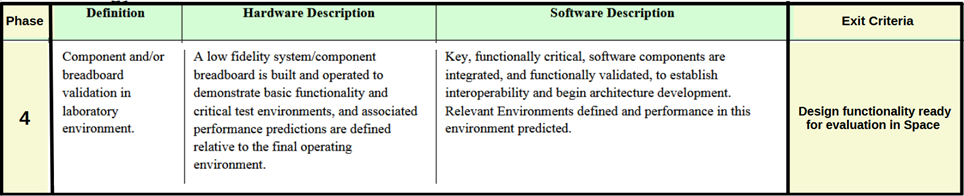
Figure 1: Proposed Design Phase 4 Definitions. Credit: NASA, P. Robinson.
As before I will concentrate on three key sub-systems, “Tether”, “Climber” and “Dynamics”, defined in [1].
Again, my presentation at the 2014 ISEC Conference [4] is partially relevant, although it primarily concentrated on simulation model validation. Figure 2 shows my thoughts from then on "Groundwork” activity, aligning with what I now describe as “Dynamics” Design Verification Phases 3 and 4.
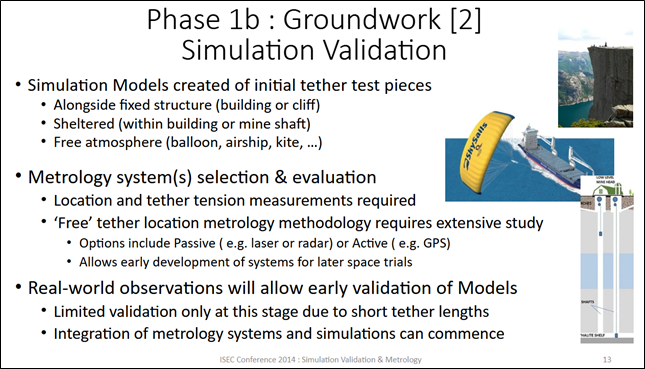
Figure 2: 2014 Project Suggestion. Credit: P. Robinson.
2. Design Verification Phase 4: TETHER
2.1 Tether Production
The fundamental tether material(s) and structure for the first Earth Space Elevator will have been defined during Phase 3, meaning that “Tether Phase 4” will primarily concentrate on the production process. This means the development of the machines required to produce sufficient tether with the required quality in the necessary timescale.
A simple calculation shows that to produce, let's say, 100,000km of tether over perhaps two years would require a continuous production rate of 1.58 metres/second (= 100,000 x 1000 / 2 / 365 / 24 / 3600), but this assumes all the atomic layers of the tether are manufactured and assembled simultaneously. If the tether consisted of conceivably 10,000 individual atomic layers and each layer were manufactured separately then, for example, a production rate of 158 m/sec would be needed even if the layers were made on 100 separate machines. These layers would then be combined (somehow) to yield the required output rate of over 1.58 metres/sec, continuously for two years.
These numbers are arbitrary but provide an indication of the order of magnitude of the necessary manufacturing process, which is further complicated by the need for the tether to be tapered (changing in thickness and/or width along the 100,000 km length).
Project “Phase 4” would not require production of the full tether length but the required machines for layer production and combination must be developed and tested, yielding many kilometres of high-quality prototype tether to support other aspects of the design verification programme.
2.2 Tether Properties
The above manufacturing development work must not compromise the material properties established in the earlier “Phase 3” work and ideally would result in some benefit, perhaps from improved quality or consistency. The detailed material property evaluation of Phase 3 would continue through Phase 4 and later stages.
2.3 Potential Production Bottleneck
The tether material specific strength and other properties would make it extremely attractive for many terrestrial applications. This would accelerate the production process development and provide much of the essential funding; but these other applications might generate a production bottleneck. The high demand for shorter-term applications might absorb much of the early output of every production machine that is built, becoming a logistics challenge for the Space Elevator project management team.
3. Design Verification Phase 4: CLIMBER
Detailed designs of prototype climber components will have been produced during Phase 3, perhaps with initial integration. Phase 4 must include extensive testing of complete climber/module prototypes, as well as continued sub-system development work. This work must include tests in simulated space environments, including over a wide range of temperatures in vacuum chambers as current spacecraft.
3.1 Climber/Tether Interface
Phase 4 work must continue extensive testing of the climber drive systems (wheels or rollers), including perhaps lengthy running on some form of vertical “rolling road” to establish durability, reliability, fatigue, thermal, and other behaviour over the full intended speed and power range. Much of this work must use a length of representative prototype tether to ensure meaningful results. Some of these tests could be performed in a vacuum chamber, perhaps a larger version of that already built for climber testing in Japan [5].
3.2 Motor Confirmation
Prototype samples of the intended drive motor should be extensively tested during Phase 4, ideally with much of this work in vacuum conditions. Some of these prototypes may well be included in the Interface testing outlined above.
3.3 Power Supply
Prototype power supply systems must be assembled and evaluated, including deployment and operation. This ground-based work would by necessity be completed under 1g gravity conditions, representative of operation at low altitudes on an Earth Elevator tether. If the system includes large solar or other arrays then this work might include tests at high altitude to minimise unwanted atmospheric effects, perhaps suspended from high-altitude balloons. If the system involves power transmission along the tether, then extensive tether electrical and climber interface development must be completed.
Both motor and array technologies are likely to continue to be rapidly developed, driven by the needs of automotive, aerospace, and other terrestrial applications. Design changes may need to be incorporated and evaluated during this Phase of work (and in later phases), although extensive changes late in the project would impact the validity of reliability growth work.
3.4 Other Systems and Reliability Growth
The numerous other climber systems (chassis, control/communication systems, cooling system, steering mechanism, tether “anti-wrinkle” system if needed, a parking or emergency brake, an “eject” mechanism, etc.) must continue development as outlined for Phase 3 [3], with design freeze and assembly into full climber or module prototypes. There must be an increased focus on durability and reliability, confirming little degradation of critical functionality such as steering accuracy.
If usual commercial vehicle industry practice is followed, then adequate climber reliability can only be demonstrated by the building and testing of a large number of prototypes. The alternative historic space industry approach of achieving reliability by extreme engineering and meticulous assembly may well result in excessive climber costs and failure to achieve the necessary low $/kg cost-to-GEO targets.
3.6 Preparation for Space Testing
The exit criteria for “Phase 4” of the Climber sub-project might be successful completion of endurance and vacuum testing of complete climber prototypes and preparation of units for launch to space for further evaluation. The need for surviving launch by rocket might require additional design changes, but such changes should be “add-ons” and kept to a minimum.
4. Design Verification Phase 4: DYNAMICS
4.1 Simulation, Metrology and Control
The previous article in this series [3] discussed at length the need for extensive real-world testing for validation of the tether simulation code and associated systems. I will again include another slide from my 2014 ISEC conference presentation outlining some of the issues and limitations inherent in ground-based work; see Figure 3 below. (Note: The Phases mentioned in this early work do not align with the Phases of these 2025 articles.)
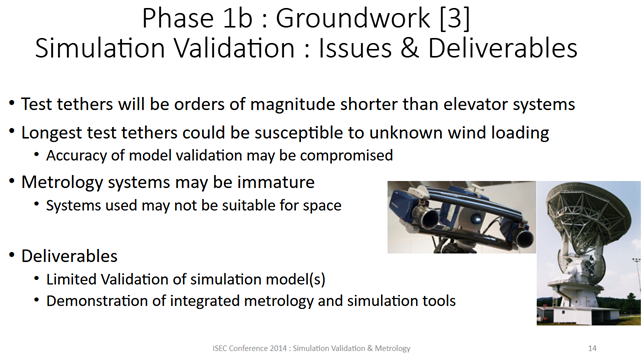
Figure 3: 2014 “Simulation Validation” Groundwork Limitations. Credit: P. Robinson.
A key activity in this “Phase 4” work might be the final selection of the tether metrology strategy, confirming the prototype hardware for continuous tether position and tension measurement. Only small-scale tether prototypes could be tested at this stage (before the transition to space testing), but this work should enable confirmation of basic metrology functionality and the real-time transfer of data to the simulation code for regular update of the model initial conditions.
The third and vital part of the Dynamic system is “Control”. Earlier work will have determined the best control mechanisms for avoiding orbital material (satellites, debris, meteoroids, etc.). The short tether lengths that can be used at this stage will limit the scope of the work, but small-scale testing should enable assessment of basic control functionality using dummy control mechanisms (simulating, for example, the motion of the Earth Port, reel-in reel-out (RIRO) operation or the thrust from thrusters). Any external forces on the tether must be kept to a minimum, meaning a tether suspended from a balloon or over a cliff edge might be unsuitable due to the possibility of random wind forces: an enclosed mine shaft or some similar dedicated test facility might be a more suitable location.
4.2 RIRO Confirmation
An important aspect of tether tension control is the RIRO system, located at the Earth Port and/or perhaps elsewhere. On the Earth’s surface this could be a relatively simple winch system, and I previously suggested that detailed designs should be produced and evaluated (at least virtually) as part of “Phase 3”.
If RIRO systems are needed in space then designs will be more complex, with the mass and power supply being important considerations. If the need for such systems was established in “Phase 3” then “Phase 4” must include prototype design, assembly, and tests in simulated space conditions.
5. Summary
The detail in the three preceding sections is not intended to be comprehensive, but it perhaps gives an indication of the scope of some technical elements of this second practical Phase of the Space Elevator Mega-Project. A significant engineering team and multiple test facilities will be needed to continue to move the project forward, requiring major financial backing and other support resources.
The next article will discuss “Phase 5”, the start of design verification in space.
6. REFERENCES
[1] Peter Robinson: September-2025 ISEC Newsletter Article, “Introduction, Technology Readiness and Design Verification”
[2] Technology Readiness Levels - NASA
[3] Peter Robinson: November-2025 ISEC Newsletter Article, “Part 2: The Start of Design Verification Testing”
[4] Peter Robinson: Presentation at August-2014 ISEC Conference, Seattle, “Space Elevator Validation and Metrology Requirements”
[5] Inoue, Fumihiro, et.al.: paper presented at October-2023 IAC conference, Baku (IAC-23-D4.3.9.x76900): “Development of Space Elevator Climber Applied in High Vacuum Space Environment and Extraction of its Problems.”
Tether Materials
by Adrian Nixon
Atomic Oxygen Corrosion Resistance of Graphene Super Laminate
Over the course of the past few months, I have had several conversations with my colleagues at ISEC. John Knapman, Jim Dempsey, and Peter Robinson have all been asking me if a tether made from Graphene Super Laminate (GSL) could resist atomic oxygen in space.
Experiments conducted by NASA on the international space station have given us the insights that enable us to answer this question.
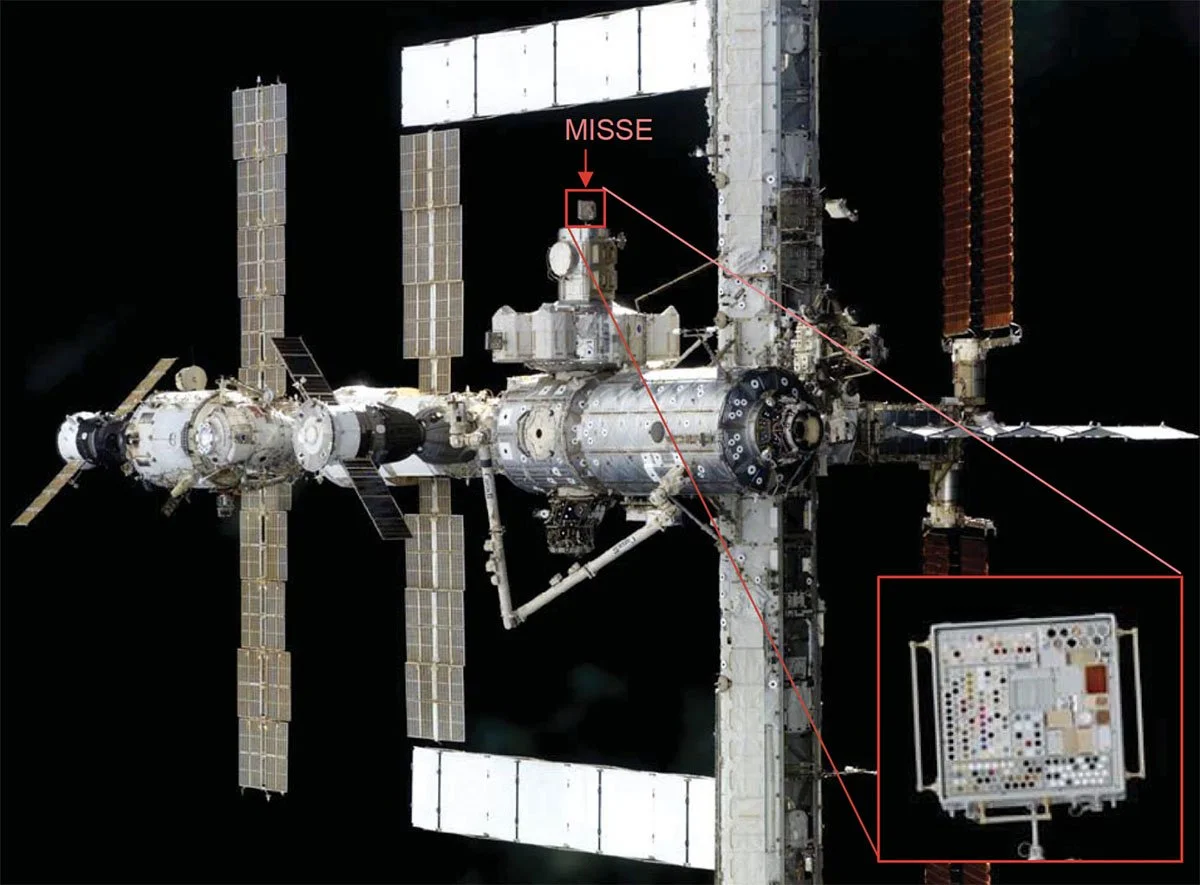
Fig 1. The MISSE experiment on the International Space station (ISS). Image credit: NASA.
Before we look at the NASA results, it is helpful to understand atomic oxygen. You will be familiar with oxygen; it exists as a molecule of two oxygen atoms bonded together, hence O2 as it is usually written. Graphene can coexist with atmospheric oxygen down here on the surface of the Earth.
Oxygen becomes a problem in the region where the atmosphere thins out to the vacuum of space. At around 400 km above the surface of the Earth we lose the protection of the atmosphere. Anything up here is exposed to ultraviolet radiation (UV) from the Sun. UV radiation with wavelengths below 243nm, has enough energy to break the chemical bond in the oxygen molecule and create two separate oxygen atoms. This process is called photodissociation.
These two oxygen atoms are neutrally charged because they have eight negatively charged electrons that balance out the eight positively charged protons in the nucleus of each atom. Each atom has an overall neutral charge. You might think this would make the atoms stable but there is a subtle difference in this atomic oxygen. These atoms are especially reactive because while there are an even number of electrons, the photodissociation creates atoms with two unpaired electrons [1].
Atoms with unpaired electrons are highly reactive and are termed radicals. In the whisper thin atmosphere of low Earth orbit there is a very low probability for the atomic oxygen radicals to encounter anything to react with and they remain in orbit until they collide with something.
My colleagues’ concern was what if that something was a space elevator tether, then would graphene super laminate withstand the attack from this aggressively reactive atomic oxygen?
Researching the literature reveals contradictory results. Some sources say graphene is used as an atomic oxygen resistant coating. A 2020 study by a team in China made an anticorrosion coating from graphene nanoplates and used this to protect Kapton film. They found that the graphene coating did protect the Kapton, but the graphene itself was corroded by the atomic oxygen [2].
Other papers reported the corrosion of monolayer graphene by atomic oxygen, but these were conducted in the laboratory and on metal substrates that could act as catalysts accelerating the corrosion reaction [3].
This brings us to the NASA Materials International Space Station Experiment (MISSE) experiment [4]. NASA launched samples of various materials to the International Space Station (ISS) and exposed them to the environment at low Earth orbit where atomic oxygen is prevalent. They measured the flux of atomic oxygen and the amount of corrosion of the samples over a period of 5,000 to 6,700 equivalent sun hours.
The MISSE experiment included a sample of pyrolytic graphite. This is not graphene super laminate, however. As figure 2 shows, it can be a proxy for graphene samples.
Using the data from the MISSE experiment, we can calculate the erosion rate of pyrolytic graphite by atomic oxygen in typical LEO conditions is on the order of about 20-25 nm per year [5]. This means approximately 74 layers of a tether made from GSL would need repairing each year. To put this into context, a tether capable of supporting 20 tonne climbers would require 12,333 layers of graphene.
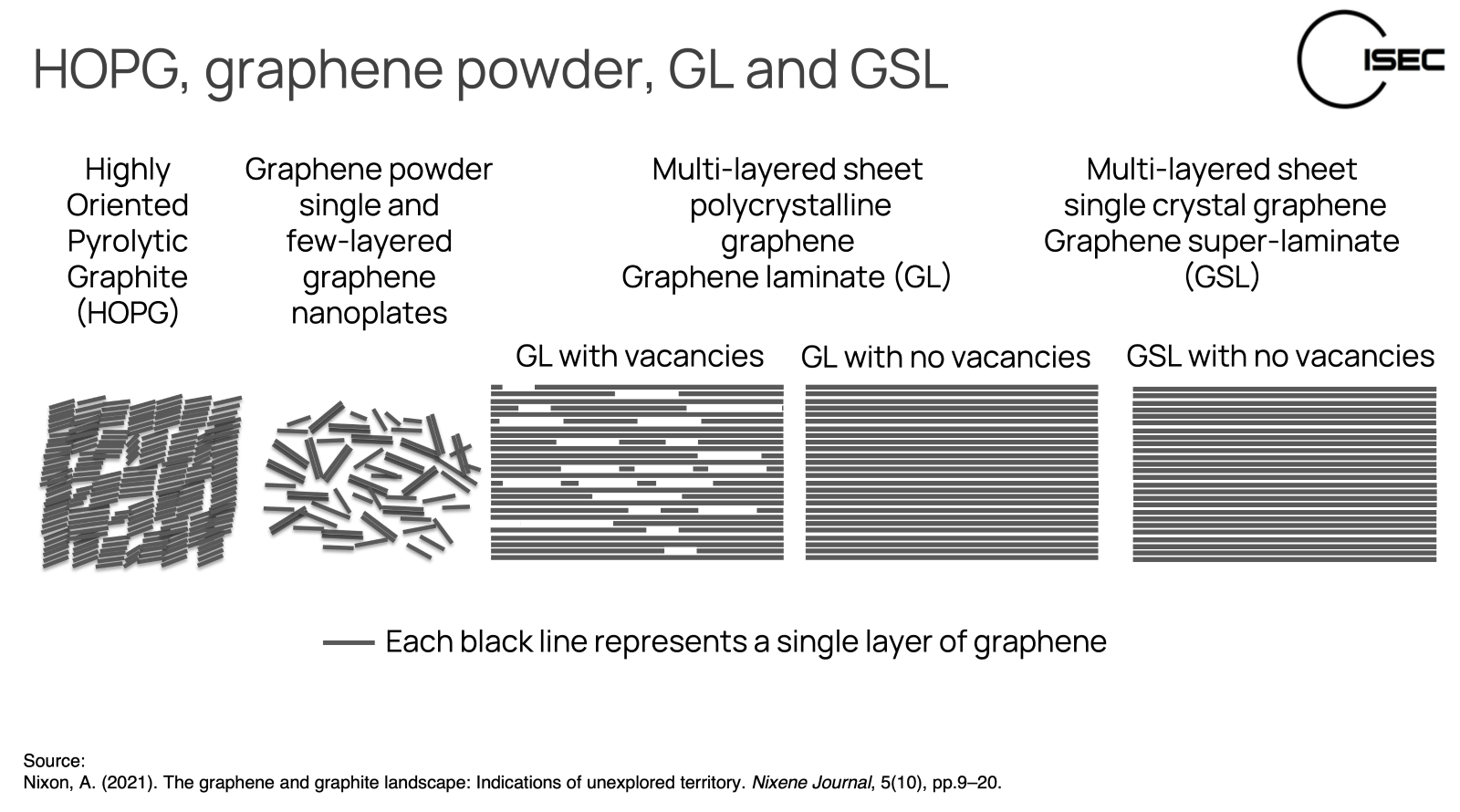
Fig 2. Graphite, graphene, and graphene laminates.
This figure for pyrolytic graphite compares well with the atomic oxygen erosion rate for gold, at typical LEO exposure conditions about 10-30 nm per year depending on conditions and coating thickness [6]. Gold is still affected by atomic oxygen especially if the gold coating contains cracks or pinholes allowing exposure to the underlying material.
So, we have experimental evidence obtained directly from low Earth orbit that shows a graphene-like material is at least as good as gold when it comes to resisting atomic oxygen corrosion.
There is one final point to make. Reactions in graphene occur at the edges of the material rather than on the basal plane. The edges are at least twice as reactive as the basal plane [7] and probably much higher. Figure 2 shows the structure of pyrolytic graphite compared with graphene super laminate. You will note that there are far fewer edges in GSL than in the graphite used by NASA. This means we can form a hypothesis that Graphene Super Laminate will be at least twice as good as gold and probably at least an order of magnitude better than gold when resisting corrosion by atomic oxygen. We will wait for GSL to be made, and the experiments conducted to find out if this prediction is correct.
References
1. Plante, I. (2010). Energetic and chemical reactivity of atomic and molecular oxygen. [online] The Health Risks of Extraterrestrial Environments. Langley, Hampton, VA: NASA. Available at: https://three.jsc.nasa.gov/articles/RadChemO2Sidebar.pdf.
2. Zhang, X.-J., Shen, Z., Zhang, W., Yi, M., Ma, H., Liu, L., Liu, L. and Zhao, Y. (2020). Graphene Coating for Enhancing the Atom Oxygen Erosion Resistance of Kapton. Coatings, 10(7), pp.644–644. doi: https://doi.org/10.3390/coatings10070644.
3. Vinogradov, N.A., Schulte, K., Ng, M.L., Mikkelsen, A., Lundgren, E., N. Mårtensson and Preobrajenski, A.B. (2011). Impact of Atomic Oxygen on the Structure of Graphene Formed on Ir (111) and Pt (111). The Journal of Physical Chemistry C, 115(19), pp.9568–9577. doi: https://doi.org/10.1021/jp111962k.
4. Bank, B.A., Kim and Backus, J.A. (2008). Atomic Oxygen Erosion Yield Predictive Tool for Spacecraft Polymers in Low Earth Orbit. [online] NASA.gov. Available at: https://ntrs.nasa.gov/citations/20090011780 [Accessed 28 Oct. 2025].
5. The atomic oxygen erosion rate of pyrolytic graphite in low Earth orbit conditions is approximately 4.15 × 10^-25 cm³/atom in volume erosion yield, as measured by the NASA MISSE 2 PEACE experiment.
To estimate the erosion rate in nm per year:
+ The density of pyrolytic graphite is about 2.22 g/cm³.
+ The erosion yield indicates volume lost per incident oxygen atom.
+ Typical atomic oxygen flux in low Earth orbit is about 1.8 × 10^15 atoms/cm²/s (ram direction exposure).
Using these:
a. Calculate volume eroded per second per cm²:
b. Convert this volume to a thickness loss rate (assuming erosion depth = volume/area):
c. Convert to annual erosion rate:
Therefore, the erosion rate of pyrolytic graphite by atomic oxygen in typical LEO conditions is on the order of about 20-25 nm per year.
6. De Rooy, A., 1985, November. The degradation of metal surfaces by atomic oxygen. In Proceedings of the 3ed European Symposium on Spacecraft Materials in a Space Environment (pp. 99-108). ESA SP-232.
7. Sharma, R., Baik, J.H., Perera, C.J. and Strano, M.S., 2010. Anomalously large reactivity of single graphene layers and edges toward electron transfer chemistries. Nano letters, 10(2), pp.398-405.
Space Elevators in the Movies
by David Brandt-Erichsen
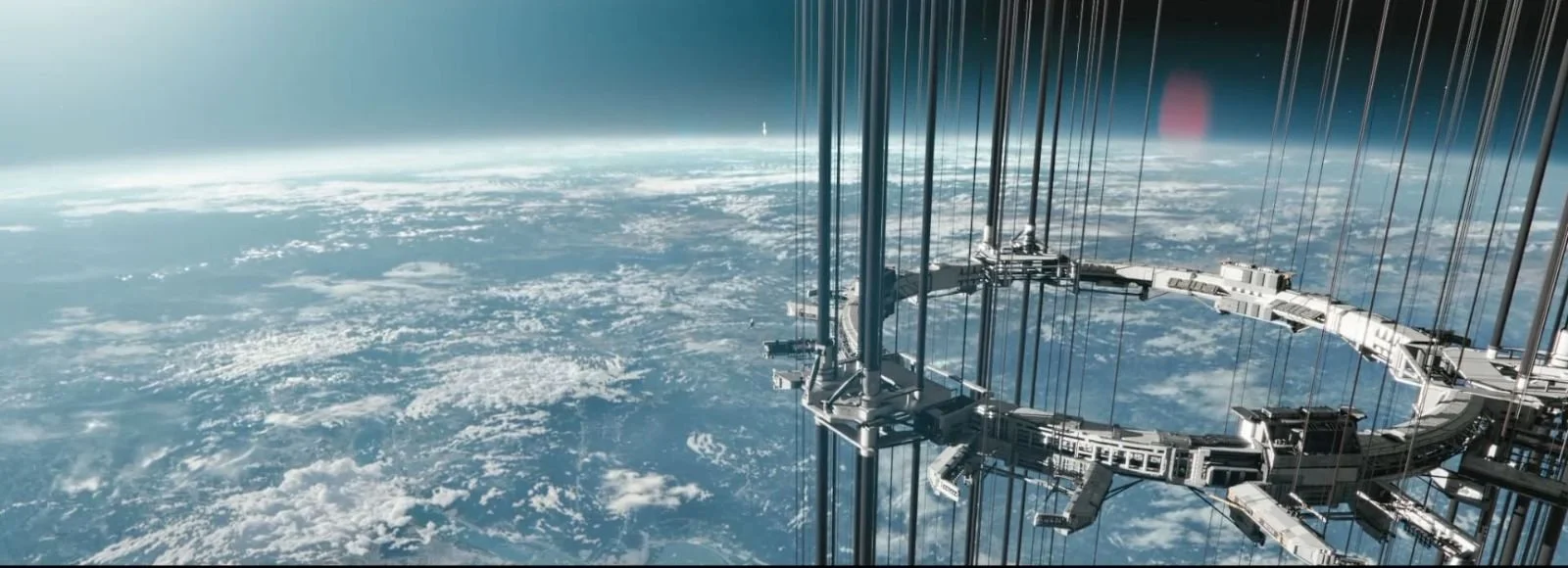
I am aware of three science fiction movies that depicted a space elevator. In two of them, the elevator gets attacked and destroyed.
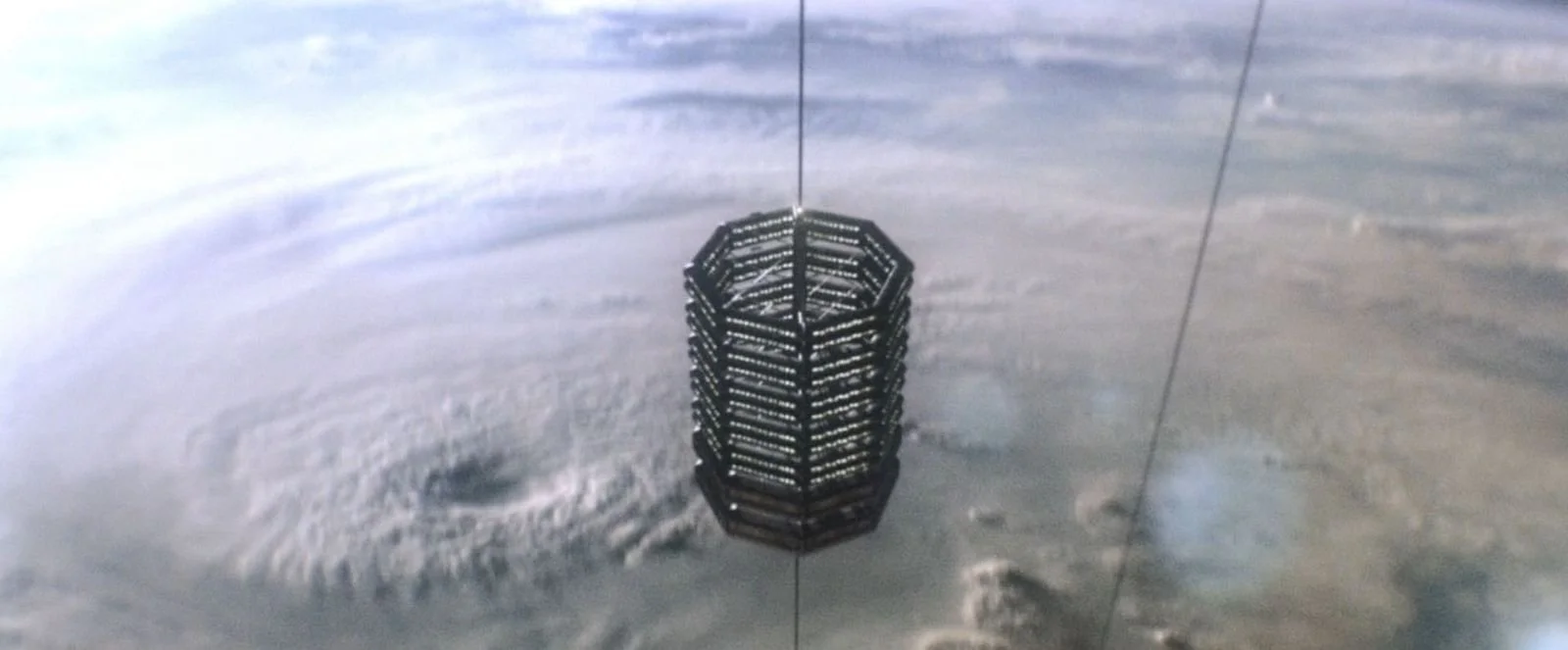
1. Aniara (2018). This is a fairly low budget Swedish movie of which there is an English dubbed version. The first scene after the opening credits shows a space elevator ascending to dock with a spacecraft headed for Mars.
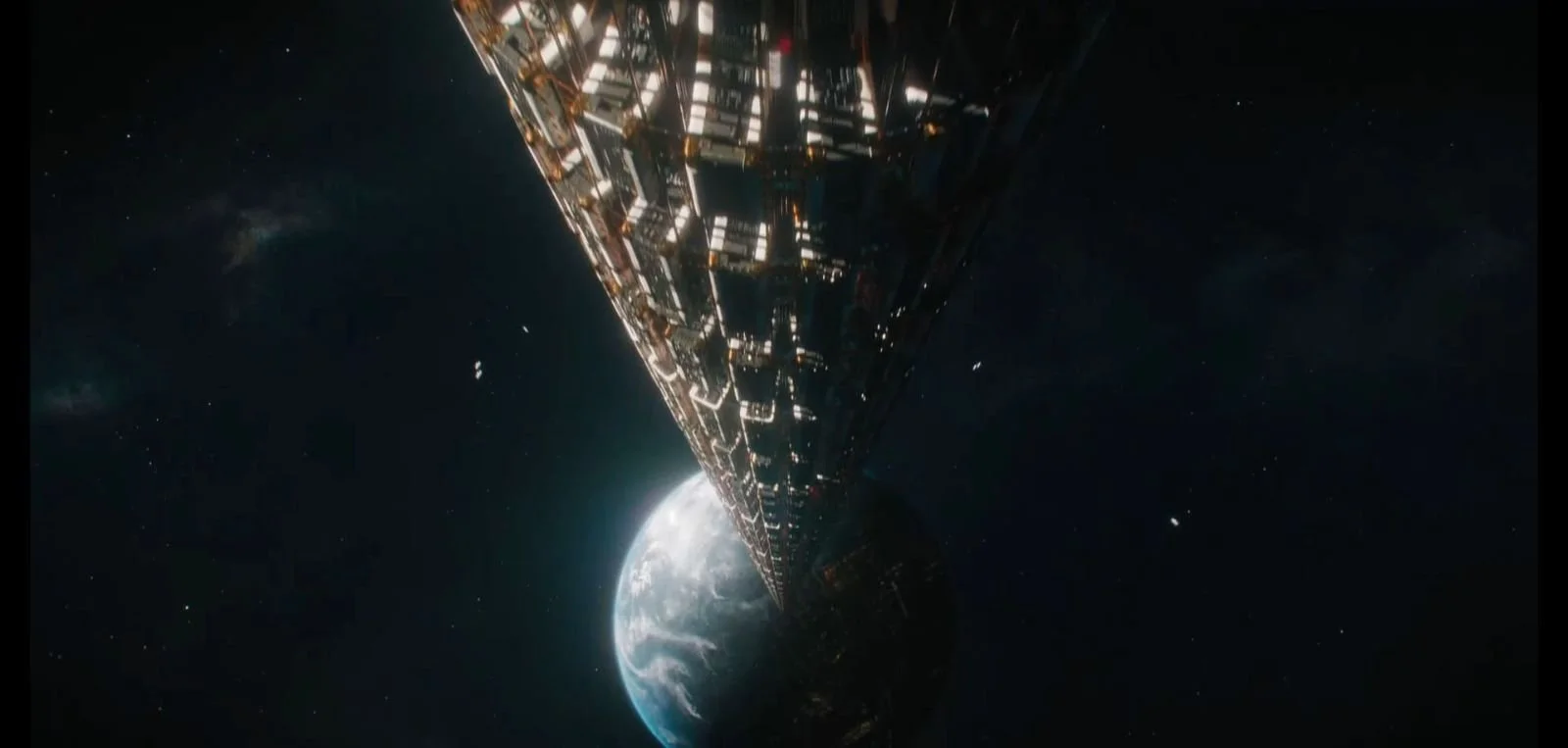
2. Foundation (2021). The first episode of this Apple TV series has two space elevator scenes that take place on the galactic empire capitol planet of Trantor, where they call it the Star Bridge. In the first, incoming spacecraft dock with a GEO space station and visitors descend to the planet. In the second, terrorists bomb the elevator and it collapses and wraps around the planet causing 100 million deaths.
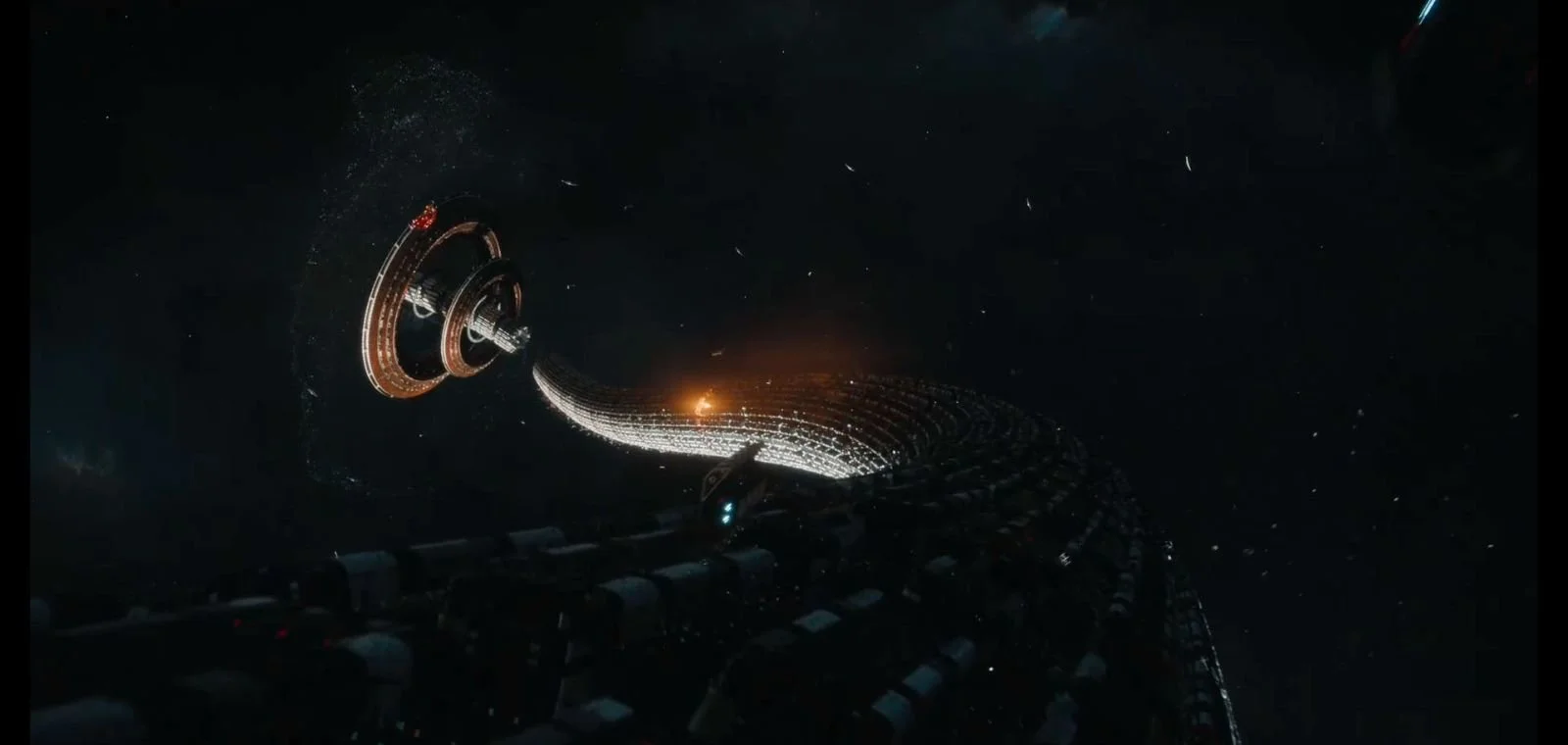
3. The Wandering Earth II (2023). This Chinese movie is a prequel to the 2019 movie The Wandering Earth. Half of the first 35 minutes of this movie shows use of and then destruction of a space elevator. The elevator uses rocket-powered climbers.
History Corner
by David Raitt, ISEC Chief Historian
Science Fiction and Space Elevators
I was interested to read the paper by Douglas Phillips presented at the ISEC 2005 conference with the title “Science Fiction: Changing the Perception of Space Elevators” (https://www.isec.org/2025-isec-conference-videos) which gave an overview of how readers reacted to his novel on the topic. Indeed, one of the most interesting concepts in the space sector today that can be traced down to a science fiction concept is the space elevator! The idea has been the topic of science fiction novels and magazines, as well as international conferences and academic and technical studies for many years. The concept has also been extensively researched, refined, and developed over the past decade or so by the International Space Elevator Consortium.
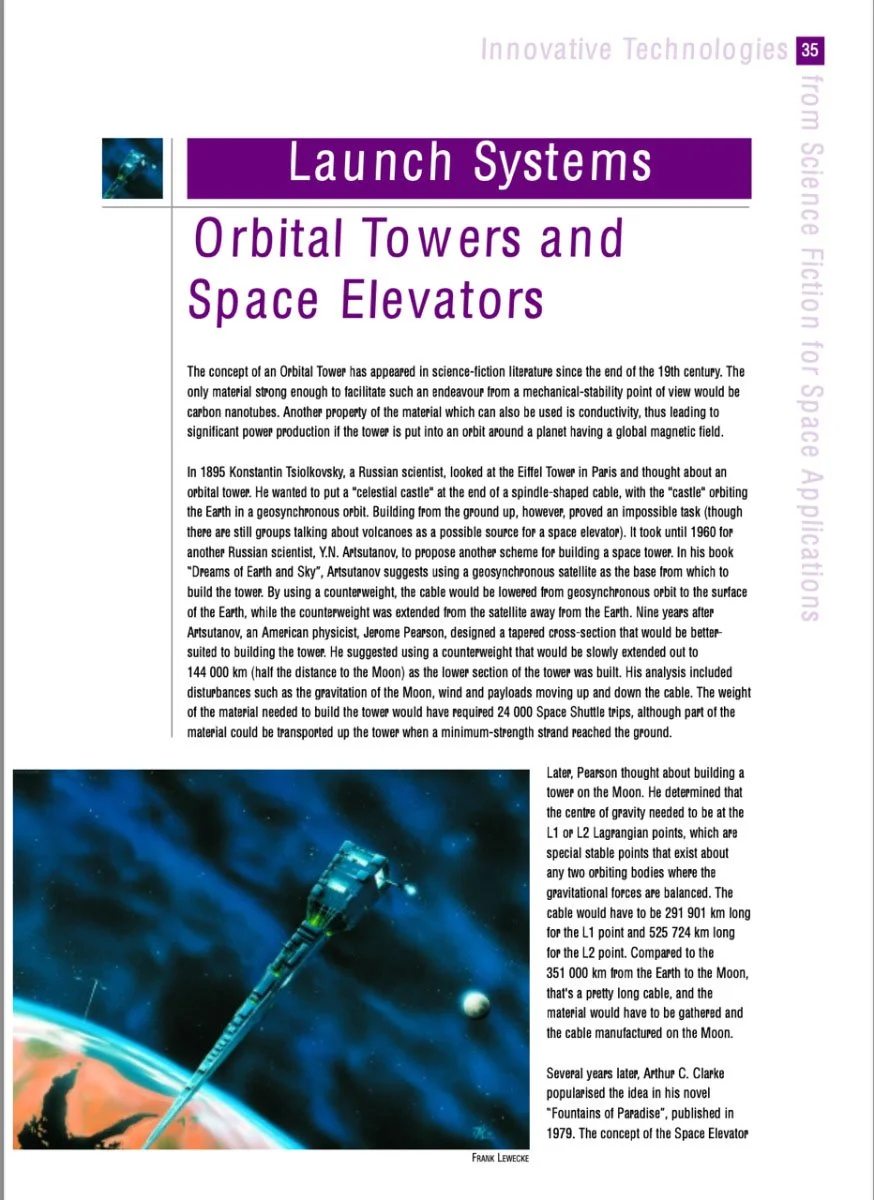
To recap briefly: In 1895, Konstantin Tsiolkovsky was inspired by the Eiffel Tower to consider a tower reaching all the way up into space with a structure at the end of a cable orbiting the Earth. The tower would be able to launch objects into GEO without a rocket. In 1960, Yuri Artsutanov wrote about employing a geosynchronous satellite as the base from which to construct a space tower. By using a counterweight, a cable would be lowered from GEO to the surface of the Earth while the counterweight was extended from the satellite away from Earth. Then in 1975, Jerome Pearson designed a tapered cross section cable that would be suitable for building a lunar space elevator. He suggested using a counterweight that would be slowly extended out to 144,000 km. In 2000, Brad Edwards suggested creating a 100,000 km long 1 m wide, paper-thin ribbon made of carbon nanotubes, along which climbers would travel to release payloads into orbit at diverse points. His design comprised all the necessary elements and it is this architecture which is still considered the most feasible (though with graphene replacing CNTs and the space elevator operating within a galactic harbour).
It was the science fiction writer, Arthur C. Clarke, who introduced the concept of a space elevator to a much broader audience in his novel, Fountains of Paradise, published in 1979. His book describes the construction of a space elevator – a giant structure rising from the ground and linking with a satellite in geostationary orbit. Such an orbital tower would be used to raise payloads to orbit without the expense of using rockets. Clarke’s novel spawned a spate of other stories, films, and videos depicting variations of space elevators in different scenarios.
A valid question might then be: has science fiction been more successful at predicting future technologies or at inspiring them? Science fiction literature, artwork, and films, are full of descriptions of space technologies and systems – often they are just pure imagination and sometimes based on some semblance of fact. However, early science fiction authors and illustrators described space concepts and spacecraft based on the limited scientific knowledge available at the time, whereas more modern contributors generally portray the same basic systems as used in real life space flight in their literature and art (even though artistic licence is often employed). This gives them the opportunity to explore and promote their ideas which may not otherwise be possible through more formal scientific evaluation processes.
There are plenty of technologies that have taken many years to be accepted and deployed. Equally today, there are many technologies in existence that could never have been conceived one hundred or even fifty years ago. This phenomenon allows writers to put ideas or dreams down on paper that are not immediately dismissed as irrelevant either by the layman, engineer, or scientist and which may perhaps ultimately bring the seemingly fantastic inventions into reality. Science fiction can thus be used to stimulate thoughts and ideas that could perhaps be turned into a more realistic scenario with the eventual development of new innovative technologies not as conservative as those currently used in the space field. In fact, Hugo Gernsback, founder of “Amazing Stories” magazine in 1926, noted that science fiction was socially useful precisely because it inspired research and inventions.
As far back as the 1600s, writers have predicted satellites, spaceflight, Moon landings, etc. well before they were actually possible. Although early writings were often wildly inaccurate and fantastical in many areas, some of the predictions made did come to pass and some of the systems and technologies described were subsequently successfully developed.
Many space scientists and engineers began their careers in the pages of a science fiction novel or in seats of a movie theatre, and over the past decades of space exploration, science fiction writers and artists have not only inspired but also helped these space professionals to visualize their plans and projects and give form to their developing technologies.
As to the wider questions regarding the role science fiction has had in shaping public perception about space agencies and exploration, we can say that art and literature about space have not only been an integral part of space exploration since its very beginnings, they have also played a vital role in its development as well. In fact, the primary way of introducing the general public to ideas about space exploration has probably been through the fictional images and scenarios created by science fiction artists and writers.
Their works laid the foundation which made future space activities understandable to the general public. They have stimulated the public's imagination and excitement about space exploration which has thus helped to secure the necessary political and financial support for space programmes. Indeed, NASA has been happy to fund studies and host conferences on various science fiction concepts, such as space elevators, at least as far back as 1999 when David Smitherman organized a conference on the topic (https://highfrontier.org/oldarchive/Archive/Jt/Space Elevators MSFC 2000.pdf).
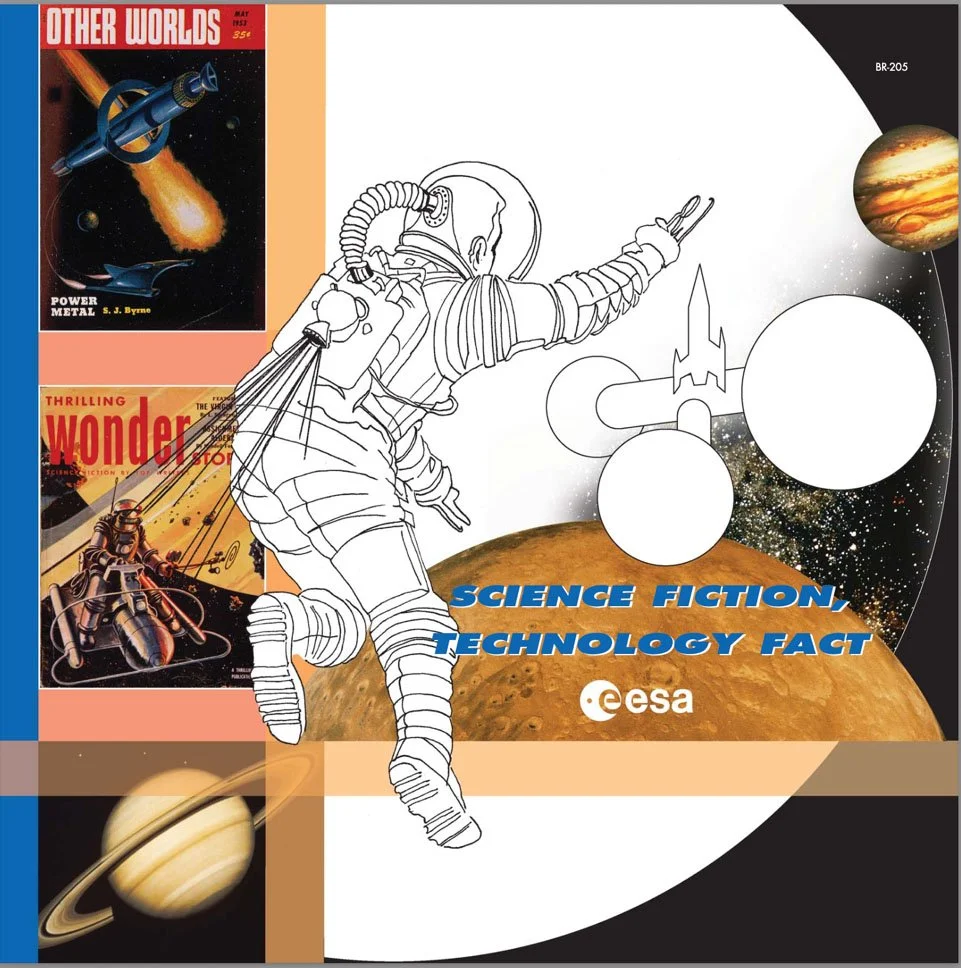
ESA came to realise this because of huge public and media interest following a study I conducted in January 2000 on “Innovative Technologies from Science Fiction for Space Applications,” the cover and a page from which is illustrated below. Additional factors were subsequent spinoffs including competitions, books, studies, videos, and other initiatives. One competition specifically on space elevator art and fiction had prize money offered by Brad Edwards (see Edwards and Raitt, “Running the Line: Stories of the Space Elevator”, Bradley Edwards, 2006). Studies included one conducted with the IAA on the “Impact of Space Activities upon Society” in February 2005, and another with the IAA in 2007 on “Space Expectations.” Such science fiction activities allowed the space elevator name and image to become much more widely known and appreciated, especially among young people.
ISEC Presents the “Green Road to Space” Inside an International Conference Entitled:
“2025 INTERNATIONAL SYMPOSIUM ON THE PEACEFUL USE OF SPACE TECHNOLOGY-HEALTH.”
“Trends in Space” was the topic of the day with three presentations [virtual] inside Session: Space Elevators for Green Space Activity.
+ “Modern-Day Space Elevator's Transformational Strengths Leads to the Green Road,” [Peter SWAN, Ph.D., Chief Architect, International Space Elevator Consortium (ISEC), Academician, IAA]
+ “APEX ANCHOR, a Green Space Port,” [Paul W. Phister, Ph.D., P.E.; President, MANIAC Consulting, board member - ISEC]
+ “Space Elevators, as the Green Road to Space, Defines Space Sustainability,” [Peter SWAN, Ph.D.]
The location was: Boao, Qionghai City, Hainan Province, China, 9-11 Dec 2025
IPSPACE 2025 Overview https://spacetu.org.cn/news/articleDetails?articleId=123
Around the Web
Larry Bartoszek was a guest speaker on the National Space Society’s Forum a few weeks ago talking about asteroid mining.
https://www.youtube.com/watch?v=TMQ0bHCEdgU
If you didn’t see Larry’s last guest spot with the National Space Society from a year ago, he spoke about delivering power to space elevator climbers.
Upcoming Events:
International Space Development Conference 2026
Sponsored by the National Space Society
https://www.isec.org/events/isdc202
Thursday, June 4th, through Sunday, June 7th, 2026
Space Elevator Session, Saturday, June 6th
Tysons Corner, Virginia, US
77th International Astronautical Congress
Sponsored by the International Astronautical Federation (IAF)
https://www.iac2026.org/iac-2026
Theme: “The World Needs More Space”
October 5th through October 9th, 2026
Antalya, Turkey
Contact Us:
Our website is www.isec.org.
You can find us on Facebook, X, Flickr, LinkedIn, Instagram, YouTube, Mastodon, Threads, Bluesky and Reddit.
Support us:
Sign up to be a member at: https://www.isec.org/membership
You can also give directly using the “Donate” link at the bottom of our website page.
Does your place of employment do matching funds for donations or volunteer time through Benevity? If so, you can make ISEC your recipient. Our 501(c)(3) number is 80-0302896.